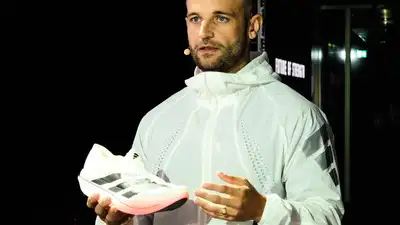
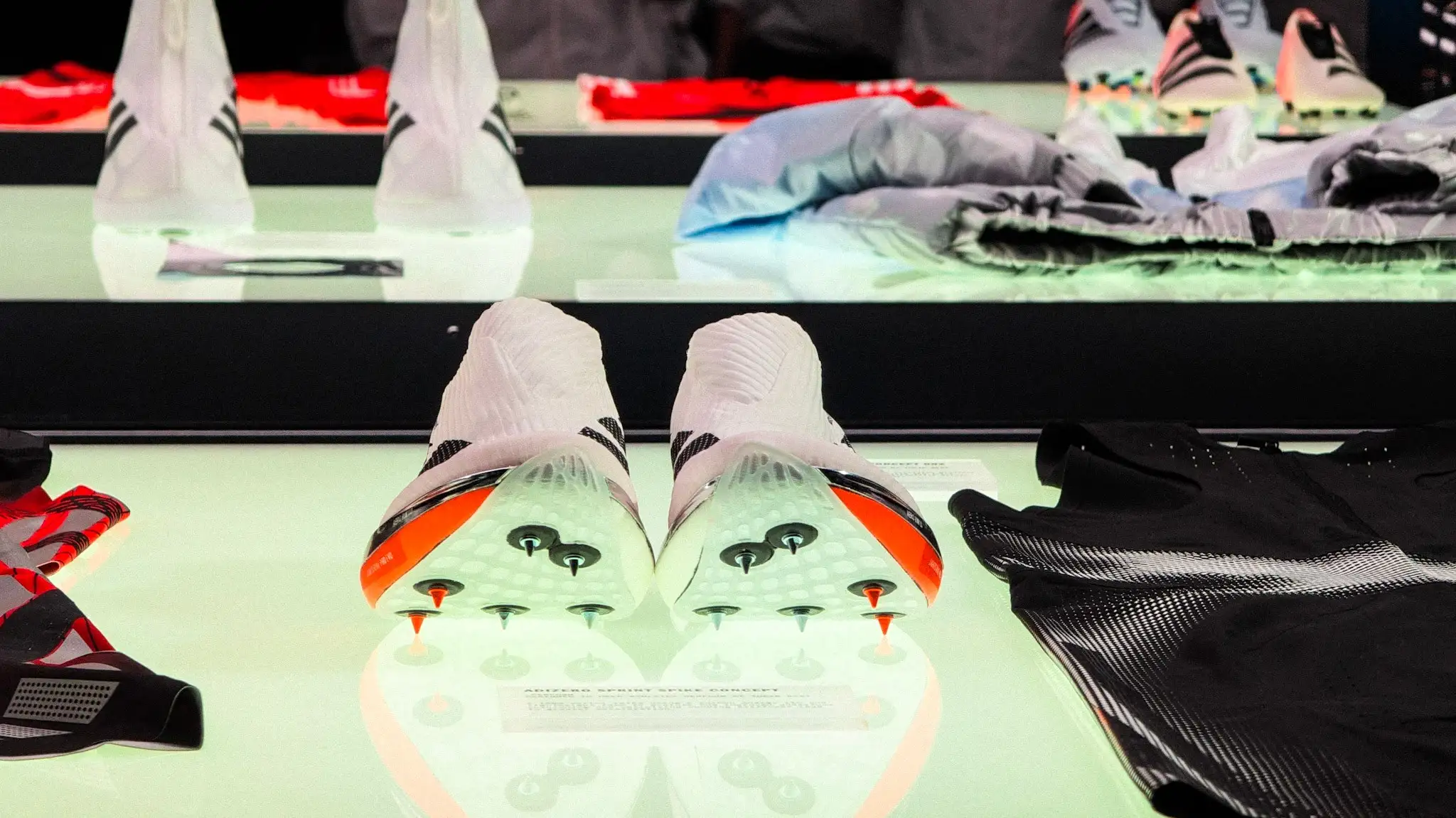
Harry Miles, who directs footwear innovation at Adidas, presents the Adizero Sprint Spike Concept at the company’s Home of Innovation in Herzogenaurach.
The Adizero Sprint Spike Concept, one of many concepts Adidas had on show, is made for sprinters who run 100 metres in under 10 seconds, whose feet touch the ground for about a tenth of a second on each stride, under forces several times their body weight. Since carbon-plated racers with high-rebound foams arrived in 2017, every major sportswear brand has built its fastest shoes around the same basic recipe. That engineering peaked in April, when Sabastian Sawe ran the first official sub-two-hour marathon in Adidas’s Adizero Adios Pro Evo 3, a shoe tuned for someone covering a kilometre in under 2 minutes 50 seconds. Yomif Kejelcha crossed the line 11 seconds behind him in the same shoe. On Sunday in Berlin, the Evo 3 swept both the men’s and women’s podiums, the first time a single brand has done that at a major marathon since 2017. The Evo 3 also points to where the category is heading. It is designed to last a single marathon, its foam and upper too fragile for much more, and it costs $500 in the US, when you can find one at all.
“You wouldn’t take this onto the road if you’re doing a 5K jog in the morning,” he said at Adidas’s Home of Innovation in Herzogenaurach, where the company opened its labs to visitors over the Berlin Marathon weekend. The word “supershoe” has done a lot of marketing work since then, but underneath it sits a fairly precise piece of engineering. The shoe on the table beside Harry Miles is one almost nobody reading this will ever wear. Miles directs footwear innovation at Adidas and has worked on everything from custom shoes for ultramarathon record attempts to football boots, so he knows better than most how far that spike is from the way most people run. That distance runs through the entire supershoe category. Shoes like it are starting to be called hypershoes, a tier above the supershoes that defined the last decade.
The weekend runner is still the hardest customer to design for
The aim is a foam that loses less energy and weighs less, and Adidas says Lightstrike Pro Evo, the foam in the Evo 3, is around half the weight of the previous version. The runners behind them at a city marathon range from heel strikers to forefoot runners and from 50 kg to 100 kg, often on roads far rougher than a closed race course. So what does a sub-two-hour marathon change for someone running 5 km on a Sunday? Super shoes at the very top, or hypershoes as the likes of the Evo 3 are now being called, will stay rare and expensive. Over the next few years, though, what was learned building them will filter down, first into shoes like the Pro 5 and then into more affordable trainers such as the Adizero Evo SL, Boston and SL2.
Almost every shoe today is built on a last, a standard foot-shaped mould, with the same foam density running through the midsole, which means it is designed for an average foot that nobody actually has. Whatever it doesn’t give back is lost as heat inside the material, which engineers call hysteresis. The more likely payoff is one the watch won’t record at all: a run that leaves a little more in the legs, in a shoe that carries a little of what was built for the front of the race.
Miles says all of it, along with the lab data, ends up in “big machine learning systems” that surface the right insights from the right athletes far faster than before. “If you close the loop much quicker, you can learn faster,” he says, sounding more like a software engineer than a shoe designer. A lab session only captures an athlete on one day. The fuller picture comes from training, and this is where AI comes into shoe design. Adidas collects training data through smartwatches and sensors it gives athletes at training camps. Anyone who has opened a running watch export will understand why. One session produces continuous readings of stride, ground contact time, cadence and heart rate, and across dozens of athletes and months of training, that becomes far more than any team can compare by hand. Finding patterns in more numbers than anyone has time to read is exactly the kind of job machine learning suits. Miles is careful to call it one tool among many at Adidas, and that restraint makes the claim easier to believe. Strip a racing shoe down and most of its efficiency sits in two parts, the foam and the carbon. These are also the parts Miles expects to reach ordinary runners first, and in Adidas’s line-up, some of it already has. A midsole works like a spring. It compresses when the foot lands, stores energy and gives part of it back at push-off. That previous version, Lightstrike Pro, shows how the trickle-down works. At three months per prototype, a team gets about four attempts a year. It is also the most convincing case in the conversation for how elite technology gets fast-tracked to the rest of us. Taken far enough, that loop could close around a single foot. The printer is the part everyone photographs, but the more interesting work happens before it starts. A foot scan and motion capture map where an athlete’s foot takes the most pressure, where it flexes and how force moves through it on every stride, and the shoe is built around that map instead of an average. Every new session sharpens the map for the next pair, which is Miles’s loop at its most personal. For now, only a handful of athletes get to wear one. The further a runner is from that handful, the less certain the science gets. Independent research on everyday runners is still unsettled. Some studies find the economy gain narrows at slower paces, with a few runners measuring worse in the shoes, while others find it holds. Part of the problem is that there is no such thing as a typical weekend runner. An elite field sits in a narrow band of bodyweights, cadences and foot strikes, and Adidas can fit a shoe to each athlete in it. They need one shoe that works for all of them, lasts hundreds of kilometres and costs a fraction of a racer. That is a harder brief than a world record. The Adizero Evo SL uses Adidas’s Lightstrike Pro racing foam without any rods, at a lower price than the brand’s plated shoes. The maths does have a quirk that favours slower runners. Someone on the course for four and a half hours gains more minutes from the same percentage improvement than someone finishing in just over two, so a small efficiency gain means more to them, not less. Not much right away. That slow trickle, more than any record, is what Miles means when he talks about reaching the masses. Whether any of it ever shows up on a recreational runner’s watch is still an open question. You use AI every day. Now get your AI Quotient. Take the AIQ test.
At one month, it gets roughly twelve, each tested and refined before the design is locked. Earlier in the day at Adidas’s APEX Lab, I had seen what the alternative looks like: shoes 3D printed for individual athletes.
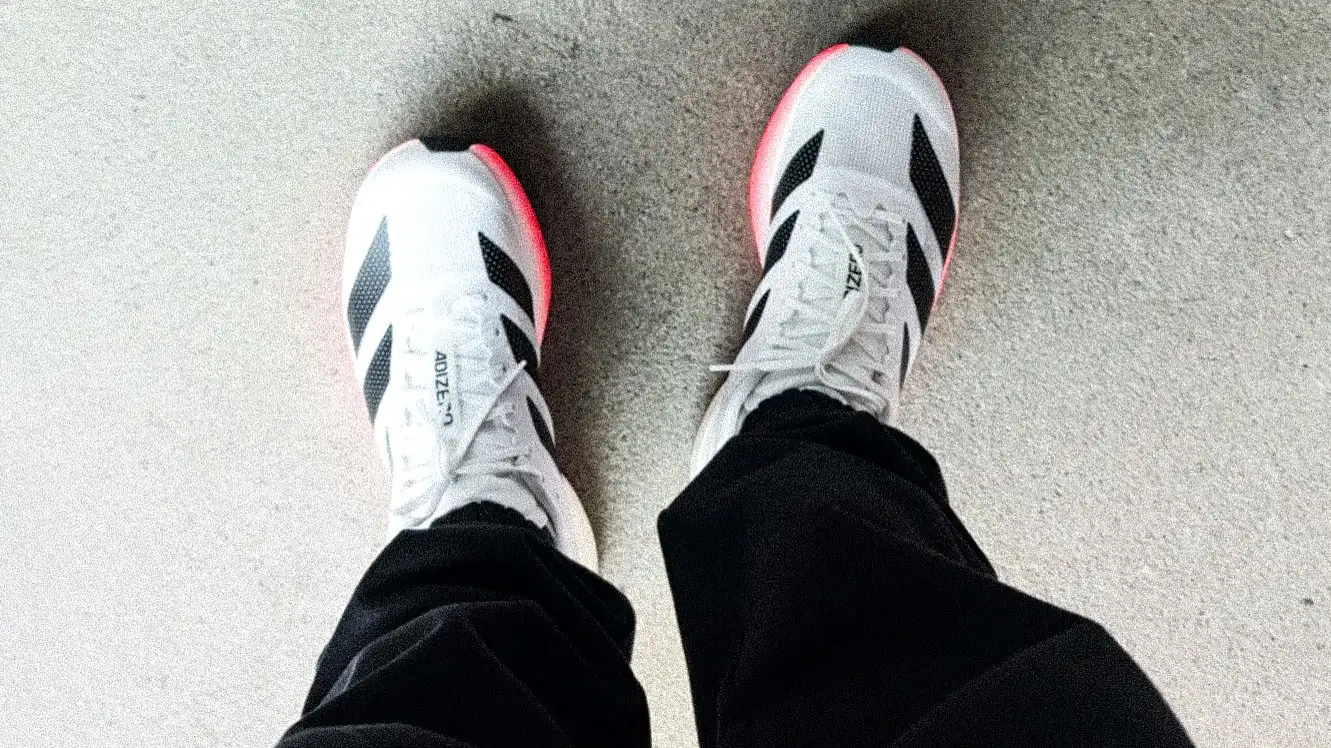
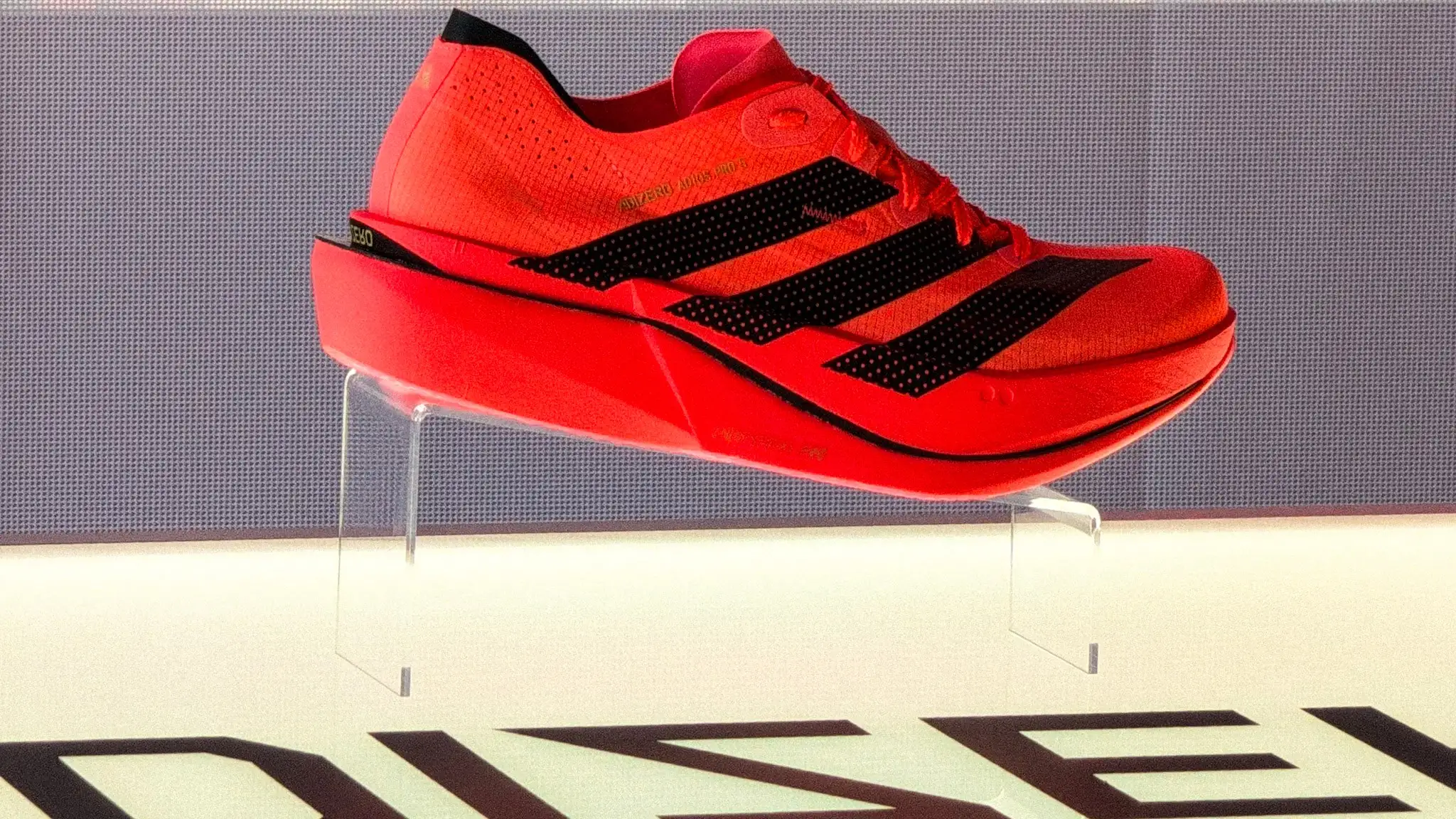
That leaves the Adizero Adios Pro 5, launched days before Berlin, as the supershoe tier below the Evo 3. A runner at 6 minutes per kilometre also lands, loads and pushes off shoes like these in a very different way from Sawe. The Adizero Evo SL uses that racing foam on its own, with no rods, in a simple construction, and it costs less than the plated Boston 13. Further down the range, the Adizero SL2 blends Lightstrike Pro with the older Lightstrike 2.0 EVA foam and regularly turns up in sales. The Adizero Adios Pro 5, launched days before the Berlin Marathon, uses the same carbon Energyrim as the Evo 3. The Evo 3 drops the traditional plate for a carbon Energyrim, which lets Adidas fit more foam underfoot while staying within World Athletics’ limits. The Pro 5 inherits it, replacing the rod-shaped Energyrods of earlier Adios Pro models, and the company says it returns 9 per cent more energy than the previous version. The Boston 13 borrows the Energyrods from the Adios Pro 4 to add punch to faster training sessions, and Adidas describes the ones in that shoe as glass-fibre Energyrods 2.0, tuned for a softer but still propulsive ride. Sawe took roughly 20,000 steps to win in London, while Oblique Seville won last year’s 100 m world title in fewer than 50, which leaves a spike under a quarter of a per cent of the steps to make its difference. The Sprint Spike Concept, as it happens, borrows the Evo 3’s Energyrim and Lightstrike Pro Evo foam, so the traffic already runs both ways. Miles says that is the work Adidas is doing now: looking at how the principles that make a spike fast over 100 metres could become something a person out for an early 5 km on a Sunday can feel. The Pro 5 shows how that usually plays out. It carries Evo 3 technology at a price that still keeps it out of reach for many, and for most runners the benefit only arrives once it trickles down again into trainers like the Evo SL and the Boston. For everyday runners, a $500 shoe that lasts one race is less a product to buy than a preview of what their next pair might carry.
Because a jogger’s stride is further from a sprinter’s than a winger’s is, a road shoe is the next and harder crossing,.
Closing that gap, Miles says, is the point of the work. He puts it a few years out, after which this kind of technology becomes, in his words, “more accessible and more usable” for road runners. One of the slowest parts of building a shoe, Miles says, has always been the wait between testing a prototype with an athlete and having data worth acting on.
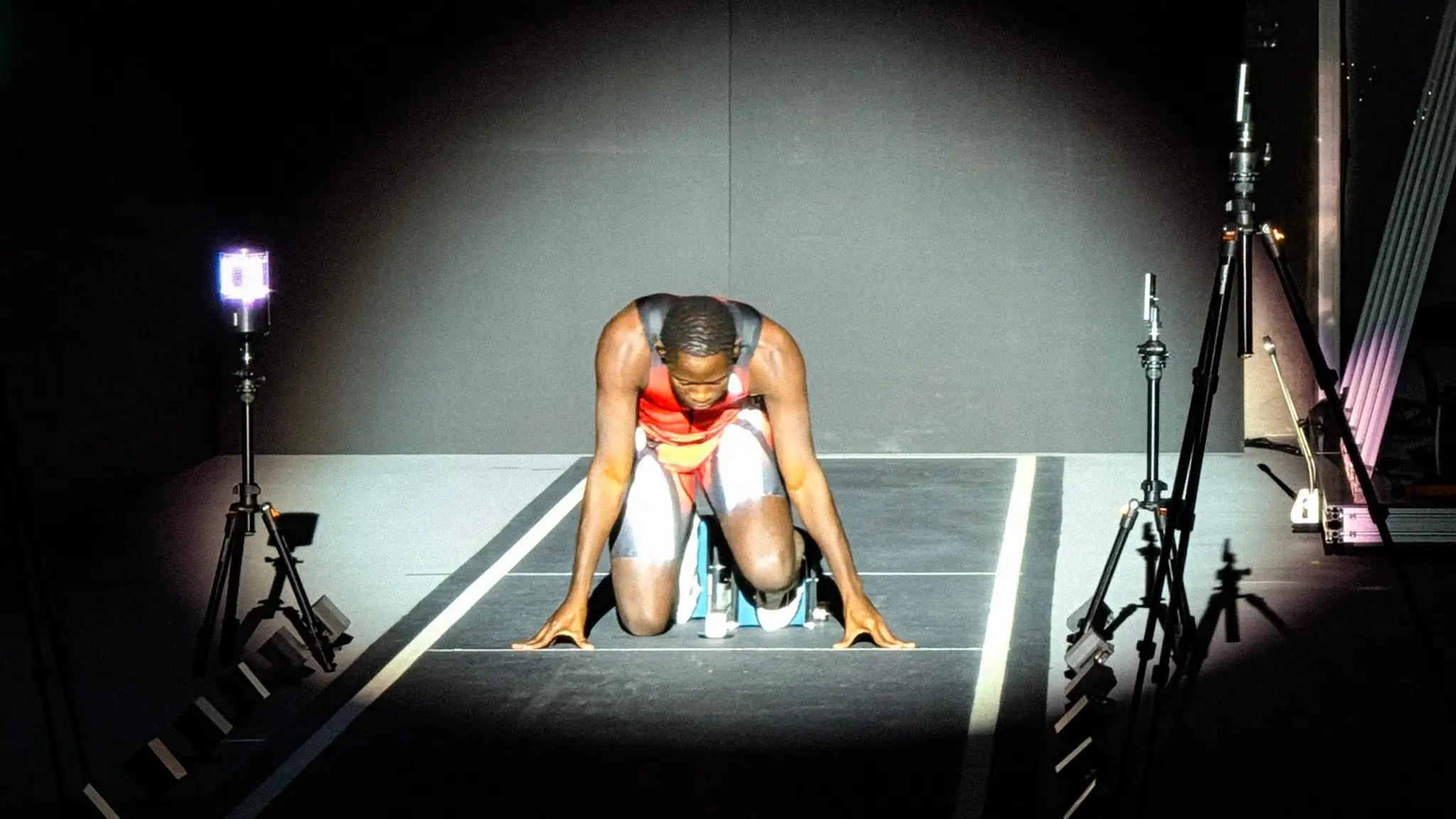
It was on many feet at this year’s race, and plenty more runners have had their eyes on it, and then on its eye-watering price. “The most important part of what we do is not only delivering for the few people who are capable of breaking world records, but also making sure it becomes accessible at scale for the masses. How that happens is an engineering question, and his answer starts with what a supershoe is actually for. Ask Miles what a supershoe does and he doesn’t talk about speed. He talks about efficiency, and uses an electric car to explain it. A runner starts every race fully charged. The more efficient the system, the less charge it uses at any given pace, so the runner can either go faster for the same effort or reach the final kilometres with something left in the battery. For most people buying these shoes, that is a more honest pitch than speed. Very few of them will ever race anyone but themselves. Sports scientists call this running economy, the oxygen a runner needs to hold a steady pace, and measuring it is about as unglamorous as the field gets. The athlete runs, usually on a treadmill, with a mask strapped to their face while a gas analyser reads every breath. Miles describes the same routine at Adidas: prototypes on athletes’ feet, masks on their faces, and the numbers deciding which version survives. Each step down trades a bit of race-day bounce for a lower price and a longer life. That longer life matters. Very light, very bouncy foams tend to wear out sooner than the denser foams in everyday trainers, which makes a supershoe closer to a consumable than a long-term buy. The hyper shoe takes that to its logical end: one race, and done. Carbon’s job is less obvious. At push-off, the joints where the toes meet the foot bend, and that bending absorbs energy the runner never gets back. A stiff carbon structure limits the bend and, together with a curved rocker sole, rolls the foot forward. Miles likens getting that stiffness right to picking a gear: too little and the runner is in the wrong one, too much and the gear is set too high to be quick. Brands have approached that stiffness in different ways, from full-length plates to separate carbon rods, and Adidas has just changed its own approach. The rods haven’t disappeared, though. They are a less rigid, less expensive version of the same idea. This is why the spike on the table can’t simply be scaled down. A sprinter’s foot is on the ground so briefly that the shoe works almost entirely at the forefoot, under loads a jogger never comes close to. A recreational runner’s foot stays down more than twice as long and often lands further back, so the foam stiffness, plate shape and rocker all have to be tuned again before any of the thinking carries over. Presenting the concept, Miles put the gap in numbers. Spike technology has already crossed over once. For its F50+ football boot, Adidas took the stiff plate and lightweight, high-rebound foam from its track spikes and adapted them for footballers, a project Miles co-wrote about for the company. The Adizero Sprint Spike Concept, built for sprinters, on display in Adidas’s lab during the Berlin Marathon weekend. The hyper shoe may speed that up. Every time the ceiling moves higher, what used to sit at the top moves down a tier. The foams and carbon that defined race day a few years ago now turn up in trainers with entry-level price tags across brands, and the Evo SL is Adidas’s version of that. A sprinter settles into the blocks during a demonstration at Adidas’s Home of Innovation, where cameras track how an athlete’s foot loads and pushes off in the first strides. How quickly that happens depends on how fast the company learns.
Anyone who has retired a pair of racers earlier than planned will know the feeling.
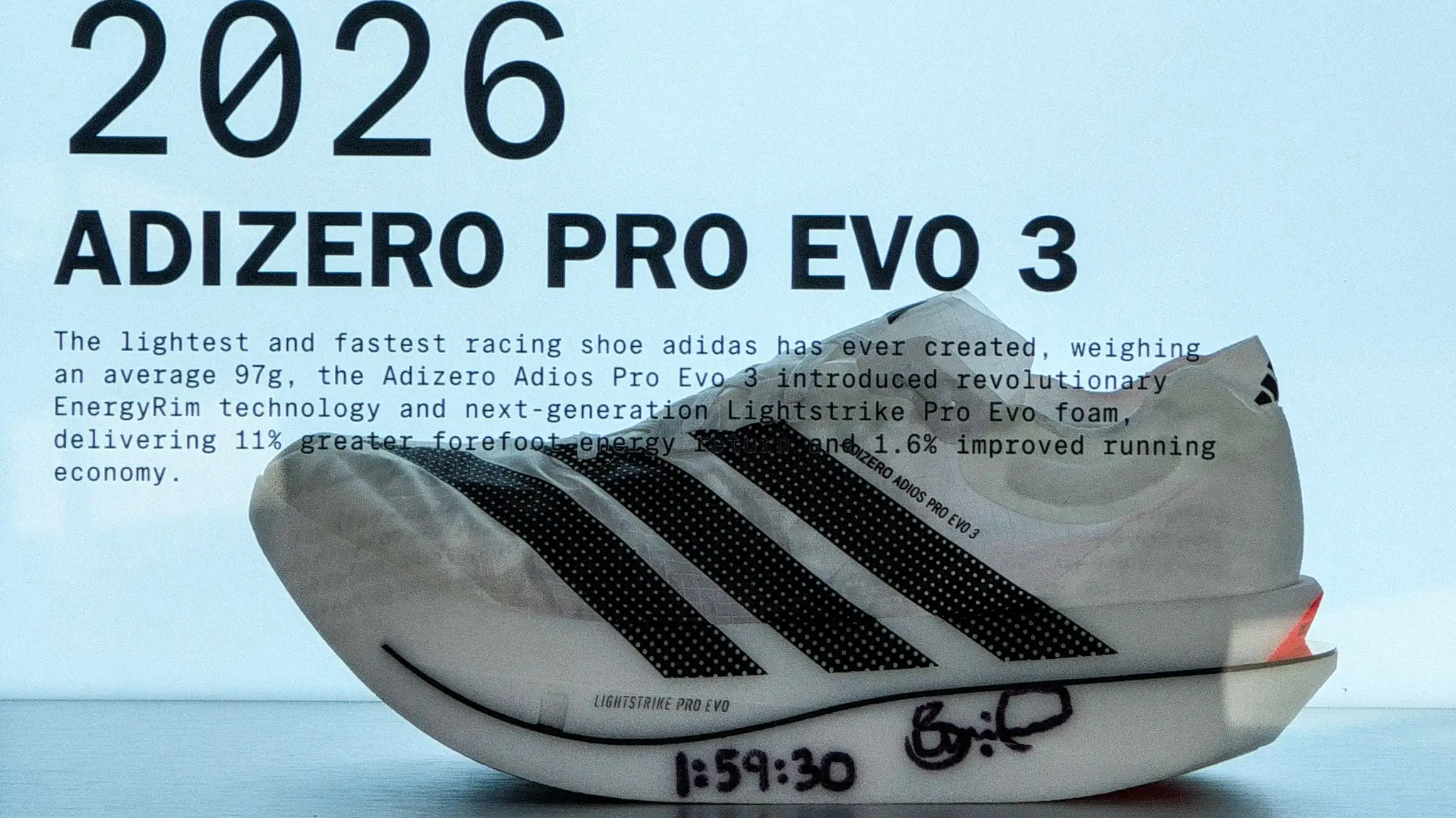
The Adizero Adios Pro Evo 3 that Sabastian Sawe wore to run the first official sub-two-hour marathon, signed with his finishing time. The Evo 3 weighs 97 grams, with rubber cut down to a thin layer only where the foot needs grip. Adidas says it is 1.6 per cent more economical than the previous Evo, though that figure comes from the company, not independent testing.
Because that weight has to be lifted and swung on every stride, since the 1980s, researchers have known that every 100 grams added to a shoe raises the energy cost of running by about 1 per cent,. Weight is where the easiest gains are. Run those numbers across the tens of thousands of steps in a marathon and it is easy to see why the industry has spent four decades shaving grams.