
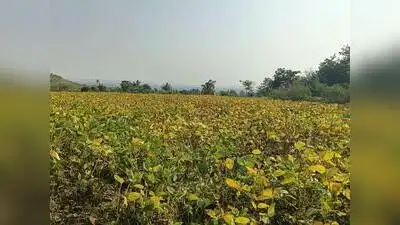
The withered soybean crops in Khed tehsil
Pune: The crop-loss assessment exercise in drought-hit parts of Pune district is proving to be a major challenge for the agriculture department, with officials completing panchanamas covering only around 7,000 hectares in the past week against an estimated 1.25 lakh hectares of affected kharif farmland.
District agriculture officer Vaibhav Tambe said teams at the tehsil level had been instructed to accelerate the exercise. But our endeavour is to complete the entire exercise within a few days,” Tambe said. The assessment is being carried out across eight drought-declared tehsils — Bhor, Velhe, Khed, Shirur, Daund, Purandar, Baramati and Indapur. Agriculture officials have been directed to visit affected farms, record crop losses and upload photographs and other details on the govt system before submitting the final assessment. “I have instructed all tehsil-level teams to expedite the exercise this week. It is a challenging task for them to visit each affected zone and farm to complete the procedure.
With nearly 1.25 lakh hectares estimated to be affected, officials face the daunting task of completing thousands of field visits within a short window. Because they are in charge of at least three to five villages, “In some cases, revenue officials do not come to the field. You Can Also Check: Gold Rate in Pune | Silver Rate in Pune | Bank Holidays in Pune | Public Holidays in Pune | Petrol Price in Pune | Diesel Price in Pune | CNG Price in Pune | LPG Price in Pune Stay updated with the latest Pune news.
They said revenue officials were required to be present in certain cases but were often responsible for several villages simultaneously. This aspect also needs to be considered before blaming agriculture officials,” another agriculture official said. So I did not think of leaving evidence in the farm,” said Asha Pandhare, a farmer from Shirur.
Some officials also pointed to the need for coordination with the revenue department. How can we go ahead without their presence? Farmers, however, argued that the procedural delays could result in an inaccurate assessment of actual losses. “I wanted to prepare my soybean farm for onion plantations. I cannot completely wait for the panchanama to be conducted. If I don’t prepare my plot, how will I replant the onion? Farmers fear that if damaged crops are removed before officials reach their fields, the extent of losses may not be adequately captured, potentially affecting their eligibility for govt relief. The department’s ability to accelerate the exercise will determine how accurately drought-related crop losses are documented and how quickly affected farmers can be considered for relief. Download the TOI App.
Therefore, this procedure should be quick,” said agriculture activist Shripad Lonari of Bhose village in Khed tehsil. Therefore, support from farmers is essential in this exercise,” the official said.
The slow pace has raised concerns among farmers and activists, who said the assessment needed to be completed before farmers removed damaged crops or began preparing their fields for the next season. Agriculture officials, however, said the exercise involved several procedural and logistical hurdles. An agriculture assistant involved in the exercise said farmer participation was crucial for completing the process.
“Maximum farmers uproot their crops or flatten the plantations if they know that their harvest is going to be poorest. In this case, if the panchanama is not done on time, how will officials understand the actual loss of a particular farmer? Apart from visiting farms and documenting losses, officials have to upload photographic evidence and ensure that farmers submit the required documents. “Farmers have to be present during the panchanama and submit certain documents mentioned on the form. If even one document is incomplete, we cannot submit the final panchanama report to the higher authorities.