
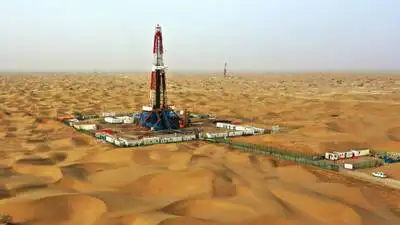
Engineers at China’s Fuman Oilfield recovered rock cores from a record depth of 8,080 metres beneath the Taklimakan Desert in Xinjiang. (Photo: China Media Group)
China’s largest desert oilfield has extracted more than 26 million tons of oil and gas from ultra-deep formations beneath the Taklimakan Desert, marking a major milestone in the country’s push to tap increasingly difficult underground reserves. The Fuman Oilfield, located on the northern edge of the Taklimakan Desert in northwest China’s Xinjiang Uygur Autonomous Region, has produced a combined 26.86 million tons of oil and gas equivalent, according to China National Petroleum Corp. (CNPC), which operates the field. The milestone comes as engineers explore formations buried thousands of metres beneath the surface, with a recent drilling operation retrieving rock cores from a depth of 8,080 metres. At the Zhentan-1 well on the edge of the Taklimakan Desert, engineers recently brought rock cores to the surface from 8,080 metres below ground. The rocks have been buried for approximately 500 million years, according to a report by China Central Television (CCTV) News. The operation marks the first time China has retrieved a core sample from a depth exceeding 8,000 metres in the northwestern Tarim Basin. An engineer with CNPC’s Tarim Oilfield, the operation has extracted 20.36 million tons of crude oil and 8.15 billion cubic metres of natural gas from ultra-deep formations beneath the Taklimakan Desert, according to Lu Zhongyuan. Together, that production represents an oil and gas equivalent of more than 26.86 million tons, Lu said, according to CCTV News. A total of 485 ultra-deep wells have been drilled at the Fuman Oilfield, according to media reports. Of those, 133 wells have each produced more than 100,000 tons of oil and gas, while 464 wells have each produced more than 10,000 tons. China has already proven more than 5 billion tons of oil and gas reserves in the Tarim Basin, with more than half located in ultra-deep formations at depths exceeding 6,000 metres, according to the information cited by Chinese state media. The latest rock-core recovery from 8,080 metres could help researchers better understand these formations and assess whether additional hydrocarbon resources exist even deeper beneath the desert.
“With these precious rock cores, we can analyze and evaluate the hydrocarbon generation potential below 8,000 meters, including the thickness of the oil and gas layers and their maturity levels,” Xu Yanan, director of the Tarim Oilfield project at CNPC, was quoted as saying by CCTV News. The samples could provide scientists and petroleum engineers with important information about the geological formations beneath the desert. The Fuman Oilfield’s ultra-deep production has already reached substantial levels. The figures underline the scale of China’s efforts to develop hydrocarbon resources buried at depths that present major technical challenges for drilling and extraction. In recent years, the Tarim Oilfield has accelerated ultra-deep oil and gas exploration and production beneath the Taklimakan Desert. The development has helped establish the Tarim Oilfield as China’s largest desert oilfield and a major ultra-deep hydrocarbon production base. The Taklimakan Desert sits in the heart of the Tarim Basin, a vast inland basin in southern Xinjiang that contains significant oil and gas resources. The basin’s ultra-deep formations are considered an important potential source for increasing China’s domestic hydrocarbon reserves and production. The scale and depth of the Fuman Oilfield development highlight the increasingly challenging environments being targeted by China’s energy industry. Recovering geological samples from more than eight kilometres below the surface allows researchers to directly examine rocks that have remained buried for hundreds of millions of years. For CNPC, the data gathered from these cores could help determine the thickness, maturity and hydrocarbon-generation potential of deep geological formations, potentially guiding future exploration across the Tarim Basin. You use AI every day. Now get your AI Quotient. Take the AIQ test.