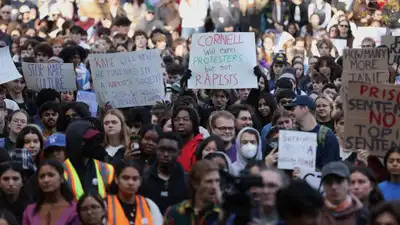
People attend a Justice for Survivors rally at Cornell University in Ithaca, New York (Image credit: Reuters)
A night at a Cornell University fraternity house in October 2024 has, nearly two years later, become the centre of a fresh storm over sexual assault, campus accountability and the limits of the justice system. Doe reported the alleged assault to Cornell police in November 2024. Van Houten later said Cornell police had not provided him with key information, including a transcript in which Doe reportedly said she was “100% confident I was raped.
She reported the alleged assault to Cornell police weeks later, but no criminal charges were filed at the time.
He said the material he initially received suggested that she had consented to some sexual activity and was intoxicated, but not necessarily to the degree of being legally incapacitated. The man said that after dancing with Doe, he suggested a three-person sexual encounter and maintained that she agreed, according to ABC News. During the call, Doe tried to identify other men she said later entered the room. At one point, according to ABC’s account, Doe told him: “What y’all did would be classified as gang rape.
Cornell conducted its own disciplinary investigation, eventually expelling two of the men and imposing lesser sanctions on others. Tompkins County District Attorney Matthew Van Houten initially declined to pursue criminal charges after reviewing a police summary of her interview. Another piece of evidence highlighted in the reporting is a phone call Doe recorded with one of the men shortly before she went to Cornell police. The man suggested that both of them might be remembering something incorrectly.
She had earlier alleged that she was too intoxicated to consent.
What did Cornell’s investigation find?
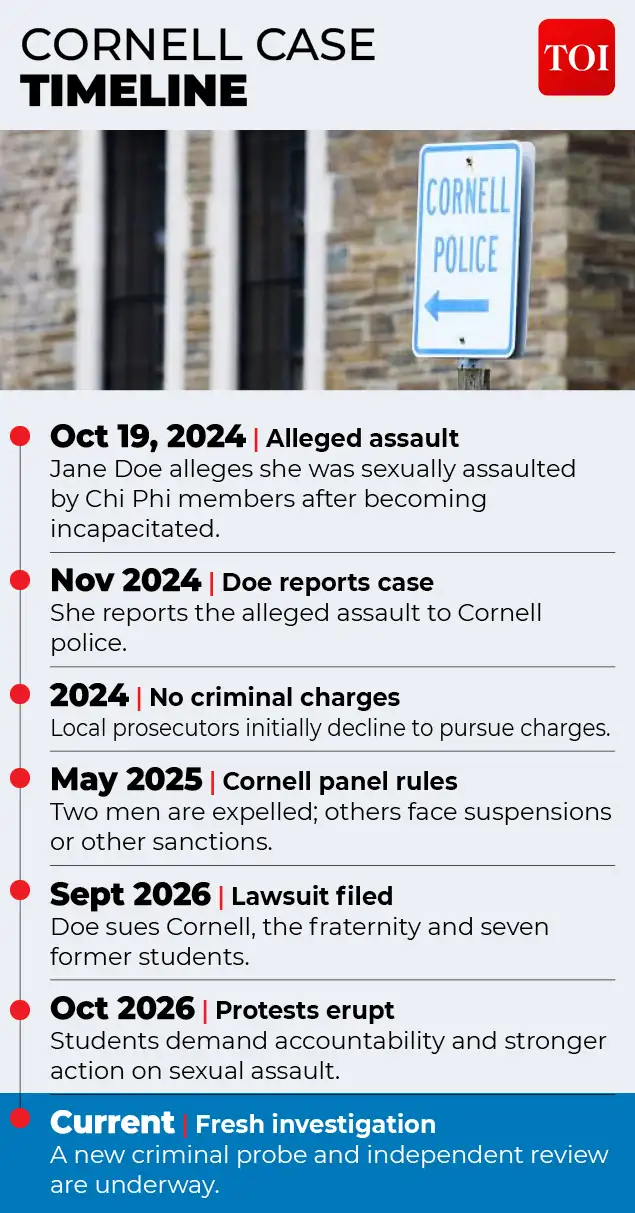
She went to the Chi Phi fraternity house on October 19, 2024, to meet Matthew Ingalls, a man she had been interested in romantically, according to Doe’s account to investigators and allegations in her lawsuit. She told investigators she initially arrived with an intoxication level she described as about five out of 10 after drinking during the evening. A look at the key developments from the alleged 2024 assault to the renewed investigation in 2026. The university’s three-member Title IX panel met over 12 days in May 2025.
For many students, the central question is not only what happened inside the fraternity house but also whether the university did enough after Doe reported it. Hochul said she had lost confidence in the local prosecutor’s handling of the matter and criticised what she described as failures by institutions that were supposed to protect Doe.
The case involves a Cornell student known in court records as “Jane Doe”, who accused seven members of the Chi Phi fraternity of sexually assaulting her after she became heavily intoxicated and, according to her account, was given ketamine. At the fraternity house, she said Ingalls asked whether she wanted to have a threesome with Jonathan Newell. Cornell’s disciplinary summaries later said Ingalls was responsible for sexual assault and that he had manipulated, exploited and endangered Doe for his own interests and the entertainment of others. She told Cornell investigators: “I felt like bait, according to records reviewed by The Associated Press. The panel reached different conclusions about the seven men and imposed different sanctions, according to disciplinary summaries obtained by The New York Times. Newell was also accused of sexual assault and was expelled, with the disciplinary records noting, among other allegations, that Doe told police he had struck her during intercourse and manipulated her into ingesting ketamine. His lawyer said he was “never accused of, nor found responsible for, rape. Demonstrators carried signs reading “support survivors, expel rapists” and “Justice 4 every Jane Doe”, while some called for Cornell President Michael Kotlikoff to resign. New York law distinguishes between being intoxicated and being physically helpless or incapacitated by drugs administered without consent, according to the supplied reporting. Doe’s civil lawsuit brought renewed attention to the case and included allegations that Van Houten said he had not previously seen. James has said the investigation could take months and that there would be no predetermined outcome. One student, Jane Wang, said that after filing a Title IX case following an earlier alleged assault, she encountered extensive paperwork, little guidance and no follow-up about the outcome. Hochul has said she supports changing New York’s sexual assault law concerning people who are too intoxicated to consent, adding another dimension to the debate over how such cases are prosecuted.
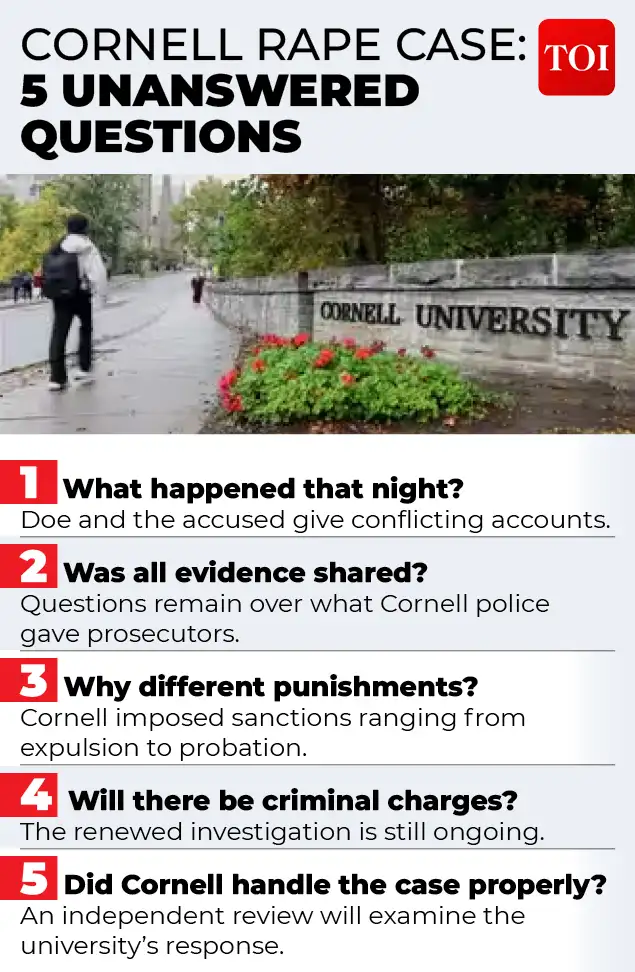
The case has now resurfaced after Doe sued Cornell and the men, triggering renewed scrutiny of the university’s handling of the allegations. New York Governor Kathy Hochul ordered an independent review of Cornell’s response and appointed state Attorney General Letitia James as a special prosecutor to take over the criminal investigation. She alleged that alcohol and ketamine were then involved and that, as the night progressed, other men entered the room and engaged in sexual acts with her while she was incapacitated. The university records also describe a Snapchat message allegedly sent by Newell encouraging other fraternity members to enter the bedroom while Doe was undressed. Doe has described the experience in stark terms. I felt like lions around me. It just was a totally debilitating place to be in. But the seven men have denied wrongdoing. Records also show that some of the accused described the sexual activity and drug use as consensual. Cornell’s disciplinary panel did not find all seven responsible for sexual assault. Cornell conducted a separate disciplinary process from the criminal investigation. Two men – Ingalls and Newell – were expelled. Ingalls was found responsible for sexual assault. Two others, Winston Lee and Gillio Lopes, were suspended. Lee received a two-year suspension followed by disciplinary probation, while Lopes received a three-semester suspension and two years of probation. Both were also ordered to have no contact with Doe and complete education and reflection requirements. Diego Sarabia, who had already graduated, was declared persona non grata and barred from campus for three years. The remaining two, Scott Norris and Scott Kretzschmar, received restrictions including no-contact orders, educational requirements and reflection papers. Kretzschmar was not found responsible for sexual assault but was found responsible for the lesser offence of attempted sexual exploitation. The sanctions ranged from expulsion to comparatively lighter disciplinary measures. Cornell has declined to provide further details, citing student privacy laws. The case sparked protests on campus, with students demanding greater transparency and accountability. The protests followed the emergence of detailed records from Cornell’s investigation and Doe’s lawsuit. Cornell President Kotlikoff acknowledged the seriousness of the allegations, saying Doe’s account “raises heartbreaking and troubling issues about sexual assault, dehumanization and aspects of party culture, alcohol and drug use. He backed an independent review and promised a commitment to “finding the answers our community deserves. This is one of the most important distinctions in the case: Cornell’s disciplinary findings and the criminal investigation are separate processes. He subsequently reopened the investigation, saying that cases sometimes have to be reconsidered when additional evidence emerges. The question of intoxication is legally significant. That distinction can affect whether prosecutors can establish the elements required for a rape charge. Van Houten has maintained that state law limited what he could prosecute based solely on Doe’s allegation that she was too incapacitated to consent. She ordered an independent review of Cornell’s handling of the case. The governor then appointed New York Attorney General Letitia James as a special prosecutor with the authority to bring criminal charges. That means the renewed criminal inquiry is still an investigation, not a finding that the accused men committed crimes. Conflicting accounts, evidence concerns and a fresh probe leave key questions unresolved. The recording is part of the broader body of material surrounding the case, but it does not by itself resolve the competing accounts of what happened. The case has turned into a wider debate on Cornell’s handling of sexual assault allegations. At a Cornell Student Assembly meeting, students discussed their experiences with sexual violence and the university’s response. Student organisations have called for an independent review of Cornell’s handling of the Doe case and changes to sexual-assault policies. Cornell’s fraternity presidents also voted to cancel social events for a weekend following the allegations. Meanwhile, the controversy has expanded beyond Cornell. Three separate tracks now matter in the Cornell case: the civil lawsuit, the university’s disciplinary findings and the renewed criminal investigation. Cornell has already imposed disciplinary sanctions on the seven men, including two expulsions, but its panel did not find all seven responsible for sexual assault. The men have denied wrongdoing, and some have disputed Doe’s account. The criminal case is different. James’ appointment as special prosecutor means investigators will now examine the evidence afresh, without a predetermined outcome. Whether criminal charges are ultimately brought remains unresolved. And that is why the Cornell case has become larger than a single night at a fraternity house: it now raises questions about how universities investigate sexual assault, how criminal prosecutors assess intoxication and consent, and what accountability should look like when the university’s disciplinary process and criminal justice system reach different conclusions. You use AI every day. Now get your AI Quotient. Take the AIQ test.