
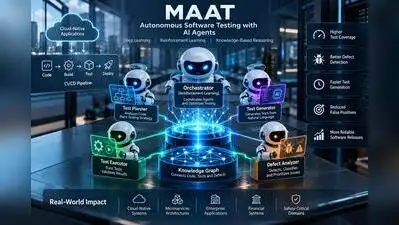
Representative photo
Pune: AI-powered multi-agent framework research designed to make software testing more autonomous has received the Best Paper Award at the International IEEE Conference on Applied Intelligence and Computing (AIC 2026) in Jabalpur , highlighting growing research interest in moving software quality assurance beyond rule-based automation toward adaptive and continuous testing. The conference, organised by Shri Ram Institute of Technology in association with the IEEE Madhya Pradesh Section and the Soft Computing Research Society (SCRS), received 4,525 submissions from researchers across 14 countries. Approximately 5% of submissions were selected for presentation, according to the organisers. In the experiments reported in the paper, 97.9% of the generated tests passed this validation process. The researchers tested the framework on five open-source software projects, including Spring Boot, TensorFlow Lite and Kubernetes, ranging from about 85,000 to 950,000 lines of code. MAAT achieved 94.3% statement coverage across the evaluated projects, compared with 86% for EvoSuite and 72% for the manual-testing baseline used in the experiments, according to the study. The researchers also reported a defect-detection rate of 91.7%, compared with 83.1% for EvoSuite and 68.3% for the manual-testing baseline. The framework generated test suites about 83% faster than the manual approach examined in the study. Its reported false-positive rate was 3.2%, compared with 7.8% for EvoSuite and 11.4% for Randoop.
Titled “MAAT: Applied Computational Intelligence for Autonomous Software Testing via Deep Learning, Reinforcement Learning and Knowledge-Based Reasoning,” the paper was led by Vinil Pasupuleti of IBM , with Nagesh Gulkotwar of Google and other team members serving as co-authors. “We designed MAAT as five specialized agents working together: a Test Planner, a Test Generator, a Test Executor, a Defect Analyzer and a central Orchestrator,” said Pasupuleti. Gulkotwar, an IEEE Senior Member and co-author, said the knowledge graph serves as a shared memory for the system. “It lets the agents focus on the code most likely to hide defects instead of testing everything blindly,” he said. The researchers said the approach is aimed at addressing challenges faced by software teams as applications undergo frequent changes through cloud-native development and continuous integration and delivery. “Our goal is not to replace engineers but to give them a reliable partner that handles the repetitive work and surfaces the problems that matter most,” Pasupuleti said.
At the centre of the research is MAAT, a framework that divides software testing responsibilities among five specialised AI agents: a Test Planner, Test Generator, Test Executor, Defect Analyzer and central Orchestrator. The agents coordinate through a shared knowledge graph connecting source code, tests and defects, giving different components of the system a common representation of the software under evaluation. The framework combines reinforcement learning, large language models (LLMs) and knowledge-based reasoning. The LLM generates candidate tests from natural-language testing objectives, while a validation process checks their syntax, executes them in a sandbox environment and assigns a confidence score. “They coordinate through a shared knowledge graph that maps how code, tests and defects relate, so every agent works from the same picture of the system. “Most testing tools treat quality as a fixed checklist. We wanted to treat it as an intelligence problem. MAAT gives each part of testing to the kind of AI best suited to do it,” Gulkotwar added. These include maintaining test suites, identifying flaky tests and distinguishing software defects from infrastructure-related failures. The findings, however, are based on the specific projects and experimental methodology used in the study and cannot be treated as universal benchmarks for all software systems. The team plans to examine continuous learning within CI/CD environments, expand the framework to user-interface testing and explore applications in sectors where software reliability is particularly important.
You Can Also Check: Gold Rate in Pune | Silver Rate in Pune | Bank Holidays in Pune | Public Holidays in Pune | Petrol Price in Pune | Diesel Price in Pune | CNG Price in Pune | LPG Price in Pune Stay updated with the latest Pune news. Download the TOI App.