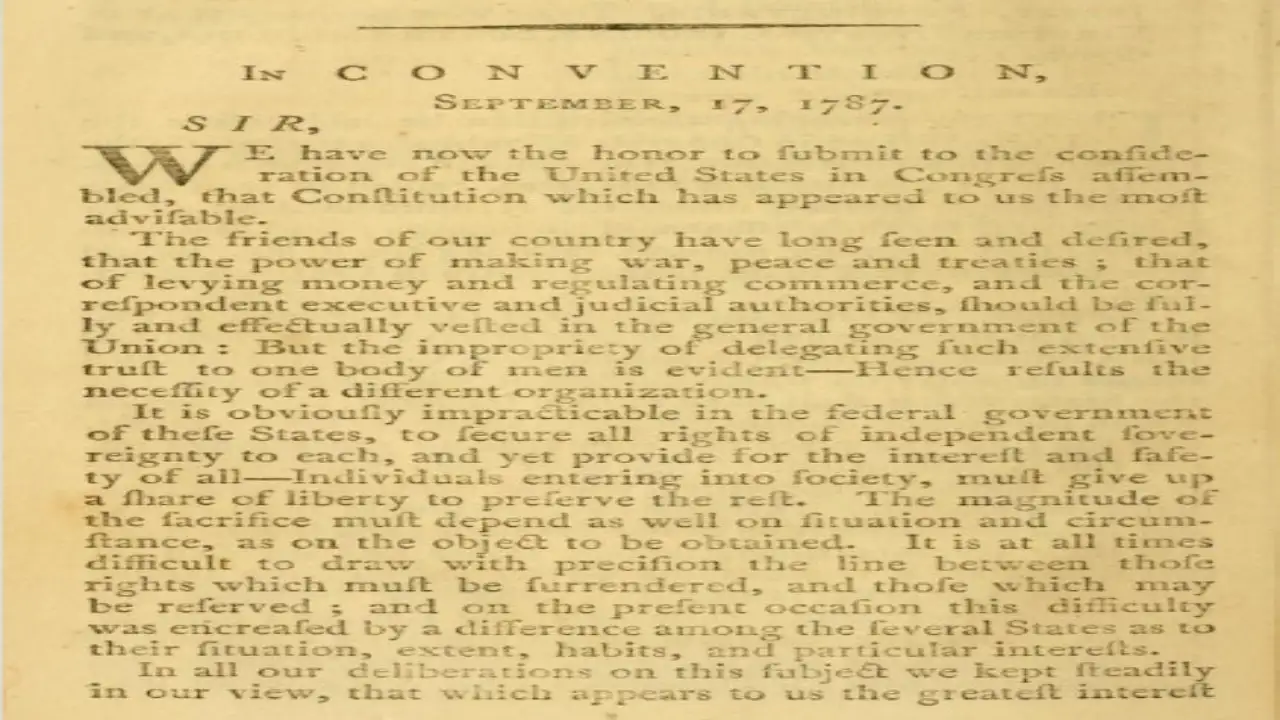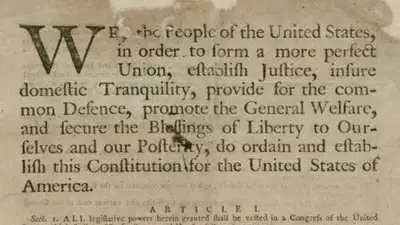
Constitution, 1787. (Image Credits: Wiki.media) Representative image of an early printing of the U.S.
A rare 1787 copy of the U.S. Constitution that had remained inside a filing cabinet in the Hayes house in Edenton, North Carolina, for decades sold for $9 million at Brunk Auctions in Asheville on Oct. 17, 2024. Discovered in 2022, the document is one of about 100 copies produced after the Constitutional Convention and sent to the states for ratification. Ken Farmer, an antiques appraiser, found the document in 2022 while assessing the contents of the Hayes house in Edenton, according to The New York Times. The auction attracted bids that mostly rose in $500,000 increments, the Associated Press reported, reaching $8.5 million before a pause, and then a final bidder offered $9 million.
It is just one of the eight signed copies known to survive, and the only privately held one, while the other seven are publicly owned. He opened a folder kept inside a dusty filing cabinet and found a sheet of paper with the signature of Charles Thomson secretary of Congress at the time, which helped identify it as an authentic official ratification copy. What made the document distinctive The document’s significance came not only from its age but from what it contained beyond the printed constitutional text. The right side of the front page was occupied by the printed constitution, alongside the entire back page and part of the left side. urging ratification, and acknowledgement that some rights held by the states would have to be surrendered for the nation’s long-term interests While the center included George Washington’s letter.
Likely 27 copies were signed by Thomson: two for each of the 13 states, one for the Congressional archives and only eight of those signed copies are known to have survived. In 1787, after the Constitutional Convention completed the proposed framework of the U.S. government, Congress had copies distributed to the states so they could review the document and consider ratification. Representative image of George Washington’s letter. (Image Credits: Wikimedia) A paper trail tied to North Carolina history The Hayes house where the copy was found had belonged to Samuel Johnston who was the governor of North Carolina from 1787 to 1789. Johnston also presided over the state’s ratifying conventions of 1788 and 1789 and later became the state’s first U.S. senator, serving from 1789 to 1793. Johnston settled the property in the late 18th century, and it was later given to Edward Wood in 1865. Eventually the Hayes house became part of a 1,400-acre plantation where enslaved people were held in six cottages. For more than 150 years, the Wood family kept the property before the house and 194 acres were sold to the state of North Carolina in 2022 for more than $6 million. Its eventual auction price was far above the last known sale of a Constitution copy in 1891, when a similar copy sold for $400. The $9 million sale was also distinct from the $43.2 million auction record set in 2021 for another early Constitution copy, which belonged to a different group of surviving copies.
Because it helped Seth Kaller, a historical documents expert, determine that the sheet was an authentic version of the official ratification copy, its connection to Charles Thomson was particularly important. The document’s physical condition also helped preserve evidence of its history. It was creased at the center and had become yellowed, but the printed words remained legible. Handwritten notes survived in the margins, which included the words “Adopted it must be & shall be. Furthermore, the document belonged to a specific stage in the Constitution’s adoption. For generations, the property had remained connected to the Johnston and Wood families. Farmer had been hired to assess the property’s items, including objects that were not being offered for sale and the Constitution was among the materials he examined. The state later reviewed the discovery and did not deem the document to be public property. You use AI every day. Now get your AI Quotient. Take the AIQ test.