
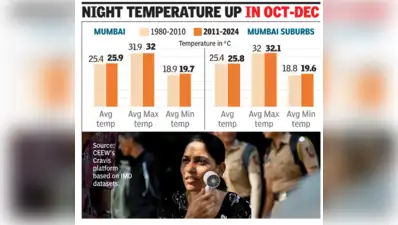
Research shows the post-monsoon months are getting warmer and more humid largely due to global warming—with some changes more pronounced than in other seasons. Mumbai: October has always been like a second, small summer for Mumbai—a few sweaty weeks between monsoon and winter. But this period may be getting more oppressive.
A study by IMD scientist P Rohini and others, published earlier this year, found significant increases in humid-heat stress along the Indian coast over 1981-2020. It found the largest increase in the post-monsoon months: on the west coast, humidity increased by 6.5% per degree of warming in October-December. (The east coast saw even higher increases, both overall and in the post-monsoon season.) High humidity makes it more difficult for the human body to cool down by sweating in hot weather. Average night-time temperatures during the months of Oct-Dec were 0.8°C higher in 2011-2024 than in the 1980-2010 period. By comparison, summer night-time temperatures went up by 0.5°C.
But for coastal areas and southern districts especially, this can be a period of high heat stress,” says study co-author Madhavan Nair Rajeevan, former secretary in Ministry of Earth Sciences and vice chancellor of Bengaluru’s Atria University. “This doesn’t mean that post-monsoon periods are becoming hotter than summers, but rather that nights are warming more rapidly relative to their baseline conditions,” says Vishwas Chitale of Council on Energy, Environment and Water (CEEW), which provided the analysis of historical IMD data through its CRAVIS AI platform. On the west coast, the study found, the number of days with extreme humid heat increased by five days per decade in the post-monsoon season of October-December—more than the increase during monsoon (four days) and winter months (three days) and as much as during summer. The study assessed humid heat using wet-bulb temperature, which captures the combined effect of heat and moisture. “Normally, we don’t care about the post-monsoon temperatures; we assume the summer is the most important. Since warmer air can hold more water vapour, the study also looked at how moisture availability changed with each degree of warming. Meanwhile, one analysis of Mumbai temperatures over several decades reveals another post-monsoon shift: the sharpest rise in minimum temperatures across seasons. Global warming is the main driver of these trends, say scientists. But other factors can influence temperatures from year to year.