
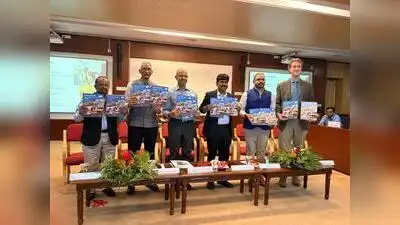
Left to right:Prof Gopal Naik, Chairperson Jal Jeevan Mission, IIM Bengaluru,, Parameswaran Iyer,Former Secretary, Department of Drinking Water and Sanitation, Ministry of Jal Shakti, Government of India, Shri Ashok K K Meena, Secretary, Department of Drinking Water and Sanitation, Ministry of Jal Shakti, Government of India, U. Dinesh Kumar, Director-in-charge, IIM Bengaluru, Dr Nitin Bassi, Fellow and Lead, Sustainable Water Programme, CEEW, Dr Daniel W Smith, Assistant Professor, George Mason University.Launch of the case study: From Gujarat to India: Water Lessons for the World.
“Publicly run surveillance networks could be created with the support of laboratories owned by state govts, while communities could conduct basic testing using field-testing kits,” said Ashok K Meena, secretary, department of drinking water and sanitation, ministry of Jal Shakti. Meena said the initiative seeks to ensure tap connections under Jal Jeevan Mission translate into safe, reliable and sustainable drinking-water services. Bengaluru: Villagers could soon become frontline monitors of drinking-water quality with the Centre proposing a community-led surveillance system enabling residents to conduct basic tests, record results through mobile applications and alert local utilities when corrective action is needed. The Centre is also considering institutionalising women’s participation in water-quality surveillance by training them to use field-testing kits.
You Can Also Check: Gold Rate in Bengaluru | Silver Rate in Bengaluru | Bank Holidays in Bengaluru | Public Holidays in Bengaluru | Bengaluru AQI | Weather in Bengaluru | Petrol Price in Bengaluru | Diesel Price in Bengaluru | CNG Price in Bengaluru | LPG Price in Bengaluru Stay updated with the latest Bengaluru news.
He was speaking after his keynote address at the launch of the case study, “Gujarat to India: Water Lessons for the World”, at Indian Institute of Management-Bangalore. The Centre is developing a decision-support system combining data on rainfall, groundwater levels, runoff, pollution and water consumption held by different departments. Govt also plans a digital twin of the country’s water-supply infrastructure, mapping assets from sources and treatment plants to overhead tanks, pipelines and household connections. Officials believe combining resource and infrastructure data with technologies such as artificial intelligence could help utilities predict maintenance needs and improve services. Download the TOI App.