
PC: Archaeology Magazine
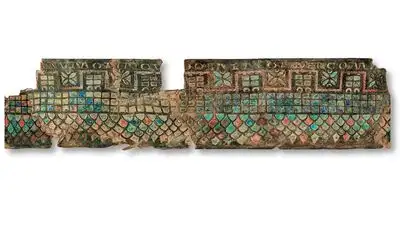
A bronze cup found in a field in central Spain may have been a Roman soldier’s keepsake from Britain about 1,900 years ago. The vessel was found in the village of Berlanga de Duero and measures 4.5 inches wide, 3.2 inches tall, and just a twentieth of an inch thick. It is 4.5 inches wide, 3.2 inches tall, and only a twentieth of an inch thick. 130.
Researchers believe the cup was made in the mid-second century A.D., in northern Britain near the wall, according to Archaeology Magazine. Its enamel decoration shows a series of fortifications along the base, while four forts from Hadrian’s Wall are named around the rim. Its owner may have belonged to the Cohors I Celtiberorum, a Roman military unit that originated in the Berlanga area and served along Hadrian’s Wall during the late first and second centuries A.D. Researchers believe the bronze cup was a memento brought home from Britain by a Roman soldier. The vessel was found in a field in Berlanga de Duero, a village in central Spain. Along its base, enamel depicts a series of fortifications. Four forts from Hadrian’s Wall are named around the rim that are Condercum, Vindobala, Onno, and Cilurnum. The cup is one of several known vessels portraying the wall’s forts that have been found in the last few centuries. However, it is the first known example to name forts from the eastern section of Hadrian’s Wall. The cup’s style and the forts named on it led researchers to date its production to the mid-second century A.D. One of the forts listed around the rim, Condercum, was completed in A.D. Two others, Vindobala and Onno, were destroyed by fire towards the end of the second century A.D.
130 but before Vindobala and Onno were destroyed by fire at the end of the second century A.D.
Archaeologist Jesús García Sánchez of the Archaeological Institute of Mérida says, “We think the cup was customized by the person who was going to have it, and the decoration was related to his experience during his military life. The fourth fort was Cilurnum. Together, these details link the cup’s decoration to the history of Hadrian’s Wall and its forts. Researchers also analysed lead isotopes in the cup and its enamel decoration. The results indicate that the vessel was made in northern Britain, near Hadrian’s Wall, rather than in central Spain, where it was later found. Researchers believe the cup’s owner was likely part of a Roman military unit, possibly the Cohors I Celtiberorum. The unit originated in the Berlanga area and was stationed along Hadrian’s Wall during the late first and second centuries A.D. This connection provides a possible route for the vessel from northern Britain to central Spain. “The inclusion of the forts’ names made it a very nice souvenir to bring back home. The bronze vessel is notable as the first of its kind to name forts from the eastern section of Hadrian’s Wall. Enamel fortifications run along its base, and the names of four Hadrian’s Wall forts appear around its rim, while isotope analysis points to northern Britain as the place where the cup was made. Researchers believe it dates to the mid-second century A.D., after Condercum was completed in A.D. The cup was later found in Berlanga de Duero, where its possible connection to the Cohors I Celtiberorum links the vessel to a Roman military unit stationed along the wall. You use AI every day. Now get your AI Quotient. Take the AIQ test.