
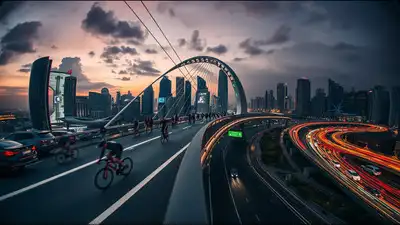
Representative Image of a circular bridge resembling a flying saucer, suspended above traffic, with cyclists and pedestrians crossing above ( AI Generrated Image)
To create comfortable gradients for the approach ramps without substantially expanding the junction’s footprint, the road level underneath the bridge was lowered by approximately 1.5 metres. The ramp gradients range from 2% to just over 3%, according to ipv Delft. The bridge’s structural design centres on a circular deck, a single pylon and 24 steel cables. The circular deck has a diameter of 72 metres, according to ipv Delft. The designer’s specifications list a width of 5 metres. The central pylon rises 70 metres above the ground. The pylon is made from 23 conical steel segments, with plate thicknesses ranging from 20 to 50 millimetres, according to steel fabricator Kersten Group.
Because of its historical links with Philips, Eindhoven wanted an innovative structure that used lighting creatively and complemented the nearby Evoluon, a futuristic, saucer-shaped building, known as the City of Light.
Kok also described how the designers addressed local concerns about the slopes: stakeholders were invited to cycle over other ramps around Eindhoven whose gradients had been measured in advance, without being told the figures beforehand. This arrangement helps prevent twisting, or torsion, in the deck, according to ipv Delft’s project description. The design reflected Eindhoven’s association with lighting and technology. The circular bridge offered a way to combine the city’s visual ambitions with a practical transport solution. Space was a major constraint. The exercise allowed participants to judge the slopes for themselves. Rather than attaching the cables to the outer edge of the deck, the designers connected them to its inner side. In his interview with ipv Delft, Kok explained that the inner circular counterweight is partly filled with concrete and helps balance the deck around the cable attachment points. The cable placement and counterweight work together to support the circular structure. M-shaped supports near the approach spans provide additional stability. Kersten also describes slotted holes cut into the inside of the pylon where the cables come together. The designers wanted a thin circular deck and a powerfully shaped pylon. In its project description, ipv Delft explains that a standard cable-attachment arrangement would have created a bulky concentration of steel near the top of the pylon, so the team developed a tailor-made solution. Positioning the pylon in the middle of a busy road junction also required approval from Eindhoven’s traffic planner.
In January 2012, Dutch regional broadcaster Omroep Brabant reported that the junction had been closed after wind-driven vibrations raised concerns about the cables’ condition. The Hovenring was officially opened on 29 June 2012. Omroep Brabant’s coverage of the opening reported that a mounting error had left dampers improperly fitted, prompting another closure shortly before the official ceremony.
Additional lights attached to the cable framework and counterweight illuminate the junction below, according to ipv Delft. Lighting is central to the Hovenring’s appearance after dark. The space between the circular deck and the inner counterweight contains aluminium lamellas, translucent sheeting and tubular lights, creating a visible ring of light. LED lighting integrated into the railing illuminates the bridge deck, helping users recognise one another’s faces. Cable vibrations interrupted the Hovenring’s early use. The repairs did not proceed entirely smoothly. The episode illustrates the engineering challenges behind a structure whose striking appearance depends on a carefully balanced system of cables, a central pylon and a circular deck.
Engineers investigated the problem before the cycle roundabout could open officially.