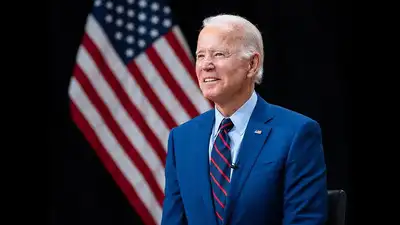
The first portrait of Joe Biden as president of the United States. Image credits: Wikimedia Commons
The Department’s release dated October 7, 2021, announced proclamations for the next day. These proclamations restored the original Bears Ears boundaries, retained the around 11,200 added acres, and restored the Bears Ears Commission of Tribal representatives. The Interior Department’s October 7, 2021 release said the new proclamation restored Grand Staircase-Escalante to the boundaries in place in January 2017. All these 2021 proclamations have re-established protection of around 2.01 million acres that were revoked in 2017. Utah and two of its counties sued in August 2022, as the Natural Resources Defense Council reports, in a case known as Garfield County v. Biden , was brought by recreation users and a mining company, and that a district court dismissed both cases in August 2023. In a divided ruling on June 23, 2026, the Tenth Circuit vacated that dismissal in part and sent the cases back to the district court, as the court’s published opinion on govinfo.gov shows.
As discussed in the report presented above, the governor and congressional delegation referred to “whiplash” due to frequent changes and noted that decisions belong to Congress. The Native American Rights Fund said a second case, Dalton v. The report by the Interior also includes opposing views. The opponents worried about the restrictions on roads, motorized recreation, mining, and grazing and noted that the jobs related to recreation pay less than those in mining. Biden . The case is now titled Garfield County v. Trump .
The Congressional Research Service’s 2021 review, National Monuments and the Antiquities Act , documents the history of presidential monument designations under the law. President Bill Clinton established Grand Staircase-Escalante National Monument in Utah on September 18, 1996, through a presidential proclamation under the Antiquities Act. Both monuments have had their boundaries changed since then; this article explains what happened when they were restored in 2021 and what followed. The US Department of the Interior’s October 2021 press release states that President Barack Obama established Bears Ears National Monument in Utah in 2016, covering approximately 1.35 million acres. President Donald Trump signed a proclamation on December 4, 2017, that cut the monument by 1.15 million acres, or nearly 85 percent. In Neither boon nor bane: the economic effects of a landscape-scale national monument , published in 2018 in Land Economics , Paul Jakus and Sherzod Akhundjanov examined ranching, mining and tourism trends around Grand Staircase-Escalante. As KUER reported, President Donald Trump signed proclamations on July 13, 2026, shrinking Grand Staircase-Escalante National Monument by about 90 percent and Bears Ears National Monument by 91 percent. Advocates for the West stated that Grand Staircase-Escalante lost about 1.69 million acres and Bears Ears lost 1.24 million acres, nearly 3 million acres total. On September 2, 2026, the Natural Resources Defense Council, Earthjustice, and the Southern Utah Wilderness Alliance filed a federal lawsuit challenging President Donald Trump’s proclamations reducing protections for Bears Ears and Grand Staircase-Escalante national monuments.
” the president claimed that the previous designations were an injustice against Utah residents While the governor referred to these decisions as “right-sizing. The Antiquities Act lets presidents protect federal lands and waters that hold objects of historic or scientific interest. It also notes that designations apply only to lands owned or controlled by the federal government and remain subject to valid existing rights. Two of the monuments in Utah have been a part of the dispute. The study tested whether the monument shifted the local economy away from ranching and mining and toward tourism. The researchers used both difference-in-differences and synthetic control methods to compare pre and post-designation paths for per capita income, alongside trends in ranching, mining, and tourism. They conclude that Grand Staircase-Escalante’s monument designation had no effect on regional per capita income, suggesting the economic shift was not as dramatic as either side of the policy debate claimed. Paul Jakus and Sherzod Akhundjanov examined ranching, mining and tourism trends around Grand Staircase-Escalante. The authors also embed the monument within a policy choice dilemma where landscape-level designations may limit the use of land and have a tendency to direct activities to low-wage tourism at the expense of high-wage mining and extraction. With post-designation data on ranching, mining, and tourism from the Grand Staircase-Escalante area, the authors conduct their analysis using difference-in-differences as well as synthetic control approaches without finding any impact on per capita income. The lawsuit argues that the Antiquities Act does not authorize a president to dismantle national monuments established by previous presidents.