
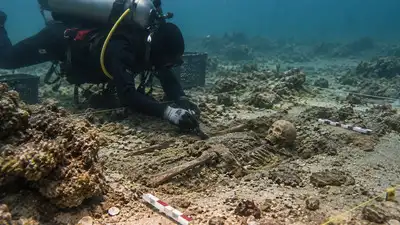
An AI-generated representative image of a diver finding burial site beneath seawater. Image credits: ChatGPT
In June 2016, an amateur diver searching for prehistoric fossils off Manasota Key, which is located in Florida, reported possible human remains to the state’s Bureau of Archaeological Research. Radiocarbon dating of two wooden stakes placed them at more than 7,200 years old, thus transforming the site into an important source of evidence about Florida’s Indigenous past and the region’s changing landscape, according to the Florida Department of State . After the initial investigation had established that the offshore location contained a prehistoric burial site, on February 28, 2018, the discovery was announced publicly by Florida’s secretary of state . In its 2018 announcement, the state’s department explained that peat slows organic decay and that the pond’s peat bottom remained as it was even after rising seas covered the area. The Florida Department of State dates the stakes to more than 7,200 years ago, during the Archaic Period.
Because radiocarbon dating of two examples provided evidence of the site’s antiquity, the wooden stakes hold special importance. The investigation that followed the report revealed a prehistoric Native American burial site beneath the Gulf of Mexico. Known as the Manasota Key Offshore (MKO) archaeological site, it contains human remains. Additionally, the site contains worked wooden stakes that were linked to ancient burial practices. Several areas containing peat, worked wooden stakes and the remains of multiple individuals were documented in the investigation. The peat underneath the pond helped preserve evidence of the burial site. The survival of the materials found alongside the human remains allowed archaeologists to study evidence that might otherwise have deteriorated. Why the discovery matters for archaeology The discovery also raises questions about the protection and respectful treatment of human remains. A federal notice records that the state’s agency consulted representatives of the Miccosukee Tribe of Indians, the Seminole Tribe of Florida and the Seminole Nation of Oklahoma when assessing the recovered remains and associated funerary objects. The notice states that the remains were determined to be Native American based on contextual data and osteological analysis.
Prompted by the fossil hunter’s initial report, underwater archaeologists from the state’s Bureau of Archaeological Research launched an investigation of the region using non-invasive techniques. The methods included magnetometry, side-scan sonar and sub-bottom profiling. These helped the researchers map features beneath the water and identify areas for further examination.