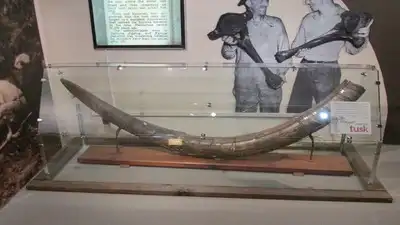
Representative image of a Mastodon tusk. (Image Credits: Wikimedia Commons)
A fossil-hunting diver exploring the seabed off Florida’s Gulf Coast discovered a large section of mastodon tusk in April 2024, which he initially mistook for a piece of wood. The fossil measured approximately 4 feet (1.2 metres) long and weighed 70 pounds (31 kilograms), according to the Associated Press. It was found near Venice, Florida, at a depth of about 25 feet (7.6 metres), and was the largest intact section of mastodon tusk diver Alex Lundberg had found in the area. However, the precise age of the tusk had not been determined when the find was reported in June 2024. However, what he found was not a complete tusk, and the recovered section measured about 1.2 metres, in contrast to a full-sized tusk which the BBC reported could approximately reach 4.8 metres. A University of South Florida graduate with a degree in marine biology, Lundberg had spent several years collecting fossils in the area and had held an official collecting permit since 2019, according to the same report. Their lineage was separated from that of mammoths and modern elephants approximately 25 million years ago, according to the American Museum of Natural History . The law dictates that vertebrate fossils found on state lands, including near-shore waters, belong to the Florida Museum of Natural History; consequently, Lundberg was required to report the find when renewing his collecting permit in December 2024, though it is unclear whether that happened.
Because the discovery represents only part of an animal’s tusk, not the entire remains of the specimen, this differentiation is critical.
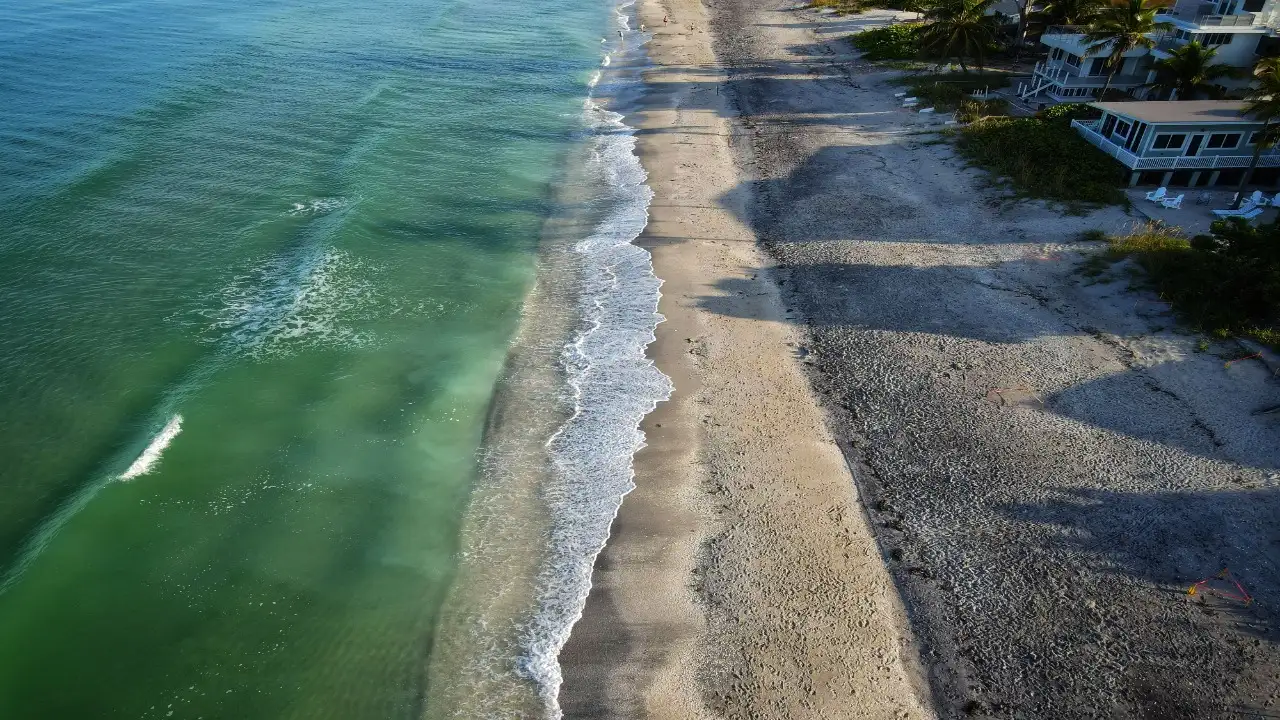
Describing the experience, he said: “It just keeps getting bigger and bigger. The discovery brought another set of remains of a prehistoric animal to the collection of fossils recovered from the Gulf seabed, although its scientific significance remains subject to further assessment. How the tusk was discovered off Florida’s coast Having already been familiar with the fossil deposits found within the area, Lundberg was taken aback by the size of the new specimen he had discovered. As he brushed the sand away, the object became more visible. I’m like, this is a big tusk. Upon recovering the fossil, he displayed it in a glass case in his living room, though state law may give ownership to the Florida Museum of Natural History. Representative image of Florida’s Gulf Coast. (Image Credits: Pexels) What mastodons reveal about prehistoric North America Mastodons were extinct relatives of elephants and mammoths; they may have lived in North America, where their fossil remains trace their widespread presence across the region. Despite their similarities, mastodons and mammoths have distinguishable features that make them different in their anatomy. Generally, mastodons had straighter tusks and molars with cone-shaped cusps, which they used to crush twigs and other vegetation. In comparison, mammoths had more curved tusks and ridged molars suited for grinding grasses and other plants. These physical differences help to establish their separate evolutionary histories and unique feeding adaptations. The museum also distinguishes the animals by the shape of their skulls and teeth. Such characteristics help researchers identify fossil remains, although the age and significance of an individual discovery require separate examination. its future depends on Florida’s fossil-collection laws Although Lundberg discovered the specimen. You use AI every day. Now get your AI Quotient. Take the AIQ test.
Before the discovery, Lundberg and his diving companion had recovered fossils which included mammoth teeth, an ancient jaguar’s bones, parts of a dire wolf, and a mastodon tusk, but in smaller pieces, from the same location.