
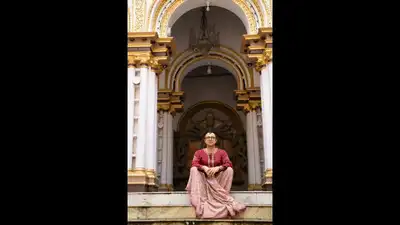
In his first exclusive interview with Calcutta Times since taking office, he spoke about Kolkata’s “very strong personality”, his early experiences of its food, art and architecture, and his hopes of strengthening Italy-Bengal’s cultural and people-to-people ties. Giuliano Fragnito’s first festive appearance in Kolkata unfolded fittingly at Ramgopal Saha Bari, a heritage home in central Kolkata, where the newly appointed Consul General of Italy donned Bengal’s iconic dhuti-punjabi. Fascinated by the ensemble and surrounded by the home’s layered architecture and lived-in grandeur, Fragnito is discovering the city with curiosity, openness and an appetite for the unfamiliar.
Kolkata’s intellectual and creative environment makes it an ideal partner, especially as it takes centre stage during the 2027 Year of Culture and Tourism between Italy and India. Announced by both governments, it will feature exhibitions and events across India in performing arts, music, cinema, literature, design and more, celebrating culture and tourism as drivers of dialogue between two countries with over 100 UNESCO World Heritage Sites together. This is your first time in Kolkata. What were your first impressions, and what has surprised you most? I would like to present Italy in its entirety. Alongside our artistic and cultural heritage, contemporary Italy is strong in technology, research, design, advanced manufacturing, innovation and entrepreneurship. I hope to connect our creative communities—designers, architects, artists, filmmakers, universities and young people—and promote Italian technological and industrial excellence. Can Italy’s experience in preserving historic cities and architecture offer lessons for Kolkata?
The Joint Strategic Action Plan 2025–29 provides a framework for cooperation in science and technology, IT, innovation, start-ups, space, energy transition and advanced manufacturing. In 2026, our ties were elevated to a Special Strategic Partnership. We are working towards bilateral trade of €20 billion. His relationship with Italy is an important part of our shared cultural history; during his 1926 visit, he lectured in Rome and engaged with Italian intellectual circles.
Kolkata has a very strong personality and does not reveal itself immediately. You need to walk around, speak to people and observe everyday life. I was struck by the combination of history and energy—extraordinary architecture and intellectual and artistic heritage alongside tremendous street vitality. Most surprising has been how naturally people engage with you; their warmth and curiosity make newcomers feel welcome quickly. Italy and Bengal share strong traditions of food, family and gathering around a table. Do you see cultural parallels? Very much so. In both cultures, food is about relationships, not just nutrition. The table brings families and friends together, encourages storytelling and reflects respect for ingredients, traditions and recipes passed down generations. Discussing food is also a cultural activity—I think an Italian and a Bengali could have a long conversation before agreeing on what to order. What aspects of contemporary Italy would you like to bring closer to Kolkata during your tenure? Certainly, though every city must find solutions suited to its own history and circumstances. Italy shows that heritage conservation and contemporary urban life need not be opposites. Historic buildings must remain part of living cities, preserving their architectural and cultural value while serving contemporary purposes. It is also important to involve architects, conservation experts, universities, local authorities, communities and private stakeholders. Can Kolkata’s openness influence how a diplomat builds relationships? Diplomacy is ultimately about people, so a city’s social character matters. When people are curious, ask questions and engage openly, they create opportunities for dialogue. Diplomacy happens not only in offices and meeting rooms, but also at cultural events, over meals, in universities or while exploring a neighbourhood. How important are connections through food, cinema, art, design, education and everyday cultural exchange ? They are fundamental. Government-to-government relations provide the framework, but people-to-people connections give it life. When countries understand each other’s cultures and encourage students, researchers, artists and entrepreneurs to interact, their relationship becomes deeper. Italy and India’s ties should not be reduced to trade or political meetings. Culture is not an accessory to diplomacy; it is one of its foundations. How do you see India-Italy ties evolving towards technology and innovation? We are not moving away from our traditional relationship; we are adding new dimensions. Italy brings expertise in advanced manufacturing, engineering, design, industrial technologies and research, while India offers technological strength, engineering talent, digital innovation and entrepreneurship. We now want to create things together through joint ventures among companies, start-ups and universities, stronger industrial value chains, increased trade and investment, and an innovation centre in India. What can Tagore still offer as a bridge between Indian and Italian cultural thinking? Tagore was profoundly Indian without being culturally closed. He believed cultures grow richer through encounter, dialogue and curiosity. We are proud that Rabindra Bharati Museum has created a permanent Italian Gallery dedicated to his three visits. Tagore saw cultural exchange as mutual enrichment, not simply the export of one culture to another. That reflects how I view the Consulate General’s role—not merely presenting Italy to Bengal, but creating spaces where Italians and Bengalis can discover each other. Has Tagore’s idea of cultural exchange gained new relevance in an increasingly fragmented world? Certainly. Tagore understood that openness to other cultures does not require abandoning one’s identity. A confident culture can engage with others without feeling threatened. His own life—marked by extensive travel and intellectual relationships across continents—was a powerful example of this belief. BOX: Discovering Kolkata through food and festivity I am still discovering my favourite food and place in Kolkata and, fortunately, this is a very enjoyable form of research. I have already found a favourite dish in tok mishti begun , which reminds me of one of my favourite Italian vegetarian dishes, caponata. As for desserts, I find it difficult to have only small portions of mishti doi. Before arriving, I had heard a lot about Pujo, but I am discovering that it is much more than a conventional religious festival. It brings together art, craftsmanship, music, spirituality, community and public life. I am particularly fascinated by its creative dimension – the pandals, sculptures, lighting and the enormous imagination that goes into creating them.
Artistic traditions and craftsmanship are very dear to Italy, so I am very curious to see that aspect of Pujo. I want to experience it. I will visit pandals, including one whose theme is this year dedicated to the city of Rome Culture here is not confined to museums, theatres or universities. It is part of everyday life. I am still trying to understand the pace & rhythm of Kolkata. You use AI every day. Now get your AI Quotient. Take the AIQ test Get the latest Lifestyle News and more. Download the TOI app.