
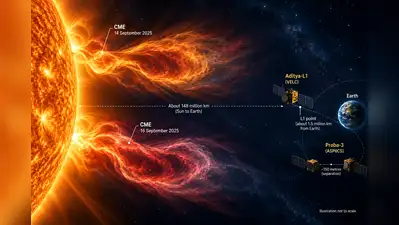
Artist’s impression of the coronal mass ejections of Sept 14 & 16, 2025, jointly observed by the VELC coronagraph on India’s Aditya-L1 at the Sun-Earth L1 point and ASPIICS coronagraph on ESA’s Proba-3, which orbits Earth
Bengaluru: In a first, scientists have jointly analysed observations of the same solar eruptions captured by India’s Aditya-L1 mission and European Space Agency’s (ESA) Proba-3, offering fresh insights into how these powerful events evolve close to Sun.
Proba-3’s ASPIICS captures images of the corona using visible light and a green emission line. Between July and Dec 2025, however, only two CMEs, those of Sept 14 and 16, were recorded simultaneously by both. The researchers found that Sept 14 CME travelled at about 645 km per second, while the Sept 16 eruption moved at a much slower 145 km per second. In Sept 14 CME, thermal energy accounted for about 1% of the total energy. In the Sept 16 event, thermal energy increased until it was comparable to kinetic energy. Aditya-L1, India’s first dedicated solar mission, was launched on Sept 2, 2023, and entered a halo orbit around the Sun-Earth L1 point on Jan 6, 2024. Proba-3, launched on Dec 5, 2024, uses two spacecraft flying about 150 metres apart to create an artificial solar eclipse, enabling detailed observations of the corona. Incidentally, Proba-3 was also launched by an Indian rocket — PSLV-XL.
You Can Also Check: Gold Rate in Bengaluru | Silver Rate in Bengaluru | Bank Holidays in Bengaluru | Public Holidays in Bengaluru | Bengaluru AQI | Weather in Bengaluru | Petrol Price in Bengaluru | Diesel Price in Bengaluru | CNG Price in Bengaluru | LPG Price in Bengaluru Stay updated with the latest Bengaluru news.
Researchers at Indian Institute of Astrophysics (IIA), Bengaluru, combined observations from Visible Emission Line Coronagraph (VELC) aboard Aditya-L1 and “ASPIICS coronagraph” aboard Proba-3 to study two coronal mass ejections (CMEs) recorded on Sept 14 and 16, 2025. “The study, published in Astronomy & Astrophysics, measured the eruptions’ mass, density and energy, providing new constraints on the physical processes that shape them in the Sun’s inner corona,” Isro said. “Importantly, estimates of mass and thermal energy obtained independently from the two instruments showed good agreement, strengthening confidence in the measurements,” as per Isro.
CMEs are large eruptions in which Sun ejects vast quantities of magnetised plasma into space. When directed towards Earth, they can disturb its space environment and affect satellites and other space-based systems. Understanding their early evolution is crucial to improving our knowledge of these events and their potential consequences. Observing CMEs close to Sun has remained challenging. The two missions offer complementary capabilities. Aditya-L1’s VELC uses spectroscopy to study the solar corona, including the temperature and density of its gas. Combining these observations allows scientists to cross-check estimates of CME properties using different methods. As per Isro, the two instruments share a common field of view in low corona. In each case, VELC caught the eruption at an early stage, showing how the two instruments complement each other. The density of the slower CME declined more sharply with height, indicating stronger early expansion. The study also found differences in how the eruptions distributed their energy. The estimated magnetic energy was comparable to or greater than kinetic energy. The findings highlight the scientific value of coordinated observations in understanding solar eruptions and their evolution. Download the TOI App.
Earlier space-based coronagraphs could not fully track the early evolution of faint eruptions, leaving scientists with limited information on how their energy is divided between motion, heat and magnetic fields.