
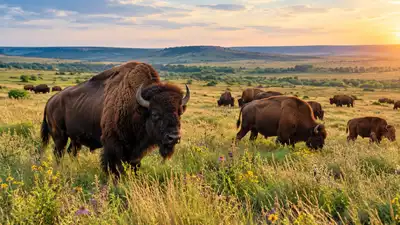
In 1993, Oklahoma ranchers Kenneth and Dianna Adams donated 300 American bison to The Nature Conservancy, setting in motion a conservation effort to restore one of North America’s most threatened ecosystems. Spanning 39,650 acres, the preserve protects a rare stretch of native grassland where bison grazing and carefully managed fires help maintain the natural balance of the prairie. Because less than 4% of the original tallgrass prairie remains, their return is particularly significant.
More than three decades later, the herd has grown to thousands of animals roaming the Joseph H. Williams Tallgrass Prairie Preserve near Pawhuska, Oklahoma. The animals influence the growth of native plants, create habitats for other species and help preserve the ecological processes that shaped the Great Plains for thousands of years.
The Nature Conservancy has reported around 2,700 bison during summer, including calves born that year, with numbers falling after the annual autumn roundup. The preserve covers approximately 39,650 acres and is recognised as the largest protected remnant of tallgrass prairie in the world. A study published in Proceedings of the National Academy of Sciences in August 2022 examined nearly three decades of vegetation data from areas grazed by bison, areas grazed by cattle and areas without large grazers.
The conservation effort also demonstrates how restoring a native species can contribute to the protection of an entire landscape. The preserve supports hundreds of plant and animal species, making the long-term management of its grasslands important for biodiversity. The herd has since expanded considerably. The animals are managed as part of the preserve’s conservation programme, which combines wildlife management with efforts to maintain the grassland’s natural character. Its landscape includes rolling grasslands, native wildflowers, scattered trees and waterways, offering a glimpse of an ecosystem that once covered vast areas of central North America. Bison play a central role in shaping the prairie through their feeding habits and movement. They primarily graze on grasses, influencing which plants dominate the landscape and creating opportunities for other vegetation to grow. This helps maintain a varied grassland rather than allowing a limited number of plant species to dominate every area. Bison grazing is combined with prescribed burning, another important tool in tallgrass prairie management. Without periodic disturbance, woody plants can spread into open grasslands, gradually changing the landscape and reducing the habitat available to species adapted to prairie conditions. The ecological importance of bison is also supported by long-term research at the Konza Prairie Biological Station in Kansas.