
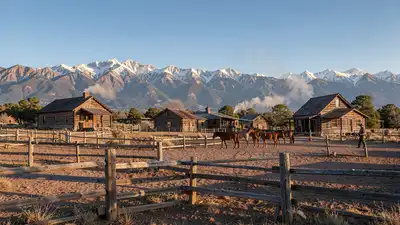
Representative Image of a historic American West ranch featuring cowboy culture and rustic log cabins ( AI Generrated Image)
In 2003, the National Park Service and the National Trust for Historic Preservation entered into an agreement to rehabilitate the historic ranch for use as a regional training centre. Preservation work began in 2005 and included repairs to foundations, roofs, windows and doors, the replacement of deteriorated logs, and improvements to ageing utility systems. The National Park Service announced the rehabilitation’s completion in December 2016, following 11 years of preservation work. The NPS and the National Trust jointly funded the rehabilitation, which cost approximately $3 million. The White Grass Heritage Project was established in 2014 to collect oral histories, documents and photographs about life at the ranch, according to the National Park Service. Former guests and wranglers have been invited to contribute their memories, preserving accounts of a business that operated for decades before closing in 1985.
White Grass became the home and primary training centre of the National Park Service’s Western Center for Historic Preservation, according to the NPS announcement. White Grass Ranch later acquired a new role in conservation. The site’s historic buildings now support training in techniques used to preserve traditional structures, including log buildings. The completed project adapted the surviving ranch buildings for a new use while retaining their historic character. Sleeping cabins provide accommodation for trainees, while the Main, Hammond and Bath House cabins serve as shared spaces for meals, teaching and practical work. White Grass Ranch’s history reflects two different periods in Jackson Hole’s development. It began with homestead claims and agricultural work, grew into a dude ranch that welcomed visitors seeking a taste of Western life, and eventually became a site for teaching historic preservation. Its buildings remain part of the landscape, but their purpose has changed from accommodating holiday guests to helping protect historic structures elsewhere.
Harold Hammond filed a 160-acre homestead claim in 1913, according to the National Park Service (NPS). His partner, George Tucker Bispham, later developed an adjoining claim, and the two properties eventually formed a 320-acre ranch. By around 1919, White Grass was accommodating paying guests, initially in three log houses. In 1956, Frank Galey and his wife, Inge, sold the ranch to the NPS while reserving a lifetime estate that allowed the family to continue using the property for residential and guest-ranch purposes. After the ranch’s guest operation ended in 1985, its historic buildings were eventually rehabilitated for a different purpose: training people to preserve historic structures. In 1913, Hammond filed a claim for 160 acres in the Teton National Forest area. Bispham started improving adjoining land in 1915 and later established his own homestead there. Their separate claims received patents in 1920 and 1923, respectively, according to the NPS’s White Grass Ranch cultural landscape history. By around 1919, they were accommodating guests in three log houses. Between 1923 and 1928, Hammond and Bispham transferred their claims to Bar BC Ranches, Inc., a partnership that included the two men as well as Struthers Burt, Horace Carncross, Irving Corse and Sinclair Armstrong. Hammond died in 1939, after which his stepson, Frank Galey, took over management of White Grass Ranch, according to the National Park Service. Galey returned in 1946 and operated White Grass until his death in July 1985. Frank and Inge Galey sold White Grass Ranch to the agency in 1956 while reserving a lifetime estate agreement permitting continued family use of the property for residential and guest-ranch purposes, according to the National Park Service. The ranch continued operating as a dude ranch until 1985, when Galey’s death brought the operation to an end and the lifetime estate expired.
Young men, including visitors from eastern universities, spent parts of the summer learning traditional ranch skills and elements of self-reliance, according to the NPS. Long before Grand Teton National Park became a major destination for visitors, White Grass Ranch in Wyoming’s Jackson Hole valley was part of a growing industry built around the American West’s landscapes and ranching traditions. Activities associated with the ranch included horseback riding, swimming and fishing, while its library and card room offered indoor recreation. White Grass began as a homestead rather than a purpose-built tourist facility. A log structure was built on the property that year, although the length of time Hammond lived in the Main Cabin is unclear. The partners developed the property gradually. White Grass subsequently became the third dude ranch established in what is now Grand Teton National Park. The ranch’s early development illustrates how homesteads in Jackson Hole could evolve from agricultural properties into businesses catering to visitors seeking recreation and an experience of Western ranch life. White Grass underwent a major change in ownership and use during the 1920s. Burt and Carncross were founders of the Bar BC Ranch, linking White Grass’s ownership history to the wider dude-ranch industry in Jackson Hole. During this period, White Grass became known as the White Grass Ranch for Boys. Thirteen cabins were added to the three already in existence, and a concrete swimming pool was built in a hayfield. The business was interrupted by the Second World War, when the ranch nearly shut down. The NPS describes it as the longest-lived active dude ranch in Jackson Hole. The arrangement meant that the federal government acquired the ranch while the family retained the right to use it during the lifetime-estate period.