
The government took a passive equity stake of about 433.3 million Intel shares in August 2025, and did not seek board representation. Tan said the backing would help Intel make the long-term investments required to establish a competitive contract manufacturing business. But it reported a net loss of $16.6 billion in the third quarter of 2024, thanks to restructuring costs. He has also reshaped the company’s senior management and identified advanced chip packaging and application-specific integrated circuits (ASICs) as potential growth areas. Intel has received additional financial backing from Japan’s SoftBank Group and rival chipmaker Nvidia, each investing about $7 billion in the company. Tan welcomed the investments but noted that the companies could also benefit financially from their stakes.
In an interview with Nikkei Asia, the CEO said the Trump administration had no policy of interfering in Intel’s decisions despite holding an equity stake in the company. They don’t have any influence on the governance of the company,” Tan said, stressing that Intel was “independent”. The US government took an initial 9.9% stake in 2025 when it converted previously allocated federal funding into an $8.9 billion investment, diluting its stake to around 8.2%. Tan said government support was important for long-term investment in advanced chip manufacturing, while adding that Intel was free to make decisions in its own interests. The investment was part of a Trump administration push to increase domestic semiconductor manufacturing. He pointed to TSMC’s development as an example of how long it takes to build a leading foundry operation. “From a foundry’s point of view, Intel had to look at the longer-term horizon, and it’s always very important to have very strong government involvement supporting,” he said. Tan added that the foundry business could become a growth driver “if we do it right,” but “it takes time.” Intel has been attempting to regain ground in advanced semiconductor manufacturing after losing market share to TSMC and falling behind competitors such as Nvidia in AI chips. Under former CEO Pat Gelsinger, Intel invested billions to expand its foundry business. Gelsinger resigned in December 2024, and Tan became CEO in March 2025. Tan said Intel was “80% done” with its restructuring efforts. He said they could “make a lot of money” and potentially earn “five to six times the return.” Intel shares have surged since Tan took the helm as CEO amid revived investor interest in the company’s turnaround efforts.
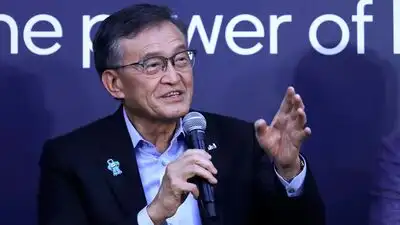
Intel CEO Lip-Bu Tan has defended the company’s independence from the US government. Tan clarified that the US government’s multibillion-dollar investment in the chipmaker does not give Washington influence over its business strategy or corporate governance. “They don’t have any policy. The investment came as part of Intel’s push to rebuild its semiconductor manufacturing business and challenge Taiwan’s TSMC.
Intel CEO comments on China’s chip industry
Tan also discussed competition from China’s semiconductor industry, which has been developing domestic chipmaking capabilities amid US restrictions on advanced technology exports. He said companies in different countries have their own strengths and weaknesses, adding that the focus should remain on what benefits consumers and businesses while accounting for “geopolitical restrictions.” Asked whether China could catch up with US chip capabilities within five to 10 years, Tan said: “Today, I think it’s not that far behind.” You use AI every day. Now get your AI Quotient. Take the AIQ test.