
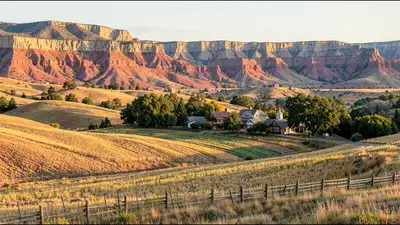
Representative Image of Cant Ranch in Oregon’s John Day River Valley, showcasing its scenic agricultural landscape ( AI Generrated Image)
The Cants acquired land in the John Day River Valley in 1910. The NPS’s Cant Ranch history describes a purchase of approximately 700 acres from the Officer family. Another NPS account identifies the property as the 677-acre Officer Ranch, purchased for $6,900 together with water rights, a band of 1,200 sheep and some cattle. The larger house, completed around 1917–1918 according to NPS accounts, became an important part of the ranch’s role in local life. Stella Pigg, identified by the NPS as the area’s first schoolteacher, boarded with the family, and the house’s upper floor was used for classes before a separate school was built in 1919.
The household therefore connected agricultural activity with the gradual development of transport and infrastructure in the valley. Before establishing their own ranch, the couple worked for Alexander Murray, another Scottish rancher. Elizabeth’s work as a cook formed part of the household labour that supported their early years in the region. The NPS biography of Elizabeth Cant describes James as having purchased land known as the Officer Homestead with a business partner, so the agency’s accounts differ in how they describe the transaction and the involvement of a partner. The property developed into a mixed agricultural operation, with livestock, cultivated crops and household food production supporting the family’s livelihood. The ranch later expanded considerably beyond the original acreage. Its growth depended not only on land ownership but also on the work required to maintain livestock, manage fields and keep a large household running in a remote setting. The Cants’ house was shaped by the needs of a growing family and a sparsely settled valley. By the late 1910s, the household was accommodating their children alongside people who needed lodging while travelling or working in the area. Education was one of its functions. The arrangement illustrates how residents in isolated rural areas sometimes relied on private buildings to meet community needs before dedicated facilities became available. The ranch also provided a base for workers involved in local development. During highway construction, the Cants accommodated workers and employed some for irrigation work. Social gatherings were another part of the home’s role. Members of the area’s Scottish community met there for meals, music and dancing. The NPS records accounts of late-night suppers that brought together sizeable groups of guests. These gatherings offered opportunities for social contact in a region where distance between settlements made regular visits difficult. Elizabeth’s contribution to the household extended into this wider community role, although the ranch’s operation also depended on the work of family members, employees and agricultural workers.
Elizabeth Cant, born Elizabeth Grant in Scotland in 1885, joined James Cant in Oregon in 1907. James died in 1972 and Elizabeth in 1973. The family sold the ranch to the National Park Service (NPS) in 1975. After travelling to the United States in 1907 to join James Cant, she married him in October 1908. James Cant died in 1972, followed by Elizabeth on 15 May 1973. The NPS biography of Elizabeth Cant records that the family sold the ranch to the agency in 1975. Separately, the NPS account Impact of Time states that the agency purchased the house and 878 acres.The monument itself was authorised on 26 October 1974 and formally established on 8 October 1975. A separate NPS collections statement records that the agency acquired portions of the ranch in 1976.
In central Oregon’s remote John Day River Valley, the history of Cant Ranch connects Scottish migration, agricultural enterprise and the development of a national monument. Together, they established a ranch that grew from an initial land purchase into a substantial livestock operation. Their home also served practical needs beyond family life, accommodating people travelling through the valley and providing space for education and community gatherings. The ranch house serves as the monument’s headquarters throughout the year, while its museum operates on a more limited seasonal schedule. Elizabeth Grant grew up in Moray, Scotland, in a family dependent on small-scale farming. Her early experience of agricultural work provided a foundation for the responsibilities she later took on in Oregon. During the first half of the 20th century, Cant Ranch grew into a large agricultural enterprise. Its land supported livestock and cultivated fields, while orchards and trees around the house helped shape the domestic landscape. The ranch’s scale also meant that its operation extended beyond the work of James and Elizabeth to include employees and, increasingly, members of the next generation of the family. The business changed as market conditions shifted. The Cants moved away from sheep farming towards cattle during the 1940s, adapting their operation to changing economic circumstances. Cattle raising remained central to the ranch’s activity in the following decades, with adult children and their spouses helping sustain the business. The ranch’s history thus reflects both continuity and change. The family retained its agricultural base while adjusting the type of livestock it raised, and the house continued to accommodate family life and social activity. The property’s eventual transition to public ownership preserved a record of this rural economy as well as the buildings in which the family lived and worked. These dates refer to distinct steps in the monument’s creation and the acquisition of property, rather than necessarily describing one transaction. The ranch house subsequently became part of the monument’s administrative and visitor facilities. The Historic Cant Ranch Home and Museum interprets the family’s history and the region’s ranching past. The house serves as the monument’s headquarters, although museum access is seasonal and subject to staffing. It is separate from the Thomas Condon Paleontology Center, which houses fossil exhibits, research facilities and museum collections. You use AI every day. Now get your AI Quotient. Take the AIQ test.
Today, the property forms part of John Day Fossil Beds National Monument.