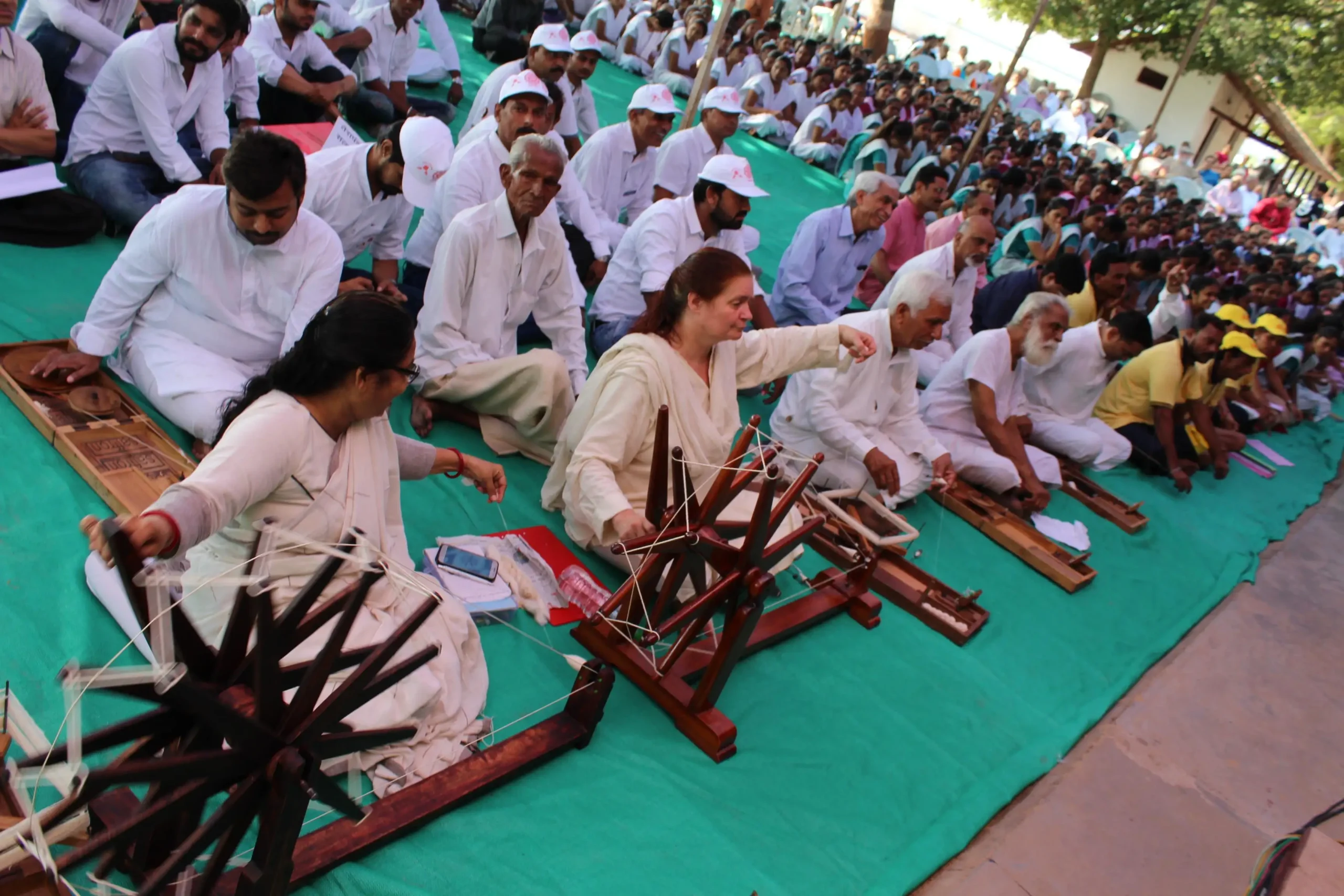
Miriam Haenen spinning on a bamboo charkha during her exploration of Gandhi’s spinning wheel
Ahmedabad: Dutch educator Miriam Haenen came to Ahmedabad in 2015 carrying an 18-year-old dream: to study Gandhian thought and finally spin Gandhi’s charkha. Now 69 and originally from Elsloo in the southern Netherlands, Haenen first came to India in 1997 to mentor Waldorf schools. She visited India 13 times between 1997 and 2008, before beginning longer stays while continuing to travel between India and Europe. Haenen had spun wool on a European wheel since her twenties and became interested in Gandhi around 30. Miriam Haenen and Lata Parmar join a community spinning programme with charkhas on Gandhi Jayanti at Sabarmati Ashram After 2015, Haenen returned to Ahmedabad many times, staying at least four weeks on each visit. A personal turn came after brain-tumour surgery in Maastricht in Sept 2020.
However, the two-year master’s programme she had enrolled in at Gujarat Vidyapith could not proceed as planned due to certain administrative circumstances, she said. You Can Also Check: Gold Rate in Ahmedabad | Silver Rate in Ahmedabad | Bank Holidays in Ahmedabad | Public Holidays in Ahmedabad | Ahmedabad AQI | Weather in Ahmedabad | Petrol Price in Ahmedabad | Diesel Price in Ahmedabad | CNG Price in Ahmedabad | LPG Price in Ahmedabad Stay updated with the latest Ahmedabad news.
“A formal written agreement allowed me to use the premises, library and archives for two years,” Haenen said. That opportunity developed into an 11-year independent inquiry, recorded in her new book, “The Thread of Life: The Mysterious Science of Charkha Spinning”. Her purpose, she said, was to help Waldorf education take root in Indian culture rather than become “a new colonial education”. “His life, and his search for truth and non-violence, interested me very much,” she said. “I knew that I should not touch the charkha before my soul had taken every gesture in,” she said. “There have been no grants or fellowships,” she said. Paediatrician Michaela Glockler calls it an “artistic-practical and meditative” journey, while Gandhian scholar Sudarshan Iyengar describes it as Haenen’s “experiential and spiritual journey”. Haenen resumed spinning the next day and recorded her recovery experience, describing it as personal learning, “not medical proof”.
The degree never began, but another journey did. At Sabarmati Ashram, she first sat silently at the prayer ground and closely observed spinners Lata Parmer, Pratima Vora and Zankhana Joshi near Hriday Kunj. “I was caught by its magic. My soul took that in for a few days, and then I started spinning. Former Ashram director Amrutbhai later helped her access housing, the library and archives. Her central proposition concerns the charkha’s contrasting movements: one hand turns the wheel while the other draws loose fibre into thread. Drawing on neuroscience references about two-handed coordination and communication between the brain’s hemispheres, she believes the action may support concentration, inner discipline and holistic development. The charkha’s specific neurological effects, however, have not been tested in a controlled study. The book’s forewords underline its experiential character. For Haenen, neuroscience may help examine Gandhi’s insights into the charkha afresh, linking inner development with non-violence and social justice. Download the TOI App.