Thermal Power Plant
Gujarat’s Electricity Demand Projected to Exceed 250 Billion Units by 2035-36
Ahmedabad: Gujarat’s electricity consumption has increased by approximately 64% over the last decade. This growth is largely attributed to rapid industrial expansion in the state. As a result, state planners are preparing for electricity demand to surpass 250 billion units (BU) annually by the fiscal year 2035-36. The surge in demand is driven by sectors such as manufacturing, data centers, and the digital economy, which are expected to play crucial roles in the next phase of growth.
You Can Also Check: Gold Rate in Ahmedabad | Silver Rate in Ahmedabad | Bank Holidays in Ahmedabad | Public Holidays in Ahmedabad | Ahmedabad AQI | Weather in Ahmedabad | Petrol Price in Ahmedabad | Diesel Price in Ahmedabad | CNG Price in Ahmedabad | LPG Price in Ahmedabad Stay updated with the latest Ahmedabad news. Download the TOI App.
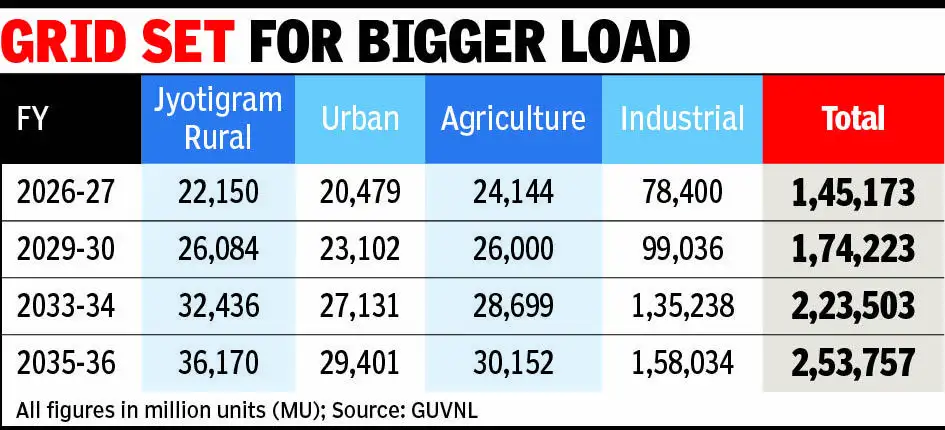
Electricity consumption increased from 83,133 million units (MUs) in 2016-17 to 1,36,722 MUs in 2025-26, according to data from Gujarat Urja Vikas Nigam Ltd (GUVNL). Industrial electricity consumption more than doubled during the period, rising from 35,097 MUs in 2016-17 to 72,526 MUs in 2025-26. The state expects electricity demand to accelerate further over the next 10 years. Official projections estimate total requirement to rise from 1,45,173 MUs in 2026-27 to 2,53,757 MUs by 2035-36, taking Gujarat beyond 250 BU of annual consumption. Our demand is projected to cross 250 BU by 2035-36 and the grid, substations and distribution backbone are being built to stay ahead of that,” a senior state power department official said. To meet the anticipated demand, Gujarat has planned transmission investments of nearly Rs 1 lakh crore by 2032 to strengthen evacuation capacity, improve redundancy and ensure reliable power supply to emerging industrial hubs.
Urban consumption rose due to expanding city limits, residential development and commercial activity.
Officials said the growth was broad-based across industrial, urban and rural consumers, though industry has emerged as the largest contributor. The state is also pursuing a “wire-free city” initiative targeted for completion by 2030, under which overhead power lines in urban areas will be shifted underground to improve safety, minimise weather-related outages and enhance supply reliability. “The key for data centres is not just megawatts, but quality and continuity—dual feeds, fast restoration and predictable power costs—and Gujarat’s grid strengthening and city-side upgrades are moving in that direction,” said Nirav Shah, former president of GESIA IT Association. Industry representatives said reliable electricity infrastructure has become a key factor in investment decisions. The state’s planned capital expenditure gives industry confidence to commit fresh investments,” a representative of a large industrial group operating in Gujarat said.
The sharp increase reflects Gujarat’s expanding manufacturing base, new industrial parks and continued private investment across sectors. Rural demand under the Jyoti Gram scheme also registered steady growth, indicating greater electricity access and higher usage in villages. Agricultural consumption fluctuated depending on rainfall and irrigation requirements but showed a gradual upward trend. Apart from manufacturing, officials believe a new category of large power consumers—data centres and digital infrastructure—will significantly reshape Gujarat’s demand profile. The growing use of artificial intelligence, cloud computing, enterprise data storage and digital public infrastructure is expected to create continuous, high-load electricity demand requiring uninterrupted power supply and high-quality grid infrastructure. “We are planning the system for the load curve of the next decade, not the last one. Distribution companies were simultaneously upgrading networks to reduce technical losses, improve feeder performance and ensure stable voltage for industries and digital infrastructure. “As we expand production and electrify more processes, reliable supply and a stronger transmission backbone become direct enablers of competitiveness.