
Student-designed technology prototypes address shortcomings in road diversion updates, public transport links, and Metro station accessibility
Organised by Google Developer Groups (GDG) Gandhinagar and GDG Cloud Gandhinagar, Metro Hacks brought together more than 200 innovators, professionals and students for a 120-minute challenge.
“They can use these insights to align bus and Metro schedules, adjust service frequencies and reduce waiting times at transfer points, making multimodal journeys convenient for commuters,” Pandey said. The second uses AI agents to track upcoming events in Ahmedabad and Gandhinagar from online platforms, map their locations, and factor in whether they fall on a weekday or weekend and which Metro station they are near,” Mamtora said. “The dashboard can flag urgent complaints, such as a medical emergency, a faulty lift or a security threat, and route them to the team concerned,” Goswami said.
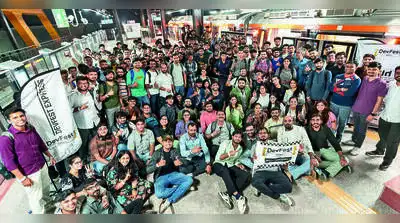
Ahmedabad: Festive-season travel is compounding commuters’ difficulties, with roadworks and infrastructure upgrades disrupting traffic on major arterial roads across the city. As drivers contend with excavated sections and shifting traffic patterns, student-designed technology prototypes address shortcomings in road diversion updates, public transport links, and Metro station accessibility. Students developed these innovations during Metro Hacks, a hackathon hosted aboard a moving Gujarat Metro train. Rohan Pandey, a startup founder and BTech CSE student, developed a prototype that brings AMTS, BRTS and Metro data onto one platform, helping officials monitor ridership patterns, identify unusual changes in passenger numbers and flag operational exceptions. Another participant, Jatin Mamtora, has developed two separate systems: one focused on operations and maintenance of Metro assets, and the other on anticipating passenger demand to help manage service frequency and operational readiness around major events. “The first system uses machine learning to analyse metro asset data and flag equipment that may require maintenance. This can help operators identify potential faults in lifts, ticketing equipment and train components before they disrupt services. At Ahmedabad and Gandhinagar Metro stations, complaints span safety, cleanliness, faulty lifts and other passenger concerns. Without a dedicated system to consolidate grievances from the app, social media, email and paper forms, manual sorting can delay action in urgent matters. BTech student Rutvika Goswami’s prototype uses a dashboard to categorise complaints, flag those requiring immediate attention and route them to the relevant department. The tool works offline and uploads complaint records to the central dashboard when connectivity returns, helping staff track unresolved complaints, prioritise urgent cases, and spot recurring issues. Other prototypes target construction-related traffic diversions, integrating Metro, BRTS and AMTS journeys through a common planner with fare estimates and transfer walking times, and easing congestion at Metro exits. They include tools to generate diversion maps, multilingual and WhatsApp-ready advisories, identify affected bus routes, propose fare-sharing between operators, and use photographs to log obstructions such as auto-rickshaw clusters, illegal parking and encroachments.
You Can Also Check: Gold Rate in Ahmedabad | Silver Rate in Ahmedabad | Bank Holidays in Ahmedabad | Public Holidays in Ahmedabad | Ahmedabad AQI | Weather in Ahmedabad | Petrol Price in Ahmedabad | Diesel Price in Ahmedabad | CNG Price in Ahmedabad | LPG Price in Ahmedabad Stay updated with the latest Ahmedabad news. Download the TOI App.