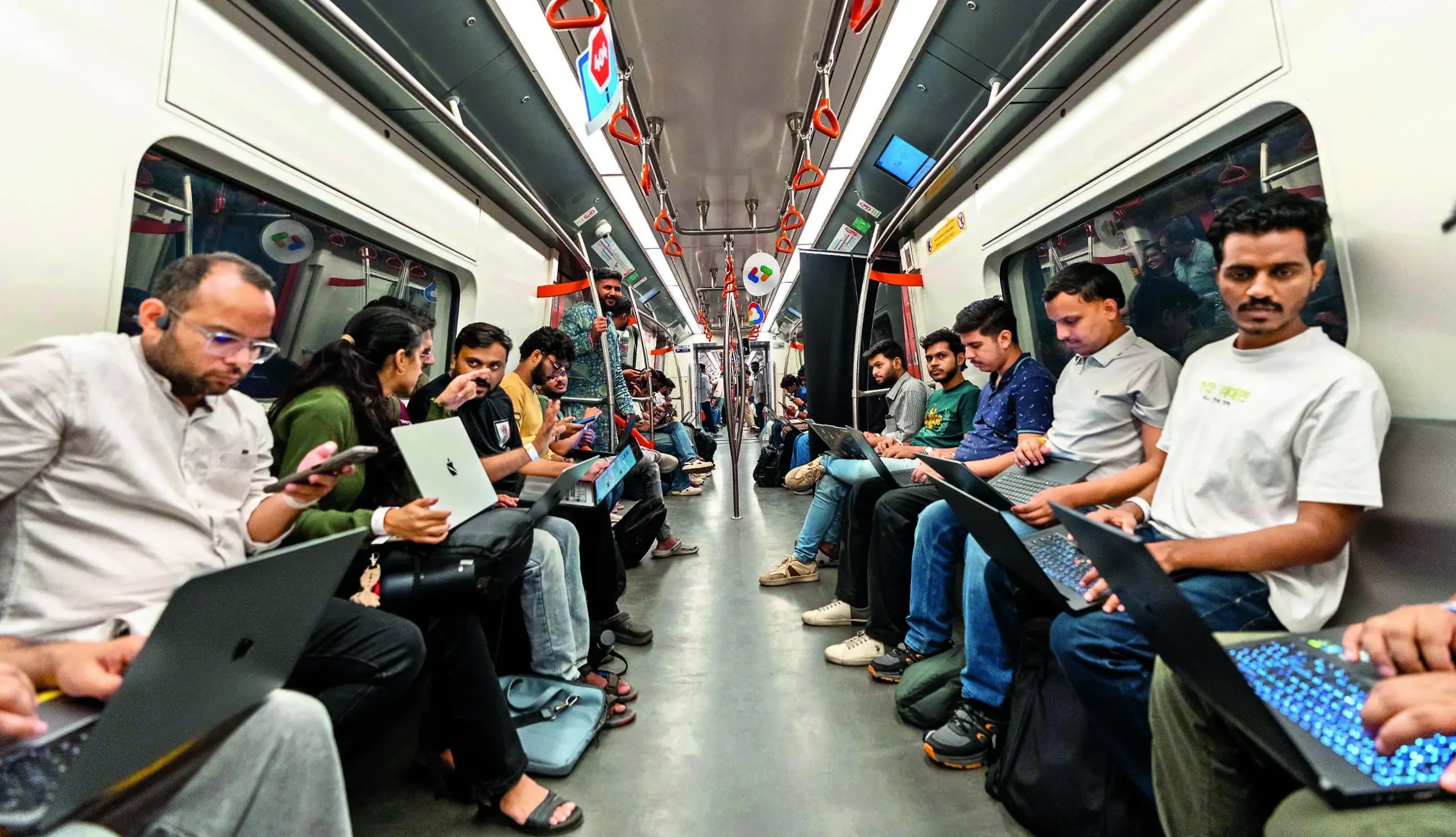
The police collaborations are part of a Rs 12-crore initiative, Project Spandan, which is drawing university students into assignments traditionally handled within the force. The Metro hackathon is a separate exercise, but the approach is similar: get young people to work on problems officials face every day
The police collaborations are part of a Rs 12-crore initiative, Project Spandan, which is drawing university students into assignments traditionally handled within the force. He now works with a 28-member Gen Z team that has developed ADR-SHIELD, a set of police portals and databases.
“They help us a lot in policing, and the best part is that they call a spade a spade,” Jat said. Known for wit, candour and authenticity, Gen Z has lately been making headlines for protests and confrontations with authority. Less visible is the work some young innovators are doing alongside police and govt officials. In Gujarat, they are building AI tools for criminal investigations, helping manage security at religious processions, studying how disputes are settled in tribal villages and developing real-time reporting tools for commuters on a moving Metro train. The Metro hackathon is a separate exercise, but the approach is similar: get young people to work on problems officials face every day. Young hands in everyday policing Ahmedabad Rural SP Om Prakash Jat has been taking help from young volunteers for two years. One records migrant workers arriving in industrial areas such as Sanand and Dholera and is meant to help police check criminal backgrounds. Other modules handle crime reports, personnel details, dossiers and election arrangements. During elections, the young volunteers compile records of polling booths, officers on duty and presiding officers’ contact details. They also assist in route mapping and police deployment for VIP visits. He is also leading an AI-assisted investigation tool with researchers from BITS Pilani. Built using a decade of FIRs, chargesheets and Supreme Court judgements, the proposed copilot aims to point investigating officers to legal provisions and alert them to procedural errors before cases go to court.
DCP, Zone 3, Rupal Solanki brought in 149 of them to help with security after an elephant went on a rampage during the 2025 procession. Hacking on a moving Metro At Metro Hacks, organised by Google Developer Group Gandhinagar and GDG Cloud Gandhinagar, more than 200 developers boarded a train between Mahatma Mandir and APMC. Gujarat Metro Rail Corporation officials had given them 13 operational problems, from equipment failures to crowd management. During the Metro ride, participants developed solutions allowing commuters to report faulty escalators and ticket gates by uploading photographs, with the complaints feeding directly into the control room’s morning briefing. ” Jatin Mamtora, 22, a software developer who has taken part in SSIP and iHub hackathons, built an AI agent and a machine-learning solution to anticipate stadium crowds and maintenance needs. “As a student and startup founder, working alongside more than 200 developers was a fascinating experience. Organiser Viral Parmar said that around 60% of participants were students. It drew more than 6,300 participants from 17 states and had a prize pool of Rs 51 lakh. More than 1,000 submissions addressed suspicious-activity detection, automatic number plate recognition, cross-camera vehicle tracking and watchlist matching. The research was initiated by Suman Nala, SP (technical services), who had earlier helped bring back 29 families exiled under community social codes.
You Can Also Check: Gold Rate in Ahmedabad | Silver Rate in Ahmedabad | Bank Holidays in Ahmedabad | Public Holidays in Ahmedabad | Ahmedabad AQI | Weather in Ahmedabad | Petrol Price in Ahmedabad | Diesel Price in Ahmedabad | CNG Price in Ahmedabad | LPG Price in Ahmedabad Stay updated with the latest Ahmedabad news.
“Our team, comprising young researchers, tackled major technical challenges including translating Gujarati text to English and converting scanned legacy FIRs into structured data,” said Dr Pratik Narang, associate professor at BITS Pilani. They also proposed a “Chowk Pe Charcha” event at Kavi Dalpatram Chowk. Young volunteers hacked real-world problems on a moving Metro recently Drijesh Patel, organiser, GDG Cloud Gandhinagar, said: “Gen Z loves solving public issues. “Being part of a hackathon inside a moving Metro train was a once-in-a-lifetime experience,” he said. But it was great fun,” Pandey said. Through the use of new technology, another system will also help categorise legacy data and utilise it for generating insights for investigators,” Korukonda said. Prof S O Junare, vice-chancellor in charge of NFSU, said the collaboration would help investigators keep pace with the evolving tools and techniques used by criminals. “It also offers a unique learning opportunity to our students,” he said. A senior police officer said participants also worked on plotting models on maps, connecting departmental systems and calculating hardware and software costs, areas not fully covered in standard courses. “They are passionate and want to learn,” he said. Among them is “chadotaru”, under which the last rites of a deceased person can be held up until a dispute is resolved. Dr Ruchi Sinha, a TISS associate professor leading the study, said, “Over the past six months, we have documented multiple aspects of different tribes. They use newer coding languages and work at an advanced level, which benefits the force greatly,” Nala said.
A major job has been turning scanned police documents into usable data. The dashboard is being designed to process records on local systems, rather than send sensitive FIRs and chargesheets to public AI platforms. Suggestions will be available in Gujarati. In Ahmedabad, young volunteers had a different assignment during the 149th Rath Yatra, held in July. The volunteers kept watch on loudspeaker noise near the elephants and shared live updates through a WhatsApp group. They had until the end of the two-hour ride to put together prototypes. Transport and last-mile connectivity are everyday problems for students and young professionals. Mamtora wants similar reporting and tracking systems for municipal services, particularly garbage collection. He also sees scope for apps that explain govt welfare schemes to people who may not know they qualify. Gandhinagar University student and startup founder Rohan Pandey has worked on a system combining Metro, BRTS and AMTS data for operational briefings. It was my first two-hour hackathon, and doing it on a moving Metro train added to the pressure. From narcotics kits to CCTV feeds At the Gujarat Anti-Terrorist Squad (ATS), young chemical researchers working with IIT Gandhinagar are developing low-cost, on-site narcotics-testing kits. Scholars from National Forensic Sciences University (NFSU) are working with ATS SP Siddharth Korukonda on AI tools for dark-web and deep-web surveillance, cryptocurrency transaction tracking and real-time alerts. “The aim is to develop an AI-driven system for dark-web and deep-web surveillance, cryptocurrency transactions and real-time alerts about illicit activities. At Trinetra Central Command in Gandhinagar, Gujarat Police and partners, including startup incubator iHub, held Sentinel, billed as India’s largest CCTV integration hackathon. The competition was nearing its final phase at the time of reporting. Project Spandan has four tracks: university-led research into AI, machine learning, facial recognition, big-data analytics, GIS crime mapping, cybercrime and cryptocurrency forensics; student internships developing police apps and dashboards; training for police personnel in cybersecurity, law, behavioural analysis and digital evidence preservation; and advanced courses for selected officers at premier institutions covering critical infrastructure protection and forensic science. Understanding tribal customs But not all the assignments involve technology. In Danta taluka of Banaskantha, three researchers from Tata Institute of Social Sciences (TISS), Mumbai, have spent six months documenting tribal customs and dispute-settlement practices. “The study also gives a unique perspective to young scholars on the social dynamics of the region. She wants the findings to help officers newly posted to the region. Nala has also been engaging interns from colleges and universities to assist police with IT and technical assignments. “Gen Z members are receptive to different ideas. The success of these collaborations will be measured by how many solutions prove useful on the ground. Gujarat Police have opened their doors to young problem-solvers. What matters now is what difference their work makes. Download the TOI App.