
Geopolitics, national security, import substitution and supply-chain resilience are bringing greater strategic importance to businesses with tangible assets and domestic manufacturing capabilities
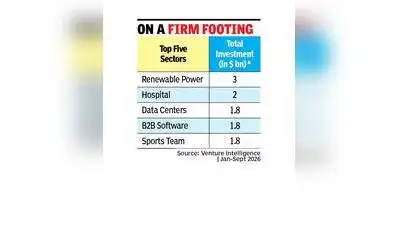
Data sourced by TOI from research firm Venture Intelligence shows that investments to the tune of $39 billion, comprising 1,434 deals, were recorded in CY2025. With 1,076 deals, it has already reached $32.7 bn during the nine-month period (Jan-Sept, 2026). It was primarily driven by record PE-VC investments in Sept 2026 at $6 billion. Large foreign investors have made several mega bets on infrastructure companies across sectors like renewable energy, telecom towers & data centers and toll roads; especially dominant has been the role of Canadian investors—like La Caisse (formerly CDPQ), CPP Investments and Brookfield—who have deployed over $3 billion in infrastructure companies in 2026,” he added. Aniket Dharamshi, co-founder and managing partner, ValueQuest Investment Advisors, said headline investment numbers in 2026 could exceed last year’s levels, particularly if large infrastructure transactions sustain the momentum seen in the third quarter.
Noting that the Indian economy has been able to withstand many external shocks, including an oil-price-impacting US-Iran war, he said the IPO market has also held up—despite volatility in the secondary markets. “While India offers global investors an opportunity to diversify across sectors and growth drivers, beyond the concentration of capital in a few global technology themes, whether this translates into a higher deployment on core PE-VC will depend on economic and earnings growth, valuation expectations and a more stable investment environment,” he said. Nidhi Killawala, partner at Khaitan & Co, said global private equity funds, sovereign wealth funds and other long-term institutional investors continue to show strong appetite for mature Indian businesses that have solid fundamentals, stable and predictable cash flows, and models capable of scaling. “What really sets 2026 apart is that India is still drawing significant private capital, but investors are being far more intentional about where that money goes, how it is safeguarded and how they eventually get it back,” she added.
The PE-VC investments do not include those related to the real estate sector. “One of the key highlights this year is PE investors doubling down on their infrastructure investments. Geopolitics, national security, import substitution and supply-chain resilience are bringing greater strategic importance to businesses with tangible assets and domestic manufacturing capabilities. “At the same time, the AI build-out is creating demand from data centre infrastructure to power. Together, these forces are influencing where private capital is being deployed,” he added. You Can Also Check: Gold Rate in Chennai | Silver Rate in Chennai | Bank Holidays in Chennai | Public Holidays in Chennai | Chennai AQI | Weather in Chennai | Petrol Price in Chennai | Diesel Price in Chennai | CNG Price in Chennai | LPG Price in Chennai
It is expected to exceed last year’s levels of $39 billion, signalling a consecutive YoY revival. After a plunge in PE-VC investments, which dropped to $48.9 billion in CY2022 from $64.4 billion in CY2021, it further decreased to $33.8 billion and $33.5 billion during CY2023 and CY2024, respectively.
“Based on the very strong Jul-Sept quarter investment figures, the PE-VC investment tally for 2026 can be expected to end the year at an amount similar to or higher than the previous year,” Arun Natarajan, founder of Venture Intelligence, said. Chennai: Despite geopolitical and global disruptions, India’s private equity and venture capital (PE-VC) continues to rise. International PE investors’ growing interest in Indian firms is putting greater focus on hard-asset businesses such as infrastructure and domestic manufacturing.