
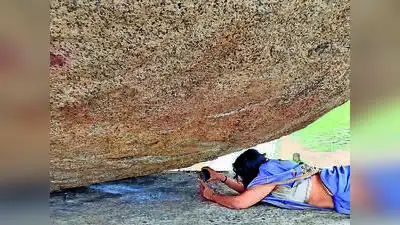
Vinita Sidhartha photographing a game board etched beneath Krishna’s Butterball in Mamallapuram
The gamer’s latest research, published last month in the CSMVS Journal, gives clues to the age of the game of ‘dahdi’ or ‘three nested Squares’, which she found etched at the entrance of the Saluvankuppam temple near Mamallapuram, unearthed by the 2004 tsunami. Their latest find, in Dec 2025, was the game of ‘navakankari’ (also a version of nine men’s morris) etched into the stone near the entrance gopuram of the Jalakanteshwara temple in Vellore. They have documented board games on the floors of more than 100 temples, mostly in Karnataka but also in Odisha, Maharashtra, Uttar Pradesh and Tamil Nadu. In forts, we find games at vantage points that have a 360-degree view.
Games such as these have also been found etched in church parapets in Spain,” says Vinita. Game graffiti is not found everywhere in a temple, says Dharmendra. Clearly, the guards who kept watch passed time with a game,” he says. “Nobody could have gone down there, where their hands can’t even reach, and carved games to play,” she says. “This told me the games were etched before the Butterball came to be there, which, according to legend, was perhaps before the 12th century.”
“Dahdi resembles ancient European games such as ‘nine men’s morris’. Vinita isn’t a one-of-a-kind game seeker. R G Singh and Dharmendra Raghu of Ramsons Kala Pratishtana, a not-for-profit cultural trust in Mysuru, have spent two decades tracking down forgotten games. “We usually find them on elevated platforms or in shaded spots where people could sit comfortably. At Salem Fort, Vinita found two boards carved into a small lookout shelter. Sometimes, though, the placements are puzzling. At the Erikatarama temple in Madurantakam, Vinita found a game etched on the compound wall. Her explanation is that a horizontal stone was reused during renovation. At the Jawaharlal Nehru campus in Delhi, she found a game behind the foliage and later came to know that the spot was originally a quarry. Under the Butterball, where she slid her phone with great difficulty, Vinita found ‘dahdi’, a game she has seen in other temples.
Because one board can accommodate several games, working out the rules of some of the games is a challenge, says Singh,.
“But for many everyday games, the rulebook exists in people’s heads, passed from one generation to another,” he says. The team draws on anthropologists’ records of traditional games, rules noted by British writers, texts such as ‘Krida Kausalya’ and ‘Manasollasa’, and recent academic research.