
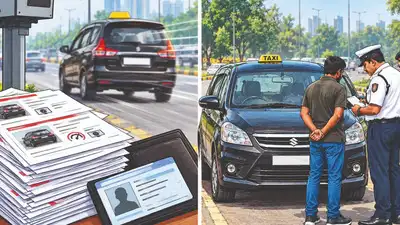
A Delhi cab driver received 208 traffic challans totaling over Rs 4.1 lakh in fines.
The 38-year-old cab owner-driver eventually found himself at the centre of a larger Delhi Traffic Police crackdown on habitualviolators, after West district traffic police analysed camera footage and identified motorists repeatedly flouting rules. In this case, the driver clocked his first challan on June 27, 2025, and his 208th on Sept 6, 2026. At least 10 licence-suspension proposals have been initiated by West district traffic police against habitual violators. The case with 208 challans topped the violation count, followed by two motorists with 134 challans (97 for speeding) and 107 challans (76 for speeding). The exercise by West district traffic police, held from Aug 1 for nearly two weeks, came in the backdrop of road crashes and aimed to identify motorists whose repeated violations show up across camera records, rather than treating each challan as an isolated offence. Notices under Section 133 of MV Act were then issued to the identified motorists. The 208-challan offender, however, was not easy to trace.
Because the mobile number linked to his driving licence was incorrect, police took about 20 days to locate him.
Sources said most of the speeding violations were recorded on Deen Dayal Upadhyaya Marg. Deputy commissioner of police (traffic) Ranbir Singh said the team eventually traced the man and his black Maruti Ertiga cab, bearing a Delhi registration number, to Jalpura village in Greater Noida last week. “Our counterparts in UP Police helped us locate him and his vehicle,” Singh said, adding that the cab owner himself was driving the vehicle when the violations were recorded in Delhi.
Police have now initiated proceedings to suspend his driving licence under Motor Vehicles Act. But he is not alone. Police analysed camera-generated violation data from across the district and prepared a list of habitual offenders. Following this, proposals were sent to the DTO or RTO office concerned for suspension of driving licences. The Delhi address mentioned on the vehicle’s registration certificate was also found to be non-existent.