Air quality index (AQI) is capped at 500 in India, but there is no upper limit for pollutants like PM2.5 and PM10.
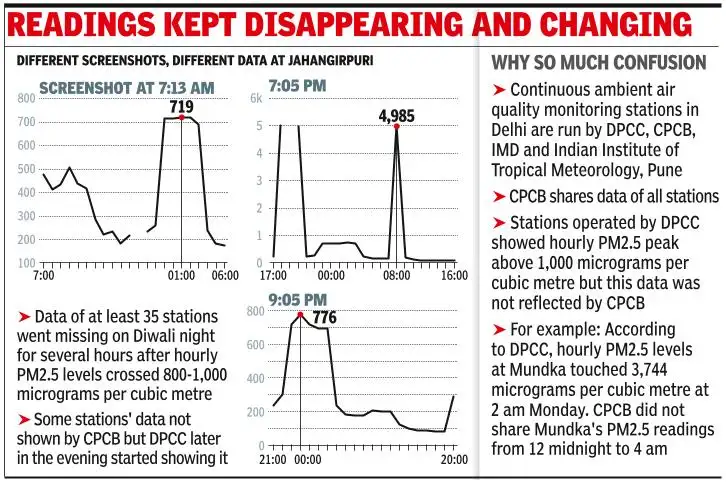
NEW DELHI: After the air quality station at Delhi University’s North Campus hit peak PM2.5 levels of 999 micrograms per cubic metre (g/m³) at 11 pm on Diwali, the real-time hourly data went missing for six hours. Central Pollution Control Board’s (CPCB) website again started displaying data from 5 am Monday, when PM2.5 concentration dipped to 723 g/m³. Delhi’s AQI Monday was calculated using data of 47 out of 60 stations Out of 60 continuous ambient air quality monitoring stations in Delhi, hourly data was initially unavailable for at least 35 stations, according to data released by CPCB. The mystery behind the missing data on Diwali night continues with most stations stopping releasing readings after hitting a PM2.5 threshold of 800 to 1,000 g/m³. Jahangirpuri was shown to have three different peak readings of hourly PM2.5 concentrations, with one at 719 g/m³ at 1 am Monday. In the evening, DPCC changed this to 4,985 g/m³, which was said to have been recorded three times. Later Monday night, it again revised the hourly peak, showing it was 776 g/m³ at Diwali midnight.
Interestingly, Delhi Pollution Control Committee (DPCC) updated its data. “This may affect the calculation of hourly and daily averages and influence the reported citywide AQI.
Manoj Kumar, analyst, Centre for Research on Energy and Clean Air (CREA), said when monitoring stations do not report readings during severe pollution episodes, the available data may not capture the full extent of pollution. This is particularly important during peak pollution hours, when even a few missing observations can affect how the overall air quality situation is assessed,” said Kumar. Continuous ambient air quality monitoring stations in Delhi are run by DPCC, CPCB, India Meteorological Department (IMD) and Indian Institute of Tropical Meteorology, Pune. CPCB shares data of all stations and calculates AQI after compiling data of all these stations.