
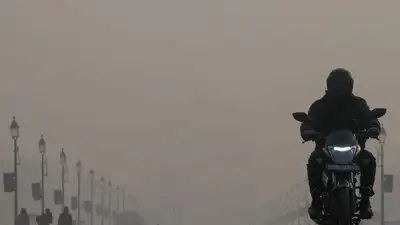
Delhi reported an air quality index of 369 on Diwali eve, marking the most polluted instance in recent years.
“In all likelihood, Nov 9 could emerge as the most polluted post-Diwali day in several years. A similar pattern was seen in Diwali 2024. Several stations saw severe air quality levels Saturday, with IIT-Delhi (452) the most polluted at 4 pm. It was followed by Punjabi Bagh (439) and Jahangirpuri (428). Other areas which recorded hazardous levels of pollution included Mundka (426), Vivek Vihar (426), Rohini (424), RK Puram (420), Bawana (420), Sonia Vihar (417), Siri Fort (415), DTU (416), Narela (416), Najafgarh (413), Dwarka-Sector 8 (411), Alipur (410), Pusa (408), Dr Karni Singh Shooting Range (407), Jawaharlal Nehru Stadium (403) and ITO (402).
Experts said city’s AQI is likely to worsen to the severe range (above 400 on a scale of 500) due to high emissions from local and regional sources, additional emissions from firecrackers and stubble burning, and adverse weather conditions, including calm winds.
With pollution predicted to spike further from Sunday, experts said meteorological conditions have also aligned to make Monday the most polluted day immediately after Diwali in several years. Meteorological conditions appear highly conducive to severe pollution, with winds at the transport level — where stubble burning smoke travels — expected to be north-northwesterly, favouring the transport of smoke from the peak burning areas of Punjab and Haryana towards Delhi,” said Gufran Beig, the founder of System of Air Quality and Weather Forecasting and Research (SAFAR) and Chair Professor at National Institute of Advanced Studies. Though chances are slim, an unusual and uncertain shift in the anticipated Super El Nino-driven weather pattern, resulting in stronger local winds, may offer some respite and prevent the severity of this anticipated pollution episode, he said.
But he has his fingers crossed. the ban was widely flouted While the use of green crackers was allowed for two hours in the night on two days. Since the festival was celebrated in mid-Oct, the impact of stubble burning was less. You Can Also Check: Gold Rate in Delhi | Silver Rate in Delhi | Bank Holidays in Delhi | Public Holidays in Delhi | Delhi AQI | Weather in Delhi | Petrol Price in Delhi | Diesel Price in Delhi | CNG Price in Delhi | LPG Price in Delhi
Central Pollution Control Board’s data shows that on the day before Diwali, Delhi recorded an AQI of 296 (Oct 19) in 2025, 307 (Oct 30) in 2024, 220 (Nov 11) in 2023, 259 (Oct 23) in 2022, 314 (Nov 3) in 2021, 339 (Nov 13) in 2020, 287 (Oct 26) in 2019, 338 (Nov 6) in 2018 and 302 (Oct 18) in 2017.