
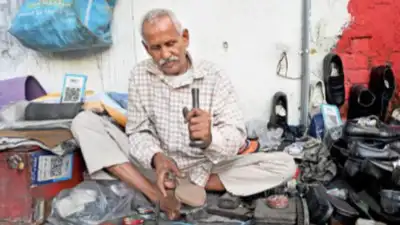
Aadhar Singh at work outside ITO post office
The moss-kissed pavement has been his workplace for over 40 years. Some years back, Singh also started peddling shoes, most of them priced less than Rs 500. He remembers coming to Delhi from Chhoti Harda, a village in southern Madhya Pradesh, a couple of years before Prime Minister Indira Gandhi was assassinated in 1984. 331 or 263 (earlier 103).
Because they are like old friends you are comfortable with, you can bring him those prehistoric pair of slippers or the exhausted leather bag, which you just cannot retire.
If you have time, he will also explain why leather “needs to breathe”, and how a good polish is like “massage therapy”. Nobody says he overcharges. “I order them from Agra,” he says. It’s the beginning of the wedding season,” he says. “Earlier, I reached home in 40 minutes; now, the ride takes nearly two hours,” he says. Each floor, he says, has only one room; a house with plenty of height, but no width. “You can’t stay up late if you have to catch a morning bus by 8,” he says.
NEW DELHI: If you ever visit the post office on Bahadur Shah Zafar Marg, look left before you step past the main gate. You will likely find Aadhar Singh, a puny, grey-haired figure with an earnest sun-browned face, hunched over a shoe, oblivious to people and pollution. Singh understands leather the way poets understand meter. A fleeting glance is all he needs to discern genuine leather and offer his prognosis on its quality. In his deft hands, many a shoe has found out there’s life after near-death. He will eye them impassively, like a senior investigator examining a crime scene, point out the rough spots and carry out the repairs. Many of Singh’s regular customers are employees of nearby govt offices, notably the Bureau of Indian Standards and CAG. Strolling during the lunch hour, some get their shoes fixed, sandals repaired or leather bags mended. As an open-air craftsman, Singh’s livelihood is tied to the vagaries of weather. When the fierce sun pushes people indoors in summer, his customers shrink. During winter, shorter days mean fewer work hours. Even monsoons are a bad time for Singh, who must stuff his anvil and other tools into a weathered wooden box and wait for the rain to stop. “November is a good month for work. Singh recalls the past, not by days or years, but through events stitched into his memory. His father toiled in the fields of a local zamindar. Singh preferred to join his uncle in the big city. The teenager trained under him, before he was tipped off that a cobbler working outside the ITO post office had landed a much-prized govt job and had quit that space. And there, by a wall close to an open drain, and two prosperous trees, often home to a bunch of naughty monkeys, Singh had found his own four feet of paradise. Over the years, ITO has morphed before his eyes. He recalls the iron footbridge near Pearey Lal Bhawan, primarily used as a rest room by vagrants, being demolished, the car queues growing longer at the red light and the metro stations coming to life. He remembers Rajesh Khanna, then a shadow of his superstar days, inaugurating the subway in front of The Times of India building. He relives the time when a langur was summoned to fight monkey menace in the area, but failed. And, more importantly, he recalls the foul-smelling open drain being covered about a decade and half ago. Old habits die hard, even though times have changed. To travel from Sunder Nagari in north-east Delhi where he lives, Singh prefers DTC bus no. The extra time on the bus is wasted. Unlike some of his fellow passengers, he doesn’t own a smartphone. He keeps a keypad phone, priced less than a gourmet pizza. He is afraid to invest more in a mobile. Singh has spent his earnings building a three-storey house over the years. By the time he reaches home late in the evening, the remote is taken. He briefly watches whatever his family is watching, generally ‘Bigg Boss’ or ‘Tarak Mehta Ka Ulta Chashma’, before signing off. For many years, Singh subscribed to ‘Sandhya Times’, the afternoon newspaper, a handy companion during lean hours. But he doesn’t read much and is not politically minded.
An earlier phone, a basic Samsung, was pick-pocketed.
One of his daughters works out of home for a company that installs smart meters, and earns about Rs 25,000 per month, he says with pride. Because the shops have been shut down by cops for a parade or for VIPs visiting Rajghat, on some days, he is forced to take the day off or arrive late. But it’s undeniable that ordinary people like him quietly keep the capital ticking and turning You Can Also Check: Gold Rate in Delhi | Silver Rate in Delhi | Bank Holidays in Delhi | Public Holidays in Delhi | Delhi AQI | Weather in Delhi | Petrol Price in Delhi | Diesel Price in Delhi | CNG Price in Delhi | LPG Price in Delhi Stay updated with the latest Delhi news.
In the past, he generally voted for the party that a local politician would encourage him to. As the politician kept changing parties, so did the symbols he stamped the ballot on. Now, he listens to his family. Singh is the father of five daughters and one son, the latter not surprisingly the youngest of the lot. The elder two are married. Sundays are holidays. “The offices are closed. Customers are few,” he explains. Niggles aside, Singh feels he is far better off from the time he started out. Like millions of anonymous migrants, he has weathered the odds to cobble together a decent life. It’s not the kind of life that makes for high drama on television. Download the TOI App.