
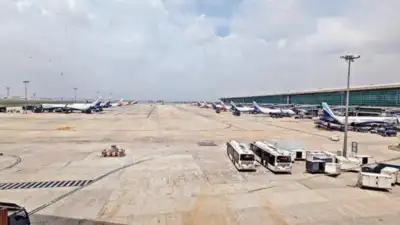
(Representative image) Indira Gandhi International Airport in Delhi is planning to enhance its international traffic capacity significantly
“DIAL informed us that the new international Pier E at T3 could cost about Rs 2,000 crore while T1 changes could cost about Rs 100 crore. ” said people who attended the meeting While IGIA has more than enough domestic capacity at almost 8 CPA. Widening roads leading to and from the airport
NEW DELHI: India’s busiest airport, Delhi’s Indira Gandhi International Airport , is gearing up for over 50% enhancement in international traffic by adding a new pier at Terminal 3, along with a marginal rise in domestic capacity through internal changes at T1 within the next four years. Together, these changes will take the hub’s capacity from the current 10.4 crore passengers per annum (CPA), spread across the all-domestic T1 (4 CPA) and T2 (1.4 CPA), and the domestic-cum-international T3 (5 CPA, with 3 crore international and 2 crore domestic), to over 12.5 CPA by early 2030. With the addition of the new international Pier E, which will have a capacity of 1.6 CPA, T3’s overall capacity will increase to 6.6 CPA, including 4.6 crore international and 2 crore domestic passengers annually. At T1, Delhi International Airport Ltd plans to increase capacity to 4.5 CPA by adding check-in and security counters without making any structural changes to the terminal. GMR Group-backed DIAL shared details of the 10-year master plan, which is being finalised with stakeholders, at a consultation held on Aug 16 at a nearby Radisson Hotel.
You Can Also Check: Gold Rate in Delhi | Silver Rate in Delhi | Bank Holidays in Delhi | Public Holidays in Delhi | Delhi AQI | Weather in Delhi | Petrol Price in Delhi | Diesel Price in Delhi | CNG Price in Delhi | LPG Price in Delhi Stay updated with the latest Delhi news. T2 will continue as it is for some years before it is demolished to make way for a bigger T4 sometime in the next decade, depending on demand, as Delhi-NCR has recently got its secondary airport in Greater Noida, which is struggling to attract flights and passenger footfalls in the shadow of big brother IGIA. This plan has to be submitted to the aviation ministry this month, which will then seek comments from govt agencies and is expected to clear it, with changes if any emerge from its consultations, by next March. DIAL will then begin execution, which is expected to take about three years from the start of work. Such planning is undertaken once every decade to prepare for contemporary travel trends. Given the increase in road traffic this will bring, along with one of India’s biggest malls opening in a vastly expanded Aerocity by then, Delhi govt had asked RITES to study how the additional traffic could be handled. RITES is learnt to have submitted its report to PWD. The original plan was to have a Y-shaped flyover between T1 and T3 to do away with a traffic signal and allow free-flowing traffic at the junction where motorists coming from the Dhaula Kuan/Vasant Vihar side go straight towards T1 and turn left for T3. The plan also proposed doubling the road width right up to T3, including expansion of the under-runway tunnel. Airside transfer system ready DIAL has completed arrangements for airside transfer of passengers between T1 and T3 since last month and is now awaiting Bureau of Civil Aviation Security clearance to begin the service. It has procured six low-floor Volvo buses with baggage compartments for the purpose, which will be brought to the airport as soon as it gets the nod. Download the TOI App.