

Hyderabad: Andhra Pradesh ’s experience shows how difficult it can be to reverse fertility decline once having fewer children becomes a social norm, an Economic Advisory Council to the Prime Minister (EAC-PM) working paper has said.
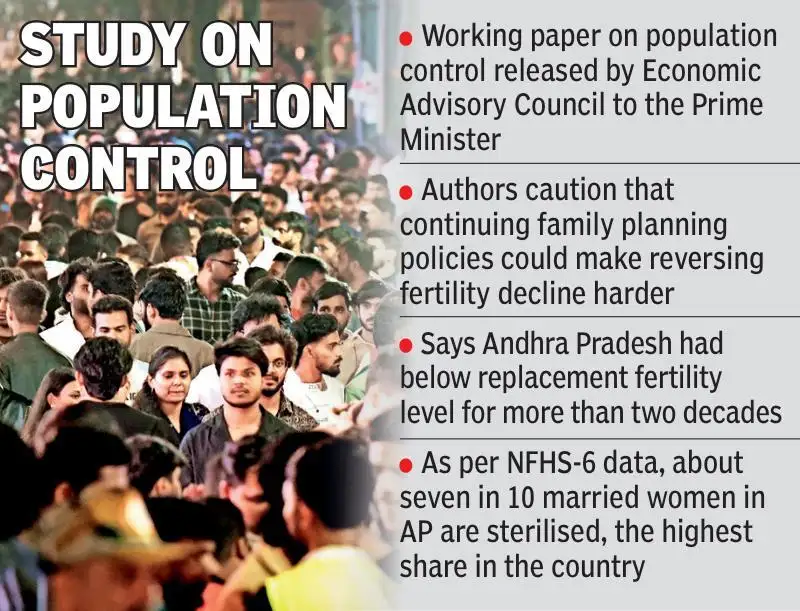
About seven in 10 married women in the state are sterilised, the highest share in the country, according to NFHS-6 data cited in paper. AP had also budgeted incentives for 1.25 lakh female sterilisation procedures every year. AP’s own experience reflects this shift. Its family planning programme relied heavily on female sterilisation for decades.
Its 2026-27 programme has no allocation for incentives for male or female sterilisation. It has allocated ₹1 crore for reversible methods such as IUCDs and injectables. Its proposed Population Management Programme 2026 now seeks to encourage second and third births. It proposes a one-time ₹2,000 incentive for a second child and ₹1,000 a month for five years for a third child. AP’s own population policy estimates that it could take five to 10 years for its share of sterilised married women to fall to 50%.
It says couples should have greater choice over when to have children and how many to have, with greater access to temporary methods that allow them to space pregnancies rather than incentives that encourage permanent sterilisation,” the authors said. AP’s own population policy acknowledges this, saying higher incentives for sterilisation had inadvertently encouraged health workers and providers to favour it over spacing methods. It proposes ending sterilisation incentives and instead incentivising spacing methods. AP has already begun changing course. It also proposes govt coverage of education expenses and lifetime health insurance for households with three or more children. But the paper cautions that money alone may not change family choices after a small family norm has become established. The authors also caution that simply paying couples to have more children may not reverse long-term fertility decline. Similar incentives have not succeeded in reversing fertility declines in other countries, they pointed out. “The paper is not arguing against family planning, however.