
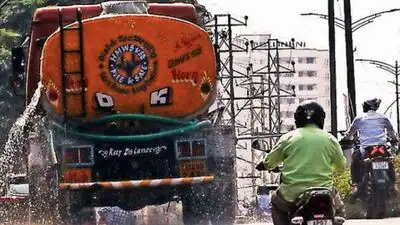
Hyderabad’s water board is taking steps to secure water supply for the city by 2028.
Answering TOI readers’ queries, he says the aim is to make Hyderabad a tanker-free city by 2028 Sewage and Conservation Plans The govt is taking measures to regulate water tanker operations and prevent the unauthorised exploitation of groundwater. There are ongoing projects for rainwater harvesting and converting unused borewells into recharge wells In the long term, after the commissioning of Godavari Phase II and III, which together will add 320 MGD, by the end of 2027, it is proposed to provide daily or uninterrupted water supply to all households in the CURE area. By the end of 2028, Hyderabad should become a tanker-free city. We are preparing a master plan for 2047 for the entire CURE area. There are currently 96 filling stations and 1,500 water tankers operating in the CURE area. In addition, 15 more filling stations are proposed for this summer, along with the registration of over 300 additional water tankers. HMWSSB maintains a 15,000-km piped network, with pipelines ranging in age from two to 50 years. We have also undertaken a programme to convert approximately 700 unused borewells into injection wells for groundwater recharge.
The objective is to progressively extend the organised water supply network and improve the availability of municipal drinking water so that households do not have to depend on expensive private tanker supplies. Treated water is also being released into lakes to maintain their hydrology.
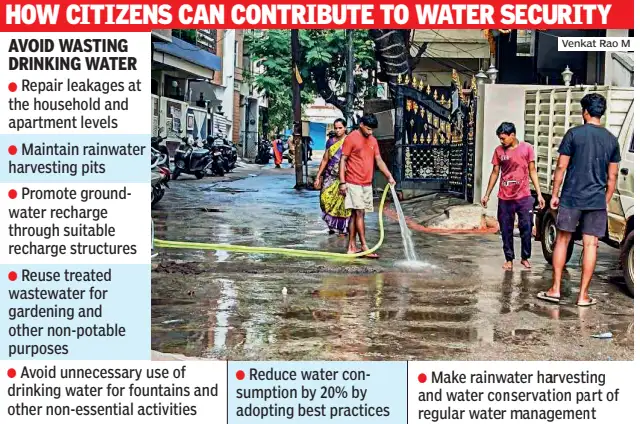
From imposing fines and creating awareness to tapping alternative water sources, water board is taking several measures to ensure city does not face supply issues, says K Ashok Reddy, managing director of the board. Recently, it issued an order to prevent the illegal extraction of groundwater for non-domestic purposes by bulk users. Strict action will be initiated against violations in accordance with the applicable rules and regulations. To protect water bodies, HMWSSB has installed several sewage treatment plants (STPs) along the Musi and near other water bodies. HMWSSB is also expanding and upgrading the sewerage network to ensure that sewage generated in the city is intercepted and conveyed to STPs. Sewerage diversion mains are being developed by HMWSSB, the Lakes Division and HYDRAA, as water bodies and lakes fall under the purview of the concerned urban local bodies (ULBs). HYDRAA, TGPCB and other enforcement agencies are involved in identifying and taking action against illegal or unauthorised discharges. The board has identified shortage-prone areas and is preparing proposals to strengthen water supply infrastructure. Special attention is being given to rapidly developing peripheral areas such as Kollur, Gachibowli, Kokapet, Neopolis and other emerging residential locations. We are continuously working to reduce transmission and distribution losses through systematic inspections, repairs, maintenance and improvements to the existing water supply network. Particular attention is being given to peripheral and rapidly developing areas where population growth has increased water demand. As a long-term solution, we have engaged Tata Consultancy Services (TCS) to prepare a master plan that will propose additional storage facilities in different localities to ensure uninterrupted water supply across the CURE area. By the time Godavari Phase II and III are completed, we plan to complete the ring main connecting all water sources to ensure equitable distribution across the CURE area. The installation of rainwater harvesting systems is already part of the existing regulations. However, having regulations in place is not enough. Effective implementation on the ground and ensuring that existing recharge pits remain functional are equally important. As part of these efforts, the Water Board conducted a survey. HMWSSB recognises that the frequency of water supply varies across localities depending on source availability, elevation, network configuration, storage facilities and local demand. Most of the ULBs were merged with HMWSSB only recently. The board is reviewing the distribution system to ensure that available water is distributed in a equitable manner. HMWSSB gives priority to water quality and continuously monitors its water treatment plants. Godavari water is lifted from the Yellampalli reservoir, and the raw water is treated at the Mallaram water treatment plant in accordance with ISO standards before being supplied to the twin cities. The board is preparing contingency arrangements to manage variations in water availability, particularly during summer and periods of reduced rainfall. Alternative water sources and existing supply systems are being reviewed to ensure the optimum utilisation of available resources. We supply water in bulk to the Cantonment, which is responsible for local distribution across the area. In addition, consumers and apartment associations are advised to ensure that internal pipelines, overhead tanks, and sumps are properly maintained. The use of STP-treated water for gardening, landscaping, fountains, and other non-potable purposes will be enforced, subject to availability. HMWSSB examines water supply feasibility and infrastructure requirements for proposed developments falling within its jurisdiction. In the case of high-rise buildings and large residential projects, the additional water requirement is assessed based on the proposed population, number of dwelling units, occupancy, and applicable water demand norms. The availability of water in the existing transmission and distribution network, hydraulic capacity, nearby reservoirs, and pumping infrastructure are important considerations. As part of the circular economy, HMWSSB has proposed to develop treated sewage conveyance and distribution infrastructure for the long-term supply and utilisation of secondary-treated wastewater from identified sewage treatment plants (STPs).
The target users include high-demand entities such as Microsoft, Amazon and CtrlS data centres, as well as manufacturing units such as Welspun in the Hyderabad Metropolitan Region.
The ultimate demand is estimated at 500 MLD. You Can Also Check: Gold Rate in Hyderabad | Silver Rate in Hyderabad | Bank Holidays in Hyderabad | Public Holidays in Hyderabad | Hyderabad AQI | Weather in Hyderabad | Petrol Price in Hyderabad | Diesel Price in Hyderabad | CNG Price in Hyderabad | LPG Price in Hyderabad Stay updated with the latest Hyderabad news. The project will cover two important industrial clusters: Attapur STP to Chandanvelly and Nagole STPs to Future City. The project is proposed to be taken up from next month. Necessary measures are being taken to prevent the unauthorised use of the board’s name, logo, and identity by private water tanker operators. The board’s Chief Vigilance Officer and team conduct regular inspections to identify unauthorised tanker operations, and appropriate action is taken against those found misusing the board’s identity. Download the TOI App.