
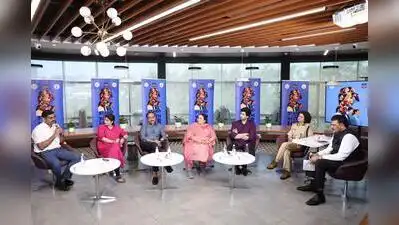
Panelists during a discussion as part of the ‘Stand With Her’ campaign in Hyderabad on Saturday
Recalling the early years of women in policing, she said they were routinely kept away from tough postings and had to prove themselves all over again with every new assignment. “An equal workplace cannot just be announced, it has to be built up,” she said.
Because it was subtle, women Safety Wing DG Charu Sinha said workplace exclusion was often difficult to spot precisely.
Hyderabad: The idea that women are merely being “allowed” to work is itself part of the problem, actor, writer and director Adivi Sesh said at a panel discussion as part of the ‘Stand With Her’ campaign in Hyderabad on Saturday. Speaking at the seventh edition of the campaign, which focused on ‘Inclusive Workspaces, Everyday Fairness and Voice’, Sesh said inequality often hides in workplace practices that appear ordinary on the surface. “The fundamental idea that we are giving women permission to work is itself the problem,” he said, recalling instances on film sets when women were not allowed to sit on apple boxes because they were menstruating. He said such incidents needed to be spoken about openly and normalised, and questioned whether workplaces and homes were designed for dual-income families, where women worked but continued to shoulder much of the domestic workload.
“Workplace exclusion is not dramatic, it is very subtle. The architecture of exclusion is inbuilt. We would like to make all this inequality visible today,” she said.
To prove that I knew my job and work was very tough,” she said. Choreographer Pony Verma Prakashraj spoke about having to carve out space in a male-dominated industry. “When I started, I was the only female choreographer competing with all male choreographers. She also spoke about consciously choosing how she dressed so people would take her seriously in meetings, and how marriage was once seen as something that would end her career.