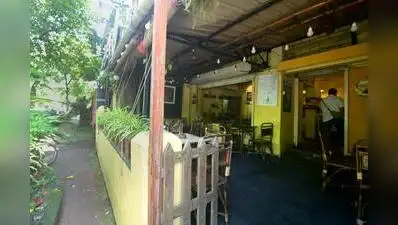
A cafe on the ground floor of a Golf Green house
The words muttered by Soumitra Chatterjee ’s Asim in Satyajit Ray’s ‘Aranyer Din Ratri’ (1970) hold true for one of the oldest ‘societies’ in the city. Golf Green — developed by the West Bengal Housing Board in 1975 — stands out among other settlements by refraining from building boundary walls to alienate itself from neighbouring refugee colonies. Golf Green may now be transitioning with 12-storey towers, cafes, and IT professionals replacing govt employees but residents agree over retaining its ‘slow-paced’ life, fascination for adda at Central Park, and stellar cultural programmes. A housing society without borders Golf Green Urban Complex did not exist before 1975. Between 1967 and 1972, it turned into a hideout for young men associated with the Naxalite movement, who were frequently hunted down by police. Crime-ridden and plagued by the golf club’s financial troubles, the land was sold to Kolkata Metropolitan Development Authority (KMDA) in 1972. A bungalow here priced over Rs 1 crore has far more takers today than in 1979. Public works minister Jatin Chakraborty’s advice in 1980 still rings clear for early buyers: “It’s better to live side-by-side as neighbours without a wall between you. Bhog is prepared exclusively by neighbourhood women, and the community observes the traditional Shodashopachara Puja, covering 16 detailed aspects. Kanishka Bishi, son of writer Pramathanath Bishi, served as cultural secretary for Phase 1 from 1984 to 1990. Actors Soumitra Chatterjee and Rabi Ghosh lived in Phase 1 while author Mahasweta Devi owned a flat in Phase 4, which often inspired the surroundings depicted in her works. Every morning and evening, 700 to 800 people walk here. In the evenings, especially during summer, residents gather outside as Central Park closes around 8 pm-9 pm. From ownership to cafe culture The periphery along Uday Shankar Road, lined with Phase 1 bungalows, has spearheaded change in this quiet enclave. This boutique cafe revolution began around 2017-18 with Travelistan Cafe — Kolkata’s first travel-themed cafe.
Culture thrived due to the long list of luminaries associated with Golf Green. The once borderless society now faces anxiety with the majority of its elderly population facing security trouble due to scattered incidents of robbery and road accidents due to rash driving. You Can Also Check: Gold Rate in Kolkata | Silver Rate in Kolkata | Bank Holidays in Kolkata | Public Holidays in Kolkata | Kolkata AQI | Weather in Kolkata | Petrol Price in Kolkata | Diesel Price in Kolkata | CNG Price in Kolkata | LPG Price in Kolkata Stay updated with the latest Kolkata news.
No puja without cultural performances “It isn’t a typical commercial (barowari) puja,” says dancer Sugata Roy, who moved to Phase 1 in 1980. “We staged dance-dramas like ‘Shapmochan’, ‘Chitrangada’, and ‘Shyama’, directed by local theatre figures like Sumit Samaddar,” Roy recalled. Standing on one side, its sheer scale becomes evident as the “lungs” of an otherwise densely concreted area. Additionally, every block features a children’s “tot-lot” park while the CS ground hosts local football and cricket matches. “New buyers are mostly young working professionals,” said Arindam (Saibal) Raha, general secretary of the Golf Green Central Coordination Committee. “We are being forced to fence up and put security kiosks at important points to avoid entry of anti-socials,” a resident said. “It’s a place you come to for slow-living,” has somewhat become their motto.
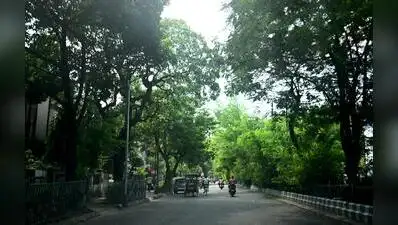
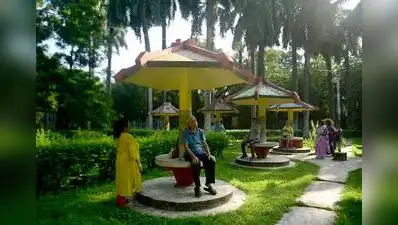
Residents start their morning at a Golf Green park Golf Green A cafe on the ground floor of a Golf Green house Residents start their morning at a Golf Green park Golf Green A cafe on the ground floor of a Golf Green house “ Kolkata thik erokomti noy. Kolkatar charidike ekta prachir ache, shey prachirti ekhane nei (Kolkata is not quite like this. There is a wall all around Kolkata; that wall isn’t here)”. Divided from the Royal Calcutta Golf Club by a running wall, this neighbourhood — known for its wide greenscape and tot parks — refused to isolate itself from the settlements that emerged in the 1940s and 50s with the influx of refugees from East Bengal. In its place was a vast, vacant expanse of trees and muddy ponds — an unused golf course belonging to royalty. In this abeyance, the grounds became football fields for local boys. A year later, West Bengal Housing Board was established and decided to build a residential society — initially targeted at high-income groups, later expanded to middle- and low-income buyers. Samir Roychowdhury, a septuagenarian who bought a first-phase flat for less than a lakh, recalled, “There were hardly any buyers. Applications were fewer than the constructed units, so we could select what we wanted. The situation changed two to three years later, when flats were allocated by lottery. Scientist Shantanu Paul attributed this slow start to the land’s dark past, secluded environment, and the traditional Bengali hesitation toward flat culture. Dotted with four-to-five-storey buildings and bungalows across seven phases, the society long carried a pale yellow govt quarters vibe. Towers were neatly arranged around parks while arterial roads looped into landmark Central Park, opening the close-knit complex to self-settled refugee colonies like Bijoygarh, Jadavpur, Poddar Nagar, and Arabinda Nagar. A wall would make you feel like unwanted guests to them. On Navami, everyone gathers for Pungti Bhojon — a traditional community feast where residents sit side by side in long lines to eat together. The four days of puja are defined by renowned artistes performing, directing plays, or judging poetry contests. Apart from Durga Puja , Golf Green’s celebration of Basantotsav (Spring Festival) became another talk of the town. Its popularity is still remembered by its residents who recall it being featured on TV. Artistes like Kabir Suman and the band Bhoomi performed here early in their careers. Other prominent residents, like Chinmoy Roy, Sujit Mukherjee, and Rabindra Sangeet singer Rama Mondal actively contributed. Meet you for adda at Central Park Adda at Central Park remains a constant. Initially a muddy pond, the park was developed after the 1980s — the pond filled, an overhead tank installed, and fencing erected. Its maintenance is managed by the Central Coordination Committee, which generates revenue by hosting film shootings and events. Originally built like cozy houses with small front gardens and single garages, these properties stood out only by the unique embellishments added by owners over time. With evolving lifestyles, the ground floors of these bungalows have increasingly been converted into commercial spaces, subleased to quaint cafes. Their layout, balconies, and repurposed rooms serve as gentle reminders of spaces once occupied by families who have since relocated. Soon, outlets like Blue Tokai and Hatari joined the strip. “We maintain strict community standards — rentals are limited, and rowdy late-night disturbances aren’t tolerated. But despite it all, Golf Green’s core remains intact. Nestled amid colonies, the society retains its love for adda, vibrant festivals, and neighbourhood warmth anchored around Central Park. Download the TOI App.