
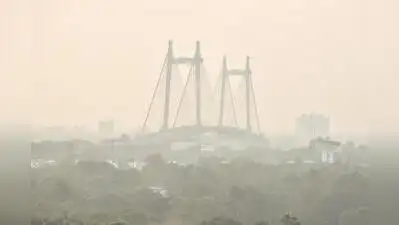
Night-long cracker bursting across the city on Diwali night left Kolkata gasping for breath
At Ballygunge, the PM2.5 index jumped more than five times in two hours — from 74 at 9 pm to 409 at 11 pm. The sharpest deterioration occurred between 9 pm and 11 pm on Sunday, when fireworks celebrations reached a crescendo. Despite the legally permitted window of 8 pm-10 pm, fireworks, including banned varieties, continued being burst across neighbourhoods well past midnight and until around 4 am, prolonging the pollution episode. By 2 am, all seven monitoring stations under review had recorded readings above 300, indicating that the pollution episode was neither localised nor short-lived. Jadavpur emerged as the worst-hit location at that hour with 411, followed by Victoria Memorial at 393, Ballygunge at 385, Fort William at 380, RBU at 379, Rabindra Sarobar at 353 and Salt Lake at 333. At 6 am, Salt Lake’s index had plunged to 25, Jadavpur to 88, Victoria Memorial to 90 and RBU to 95. Ballygunge, however, remained the most polluted among the seven stations at 149, followed by Fort William at 120.
Chatterjee stressed the need for comprehensive monitoring of toxic pollutants released by firecrackers, warning that their excessive and largely uncontrolled use posed a serious threat to public health and the environment.
Kolkata: An unprecedented barrage of firecrackers sent pollution levels skyrocketing across the city, pushing the air into the “severe” category at four monitoring stations and exposing residents to dangerously polluted air for hours. All seven monitoring stations recorded “very poor” or worse air at 2 am on Diwali night, leaving the city gasping for breath. “The impact of air pollution depends on the nature, concentration and toxicity of individual pollutants, many of which are not covered under existing national ambient air quality standards,” he said.
Atmospheric scientist Abhijit Chatterjee of the Bose Institute cautioned that conventional AQI readings alone could not capture the full toxicity of fireworks pollution. The unusually late timing of Kali Puja this year compounded concerns. With Nov’s night-time chill setting in, falling temperatures, reduced atmospheric mixing and possible temperature inversions could trap fine particles closer to the ground, prolonging exposure even after the fireworks stop. There were signs of recovery by dawn. The sharp overnight rise and subsequent decline highlighted the intensity of the fireworks-associated pollution episode. You Can Also Check: Gold Rate in Kolkata | Silver Rate in Kolkata | Bank Holidays in Kolkata | Public Holidays in Kolkata | Kolkata AQI | Weather in Kolkata | Petrol Price in Kolkata | Diesel Price in Kolkata | CNG Price in Kolkata | LPG Price in Kolkata