
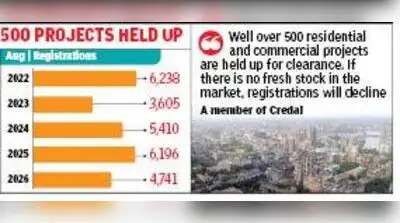
Realty bottleneck
Kolkata: The Kolkata Metropolitan Area recorded 4,741 apartment registrations in Aug, reflecting a 23% year-on-year decline from 6,196 registrations in Aug last year and a 14% month-on-month moderation from 5,516 registrations in July, according to Knight Frank India. The annual decline was largely the result of an exceptionally strong base in Aug 2025, when registrations rose 15% year on year and 33% month on month. “Well over 500 residential and commercial projects are held up for clearance. On a sequential basis, the Aug 2026 dip followed a sharp 50% month-on-month jump in July, indicating a normalisation in activity rather than a structural slowdown. Importantly, Aug 2026 registrations remained broadly aligned with the trailing 12-month average of 4,779 units, underscoring steady underlying demand in the market.
But an even more crucial factor, said developers, was the freeze on project launches in the city and its periphery as the Kolkata Metropolitan Building Committee, which usually met twice a month to approve pending projects, had not had a meeting in eight months. If there is no fresh stock in the market, registrations will decline,” said a member of the Confederation of Real Estate Developers Association of India (Credai), the umbrella organisation of major builders.
Between Jan and Aug 2026, KMA registered 36,464 apartments, down 12% from 41,440 units in the corresponding period of 2025. Apartments in the 501-1,000 sq ft category accounted for 58% of total registrations in Jan-Aug 2026, up from 45% a year earlier. This category recorded 21,263 registrations, compared with 18,560 in the same period last year. Homes above 1,000 sq ft registered a 69% year-on-year rise, increasing to 3,819 units from 2,253 units, and their share expanded to 11% from 5%. In contrast, homes below 500 sq ft saw a decline in registrations of 45% to 11,382 units, with their share falling to 31% from 50%. Together, the two zones contributed 76% of registrations in Aug 2026, reinforcing the dominance of established residential catchments. The top 10 locations accounted for 2,459 registrations, representing 52% of KMA’s total apartment registrations in Aug 2026. Sonarpur led with 385 registrations, followed by Thakurpukur with 325, Kasba with 313 and Behala with 275. Overall, while Aug 2026 saw a moderation in registrations compared to that in July 2026 and Aug 2025, the market remained close to its recent average and continued to show positive structural indicators. The rising preference for 501-1,000 sq ft and larger homes signals a maturing residential market in Kolkata, with homebuyers increasingly seeking better-sized apartments suited to evolving lifestyle and family needs.
The decline in overall registrations was therefore driven more by a reduction in smaller-format apartment transactions and the high base of last year than by a weakening of residential demand. You Can Also Check: Gold Rate in Kolkata | Silver Rate in Kolkata | Bank Holidays in Kolkata | Public Holidays in Kolkata | Kolkata AQI | Weather in Kolkata | Petrol Price in Kolkata | Diesel Price in Kolkata | CNG Price in Kolkata | LPG Price in Kolkata Stay updated with the latest Kolkata news. the composition of demand showed a healthier shift towards larger homes While the aggregate number moderated. Larger apartments also gained traction. This shift suggests buyers are increasingly prioritising space, functionality and long-term utility, even as headline registrations have moderated. The stronger share of mid-sized and larger apartments points at improving buyer confidence and an upgrade-led housing preference across the city. South and north Kolkata continued to anchor market activity. South Kolkata remained the largest contributor, while north retained a strong share. Locations such as Sonarpur, Thakurpukur, Kasba, Behala, Jadavpur, Maheshtala, Baranagar and Shibpur recorded healthy activity, supported by mid-segment housing supply, connectivity and established social infrastructure. The concentration of activity across these markets indicates that demand remains resilient in well-connected, infrastructure-backed residential pockets. Download the TOI App.