
Lightning deaths in bengal
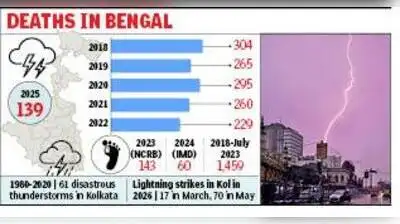
More recent national mapping has reinforced the pattern, showing eastern and central India as the regions with the highest concentration of cloud-to-ground lightning accounting for nearly 88% of India’s lightning mortality. A 2025 study analysing four decades of atmospheric conditions across Bengal found that the coastal belt was particularly favourable for severe thunderstorms. Kolkata recorded 61 disastrous thunderstorms between 1980 and 2020, the highest among locations examined in this zone. Separate NCRB data put Bengal’s lightning toll at 143 in 2023. IMD ’s disastrous-weather records showed 60 deaths and 315 injuries linked to lightning and thunderstorms in 2024, while state authorities reported 139 lightning deaths in 2025. The 2025 Bengal study found high convective available potential energy, or CAPE, abundant moisture and relatively weak atmospheric inhibition over southern Bengal. A 2026 Kolkata study based on IMD observations from 2015 to 2024 found a sharp seasonal build-up: lightning days rose from 17 in March to 70 in May, underscoring the pre-monsoon danger.
The datasets follow different reporting systems and are therefore not strictly comparable.
In simpler terms, the atmosphere has plenty of fuel to push air rapidly upward and relatively little “lid” to stop it. An IITM-Pune study had identified the south Bengal-north Odisha belt, with Kolkata close to its centre, as the country’s largest lightning hotspot. Scientists say Bengal’s geography makes it naturally vulnerable. During the hot months, the land heats rapidly while the Bay of Bengal supplies abundant moisture. Warm, humid air rises sharply and forms towering cumulonimbus clouds. Inside them, violent updrafts and downdrafts cause water droplets, ice crystals and soft hail, or graupel, to collide. Kolkata’s urban heat island may add to the instability. Concrete and asphalt retain heat, while aerosols from pollution can influence cloud formation, though scientists caution that the pollution-lightning link is complex. You Can Also Check: Gold Rate in Kolkata | Silver Rate in Kolkata | Bank Holidays in Kolkata | Public Holidays in Kolkata | Kolkata AQI | Weather in Kolkata | Petrol Price in Kolkata | Diesel Price in Kolkata | CNG Price in Kolkata | LPG Price in Kolkata