
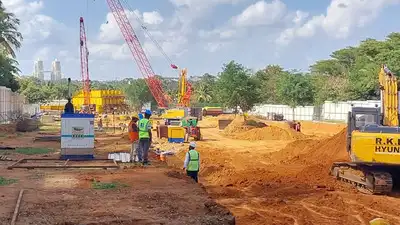
A tree-felling notification for 1,128 trees has been issued, and the matter is currently before the Karnataka high court. Work on the Hebbal short tunnel project has been underway since June, even as the IIT-B study was conducted in August.
But the August 2026 study, titled ‘Integrated Traffic Microsimulation Study – Bengaluru: Hebbal Flyover & Hebbal Short Tunnel’, prepared by Prof Archak Mittal for Rithwik Projects Private Limited, has now come under scrutiny from IISc and city-based mobility experts, who have flagged gaps in its methodology, data and assessment of traffic benefits.
Convener of IISc Sustainable Transportation Lab Prof Ashish Verma, who reviewed the IIT-B study, said the traffic data used in it was sourced from the DPRs provided by the contractor. “The model reports the speed of traffic for 2027 at peak hour in Base Case as 13.74 kmph against 4.29 kmph reported in DPR of the Hebbal Short Tunnel Project,” Verma’s review states, adding that the study did not report queue lengths before and after the interventions, and study methodology was not discussed in detail. Former chief technical adviser to Directorate of Urban Land Transport (DULT), Satyajit Arikutharam, said the IIT-B study was of “extremely poor quality” and had multiple flaws, besides highlighting shortcomings in the original DPRs from which it drew much of its data. Arikutharam also said the study had not considered the impact of a metro line and the proposed long tunnel in its traffic projections.
BENGALURU: Bangalore Development Authority (BDA) commissioned a study led by an IIT-Bombay professor to assess the traffic effects of its proposed Hebbal short tunnel following widespread criticism of the project.