
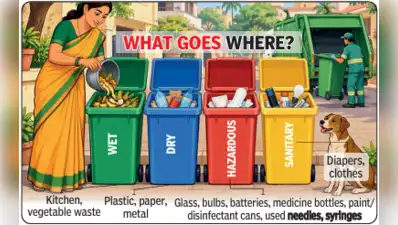
Households in Hubballi-Dharwad will segregate waste into four categories under the Solid Waste Management Rules-2026
Hubballi: Households in Hubballi-Dharwad will segregate waste into four categories under the Solid Waste Management Rules-2026, with sanitary and special concern/hazardous waste to be collected separately in addition to wet and dry waste. The 336 auto tippers operating in the twin cities, which currently have arrangements for wet and dry waste, will be fitted with two additional bins. Under the 2026 rules, sanitary waste includes diapers and clothes, while special concern/hazardous waste includes glass, bulbs, batteries, medicine bottles, paint cans, disinfectant cans, used needles and syringes. Santosh Yarangalli, executive engineer of HDMC’s solid waste management department, told TOI that compliance with the Solid Waste Management Rules-2026 Act is mandatory and came into effect on April 1, 2026. Public directives require collecting and disposing of wet waste, dry waste, sanitary waste, and hazardous waste separately. ”Until now, according to the Solid Waste Management Rules-2016, it was mandatory to segregate only wet (kitchen and vegetable) and dry waste (recyclable plastic, paper, metal, etc.). The 336 auto tippers operating in the twin cities will be modified accordingly. The twin cities of Hubballi-Dharwad generate approximately 400 to 600 tonnes of solid waste every day combined.
Green – Wet: Kitchen, vegetable waste Blue – Dry: Plastic, paper, metal Yellow – Sanitary: Diapers, clothes Red – Hazardous: Glass, bulbs, batteries, medicine bottles, paint/disinfectant cans, used needles, syringes Stay updated with the latest Hubballi news. The Hubballi-Dharwad Municipal Corporation (HDMC) plans to modify its collection system accordingly. A tender will be floated after the Model Code of Conduct (MCC) is lifted, and the vehicles are expected to be retrofitted within two months. The four categories were displayed during the Swachhata Hi Seva programme. Used medical syringes, insulin needles and chemical containers are frequently being mixed with dry waste, posing health and safety risks. Every household must now segregate and dispose of four types of waste. However, four types of waste now need to be collected separately, requiring updates to our infrastructure,” Yarangalli explained. He noted that existing auto tippers currently only have arrangements for wet and dry waste. Under the new rules, each vehicle needs two additional bins. A tender will be called soon, and the vehicles are expected to be retrofitted within two months. GFX What goes where? Download the TOI App.