
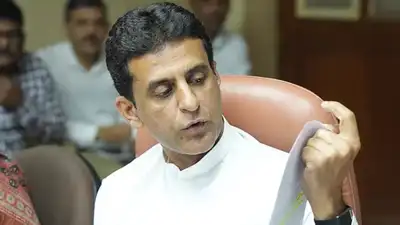
Minister Rizwan Arshad
He also accused oil marketing companies (OMCs) of supplying petrol with higher ethanol content than prescribed, saying some samples tested by the state had recorded levels of up to 31.2%. BENGALURU: Karnataka minister Rizwan Arshad on Monday demanded that consumers be allowed to choose between E10, E20, E30 and pure petrol, depending on their vehicles’ compatibility.
Arshad said the Karnataka government stood by its findings that OMCs were blending more than the prescribed 20% ethanol in petrol, according to news agency PTI. He challenged the companies to disclose the exact ethanol content in 63 samples collected from petrol pumps across the state. “I want to assure everyone in the country that the government of Karnataka stands by its report and its claim that oil marketing companies are blending more than 20 per cent ethanol in petrol. He said the state had collected the samples under Clause 8 (3) of the Motor Spirit and High Speed Diesel (Regulation of Supply, Distribution and Prevention of Malpractices) Order, 2005. Not a single sample was collected without following the joint sampling procedure mandated under Clause 8(3),” he said. The minister also referred to IS 17021:2018 and its third amendment, issued in August 2025, which provides methods for measuring ethanol content in petrol. Arshad said Karnataka had collected 63 samples from September 21 onwards and sent them to different oil marketing companies. “Why did you not invite us for a joint inspection when we asked you to provide the results of those 63 samples. He also claimed that vehicle mileage had dropped by 20-30% in some cases, adding to the financial burden on consumers. Questioning the circumstances behind the alleged overblending, Arshad said OMCs had reported combined profits of Rs 77,000 crore last year. Earlier reporting noted: K’taka govt stands by findings of ‘excess’ ethanol blending in petrol: Min Arshad Bengaluru, Karnataka minister Rizwan Arshad on Monday said that the state government stood by its findings that oil marketing companies were blending more than the prescribed 20 per cent ethanol in petrol, with some samples showing levels of up to 31.2 per cent, and accused them of evading questions on the issue. Earlier reporting noted: The minister for Food, Civil Supplies, Consumer Affairs and Legal Metrology said the state government had followed the prescribed sampling and testing procedures and challenged the OMCs to explain the actual ethanol content in 63 samples collected from petrol pumps across the state.
Under the procedure, samples are jointly labelled and signed by authorised officials and representatives of dealers or other concerned persons. “We have all the documentation, including the performance records signed by our officers and the representatives of the marketing companies and dealers. You Can Also Check: Gold Rate in Bengaluru | Silver Rate in Bengaluru | Bank Holidays in Bengaluru | Public Holidays in Bengaluru | Bengaluru AQI | Weather in Bengaluru | Petrol Price in Bengaluru | Diesel Price in Bengaluru | CNG Price in Bengaluru | LPG Price in Bengaluru Stay updated with the latest Bengaluru news.
This can cause serious damage to vehicle engines and place an additional financial burden on ordinary people,” minister said. The minister for Food, Civil Supplies, Consumer Affairs and Legal Metrology said the state had followed the prescribed sampling and testing procedures. Arshad said ethanol blending was carried out through an automated process at terminals and not at individual petrol pumps. Rejecting the OMCs’ argument that irregularities could have occurred at retail outlets, he said petrol pump owners and dealers had no role in the alleged excess blending. As far as my knowledge goes, Karnataka has six such terminals where oil marketing companies blend ethanol,” he said. Defending the testing process, Arshad said the samples were examined at an NABL-accredited and ISO-certified third-party laboratory after the companies failed to provide a clear response when the state initially approached them. When we get the samples tested through an NABL-accredited, ISO-certified laboratory, you question its credibility,” he said. Now you are disputing that report as well,” he said. He said the state was willing to take part in a joint inspection proposed by the companies but alleged that the offer came only after Karnataka raised the issue of excess ethanol blending. He himself said that a decision had been taken three or four months ago. He clarified that the Karnataka government was not opposed to ethanol blending but wanted consumers to have the freedom to choose fuel according to their vehicles’ requirements. Arshad said vehicle owners whose cars or two-wheelers were not compatible with E10 should be able to purchase pure petrol, while those with E10- and E20-compatible vehicles should have access to the respective fuel grades. The minister said Karnataka would continue conducting random checks at regular intervals through third-party laboratories. This can cause serious damage to vehicle engines and place an additional financial burden on ordinary people,” Arshad told reporters.
He alleged that the companies were avoiding questions about the findings and attempting to divert attention by challenging the sampling process and the laboratory’s credibility. “This is not an ordinary adulteration issue involving a few outlets. Ethanol has to be blended at the terminals. The samples are then divided into three portions. One is handed over to the petrol outlet, another is retained by the department and the third is sent to a laboratory for testing. He questioned why the OMCs were disputing the laboratory’s findings when their own officials were conducting ethanol tests at petrol pumps using hydrometer kits. “If this is such a simple exercise that your officers can conduct at every petrol pump, why can’t we do it. These include Fourier Transform Infrared Spectroscopy, water extraction and gas chromatography. However, the companies had not provided specific details of the ethanol-blending percentages found in the samples, he alleged. You did not give us a clear report and forced us to approach a third-party laboratory. Arshad also questioned the Centre’s response and referred to Union Heavy Industries Minister H D Kumaraswamy’s recent statement that a decision had been taken at the departmental level to increase ethanol blending to E30. “Is Kumaraswamy wrong. My question is whether oil marketing companies have been unofficially blending ethanol up to E30 even before formally announcing it as government policy,” he asked. The minister raised concerns over the impact of higher ethanol blends on vehicles, particularly two-wheelers commonly used by middle-class families. He referred to concerns reportedly expressed by the Society of Indian Automobile Manufacturers, a private insurance company and automobile manufacturers about the compatibility of E20 fuel with certain vehicles and the possibility of engine damage. “If you say that the fuel is E20, then give consumers exactly E20. The common man who pays for the fuel must get what has been promised to him. Do not deceive consumers by supplying fuel with E30 blending while claiming that it is E20. “If I own a vehicle that is not E10-compatible, I should be able to purchase pure petrol. If I own an E10-compatible vehicle, I should be able to purchase E10 fuel. If I own an E20-compatible vehicle, I should be able to purchase E20 fuel,” he added. He also appealed to other state governments, irrespective of their political affiliations, to conduct regular fuel tests rather than depend solely on checks carried out by oil marketing companies. Download the TOI App.