
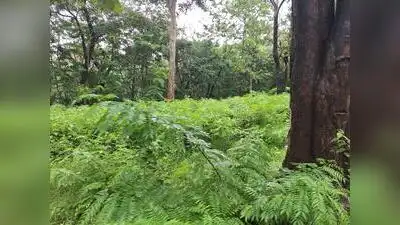
Exotic tree Senna spectabilis
Mysuru: The rapid spread of the exotic tree Senna spectabilis has emerged as a major ecological threat to native vegetation and wildlife habitats in the Western Ghats, with the invasive species estimated to have occupied more than 40% of Nagarahole National Park. In Nagarahole, which spans about 842 sq km, dense growth of the invasive tree is suppressing native grasses and other vegetation, hindering natural regeneration. Because of its rapid growth and ability to remain green even during the dry summer months, however, Senna spectabilis is considered particularly difficult to manage.
The forest department is now collaborating with the Indian Institute of Wood Science and Technology (IIWST) to develop a scientific protocol for the systematic control and eradication of Senna spectabilis. Forest experts warn that unchecked proliferation of the species could significantly alter the ecological character of the region unless large-scale, scientifically planned removal and habitat restoration measures are implemented. The invasion represents another phase in the region’s long battle against invasive plants such as Parthenium, Eupatorium and Lantana. The species, which spread into Karnataka from Kerala, has established itself across large stretches of Nagarahole and Bandipur National Parks, as well as adjoining forests in Tamil Nadu and Kerala.
Experts therefore recommend continuous monitoring and repeated clearing operations for at least five years after removal. You Can Also Check: Gold Rate in Mysuru | Silver Rate in Mysuru | Bank Holidays in Mysuru | Public Holidays in Mysuru Stay updated with the latest Mysuru news.
Principal chief conservator of forests (wildlife) Kumar Pushkar said, “The rapid proliferation of Senna spectabilis in Nagarahole and Bandipur has become a critical ecological threat comparable to the earlier spread of Lantana camara. He said scientific intervention was essential, as improper removal could trigger even denser regrowth. Simply cutting the trees down results in vigorous regeneration from the remaining roots,” he said. “Complete removal of the root system is essential for effective eradication,” he said. “The department is now working with the Indian Institute of Wood Science and Technology to develop a scientific protocol for systematic control and eradication,” Pushkar added. He also said Karnataka is exploring the Tamil Nadu model of supplying harvested Senna wood to paper mills, with West Coast Paper Mills expressing interest.
Experts are particularly concerned about its impact on grasslands and bamboo habitats, both of which are crucial to the forest ecosystem. Herbivores generally do not feed on its leaves, further limiting its ecological value as a food source. “The central challenge in managing Senna lies in its high coppicing ability and resilient root system. Pushkar noted that experimental trials near Murkal in Nagarahole showed that cut patches regenerated more densely. The species spreads rapidly through seeds dispersed by wind and water and can also regenerate from its roots. Forest authorities and NGOs have already undertaken small-scale removal and habitat restoration efforts at DB Kuppe, Antharasanthe, Nagarahole, Veeranahosahalli and Hunagund. In addition, a Wayanad-based NGO has been assigned a trial plot in Nagarahole for manual uprooting of the species, although officials described the method as highly labour-intensive. Download the TOI App.