
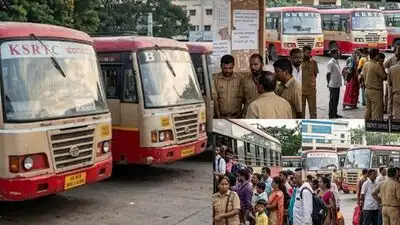
Karnataka’s four road transport corporations are under financial strain (AI image)
BENGALURU: Karnataka’s four road transport corporations are facing mounting financial pressure, with their combined liabilities touching around Rs 8,095 crore and another Rs 5,648 crore in Shakti scheme reimbursements pending from the state government. Provident fund dues account for around Rs 2,700 crore, while staff expenses and retirement benefits amount to about ₹2,500 crore. Fuel bills are estimated at another Rs 1,100 crore, with the remaining Rs 1,795 crore under other liabilities. The financial strain has been compounded by the state government’s Shakti scheme, launched on June 11, 2023, allowing women to travel free on state-run buses. Since the launch of the scheme, the corporations have incurred around ₹22,330 crore towards free travel for women and issued nearly 843 crore Shakti tickets. Against this, the government has released around ₹16,705 crore, leaving approximately ₹5,648 crore pending. Of the outstanding amount, KSRTC is awaiting around ₹2,183 crore, BMTC ₹1,352 crore, KKRTC ₹1,045 crore and NWKRTC ₹1,068 crore. Pending reimbursements stood at around ₹1,170 crore in 2023-24 and ₹1,180 crore in 2024-25. The amount jumped to around ₹2,450 crore in 2025-26. For 2026-27, the pending amount is around ₹898 crore so far, though this is not a full-year figure. The sharp rise in 2025-26 has coincided with the continued expansion of expenditure under the Shakti scheme, adding to the corporations’ working-capital requirements. Together, the four corporations recorded revenue of around ₹40,567 crore against expenditure of approximately ₹44,291 crore in the latest financial year, resulting in a combined loss of around ₹3,724 crore. The combined annual loss was around ₹1,354 crore in 2023-24, before declining to approximately ₹842 crore in 2024-25. It rose again to around ₹1,527 crore in 2025-26. Together, KSRTC, BMTC, KKRTC and NWKRTC are short of around 15,718 personnel, with proposals to fill the vacancies pending with the government. KSRTC has a shortage of 3,928 bus crew and 5,548 technical staff, while BMTC is short of 2,162 bus crew and 1,186 technical staff. KKRTC has vacancies for around 962 bus crew and 2,200 technical staff, while NWKRTC has a shortage of 384 bus crew and 1,348 technical personnel. The four corporations had last revised fares in April 2025.
You Can Also Check: Gold Rate in Bengaluru | Silver Rate in Bengaluru | Bank Holidays in Bengaluru | Public Holidays in Bengaluru | Bengaluru AQI | Weather in Bengaluru | Petrol Price in Bengaluru | Diesel Price in Bengaluru | CNG Price in Bengaluru | LPG Price in Bengaluru Stay updated with the latest Bengaluru news. The cash crunch is beginning to put pressure on routine expenses, including salaries, fuel bills and other dues. If the situation persists, officials fear it could also constrain spending on bus replacement, maintenance, recruitment and fleet expansion. The four corporations — KSRTC, BMTC, KKRTC and NWKRTC — have accumulated liabilities across several heads. The figures for the first three categories are approximate, with the balance derived from the total liability. Under the scheme, the four corporations claim reimbursement from the government for the free journeys. However, delays in releasing the funds mean the transport undertakings have to meet the expenditure from their own cash flows in the interim. The reimbursement burden has also increased sharply in recent years. The transport undertakings are also struggling with operational losses, limiting their ability to absorb additional costs. With expenditure continuing to exceed revenue, delayed reimbursement of government schemes has further tightened the corporations’ cash position. The financial pressure has increased further after the government extended free bus travel to boys in June. The corporations now have to wait for reimbursement towards the additional expenditure incurred under the expanded subsidy arrangement. The prolonged financial squeeze could affect the corporations’ ability to invest in future operations, including procurement of new buses, maintenance, fleet expansion and recruitment. The corporations are also facing a significant manpower shortage. The shortage of manpower, coupled with financial constraints, could make fleet expansion and strengthening of services more difficult. With the corporations facing mounting expenses and accumulated liabilities, a bus fare revision is also likely. A committee headed by retired IAS officer Atul Trivedi is expected to submit its report to the government shortly. Any fare revision will be implemented only after approval from Chief Minister Siddaramaiah. For now, the immediate challenge for the transport corporations is to manage recurring expenses while awaiting government reimbursements and dealing with accumulated liabilities. The longer the cash-flow squeeze persists, the greater the pressure on their ability to fund buses, maintenance, manpower and other operational requirements. Download the TOI App.