
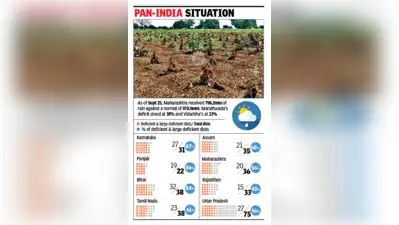
Pune: Maharashtra ’s drought isn’t the result of one dry spell — it’s the cumulative effect of a faltering monsoon, week after week, since June.
Rainfall Deficit in Maharashtra: A Closer Look
The India Meteorological Department (IMD) reports that Maharashtra is experiencing a significant rainfall deficit of 18%. This shortfall is primarily affecting two regions: Marathwada and Vidarbha.
Satyaban Bishoyi Ratna, head of climate application and user interface at IMD Pune, noted that the current drought differs from typical monsoon failures. Over the past 17 weeks, Marathwada has recorded deficient to large-deficient rainfall in 12 weeks, while Vidarbha has seen similar conditions in 11 weeks. Since mid-August, Marathwada has consistently experienced deficient rainfall, with Vidarbha’s situation only briefly alleviated by a week of excess rain in September.
Ratna said the week-by-week data shows a long persistence of deficient and large-deficient rainfall. That has driven the seasonal shortfall — not one isolated failure, but a steady accumulation of shortfalls over the season. IMD data also showed that Maharashtra was among the worst-affected states so far in terms of rainfall deficiency.
Impact of Rainfall Patterns on Agriculture in Hilly Regions
Recent observations indicate that prolonged gaps between rainy days, despite occasional heavy rainfall, significantly affect agricultural practices in hilly and high-rainfall areas. This uneven rainfall distribution has left farmers vulnerable, even as several dams in the region have reached full storage capacity. Paddy cultivation, prevalent in these hilly talukas, is expected to be particularly impacted.
According to Ratna, a crucial aspect of this situation is that relying solely on seasonal rainfall totals may not accurately reflect the ramifications of a weak monsoon. He emphasized that repeated weeks of insufficient rainfall during critical crop growth periods can lead to diminished water availability, even when isolated heavy rain events occur elsewhere in the state.