
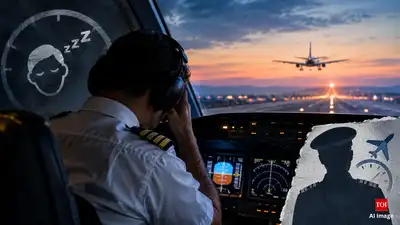
Approximately 63 out of 100 Indian pilots may be drowsy during dawn landings (Representative image generated using AI)
MUMBAI: About 63 in 100 Indian pilots were predicted to be sleepy when they land at dawn after the legally permitted maximum night duty of 10 hours, according to a review by Safety Matters Foundation, a not-for-profit aviation safety group. For Europe, which has day flights, that number was 16 in 100. The 63-in-100 figure is a forecast for a type of duty, here 9pm to 7am, not a count of named pilots, it clarified. It comes from a sleep and body-clock model run on legal limits and the anonymised rosters of 13 pilots. India’s rules leave the late evening open, allow a 13-hour day without asking when it starts, and file most fatigue reports away as ‘perceived’. The foundation’s surveys of Indian pilots, with 542 respondents in 2022 and 530 in 2024, point in the same direction. Seventy-one in 100 said they had often been too tired for cockpit duty, and 66 in 100 reported unplanned sleep or microsleeps on duty. Duties touching midnight to 6am are limited to 10 hours and two landings. “India allows 13 hours as a routine day, for any start up to 10:30am, with no extra safeguard. A day ending just before midnight may include six landings, and on a legal day with a landing at 11:30pm, 55 to 77 in 100 pilots are predicted to be sleepy. Separately, the body clock raises and lowers alertness like a tide, lowest between about 2 and 6am. “India takes a pilot off the roster for any detectable alcohol and suspends the licence above 0.009%. After 17 to 19 hours awake, a person performs about as badly as at 0.05% blood alcohol, more than five times that level, it added. Five weeks after the night rules took full effect in late 2025, the DGCA suspended them for one large operator. In the 2010 Mangalore crash that killed 158 people, the Court of Inquiry found that the captain had slept for most of the recorded cruise. In 2013, investigators found that fatigue contributed to an error in a serious incident in Mumbai.
Its author and founder, Capt Amit Singh FRAeS, said the findings match what pilots have long reported. You Can Also Check: Gold Rate in Mumbai | Silver Rate in Mumbai | Bank Holidays in Mumbai | Public Holidays in Mumbai | Mumbai AQI | Weather in Mumbai | Petrol Price in Mumbai | Diesel Price in Mumbai | CNG Price in Mumbai | LPG Price in Mumbai Stay updated with the latest Mumbai news.
At night and late in the evening, often not,” it said, adding that a duty can follow every roster rule and yet leave most of the crew sleepy. The fix is in the rules, not in the pilots, it said. “Indian pilots have told us, survey after survey, that they are too tired to fly,” Capt Singh said. It rated India as “partly met” on science and knowledge, and “not shown” on its own experience. India handles deep-night duties well, said the release issued by the foundation. And when sleep is cut short night after night, the shortfall carries over, like a debt,” the study said. The DGCA’s 2023 study, which formed the basis for the 2024 rules, “reviewed rosters and reports only”, with no wrist-worn sleep monitors and no measurement of alertness, the release said. The government told Parliament that operators’ safety risk assessments had been checked, but none had been published, the foundation said.
The question it attempted to answer was: How many pilots are sleepy as they begin the last landing? The study’s objective was to examine whether India’s rules on pilot working hours keep pilots awake enough to fly safely. “Short answer, by day, mostly yes. The message was that a legal duty period can still be a tiring duty. “The review does not say flying in India is unsafe, or that any pilot was unsafe. “The science explains why. The rules count the hours. The body counts the clock. The review tested India against ICAO’s requirement that duty rules be based on science, knowledge and operational experience. By day, however, the picture changes. “Two forces drive tiredness. From the moment you wake, sleep pressure builds like a phone battery draining, only sleep recharges it. Night flying combines a flat battery with a low tide. It drew a comparison with alcohol. The review also questioned how the rules were made. Investigators have raised similar concerns. The foundation urged three changes: duty limits set by start time; penalty-free fatigue reporting, along with an independent study of pilot sleep and alertness; and publication of the evidence behind every exemption, with an end date. Download the TOI App.