
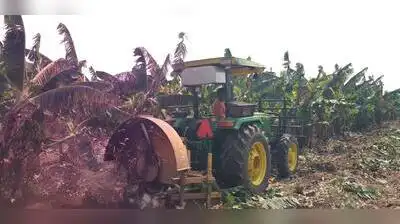
Solapur farmer destroys his banana plantations on four acres of land by blade cutter
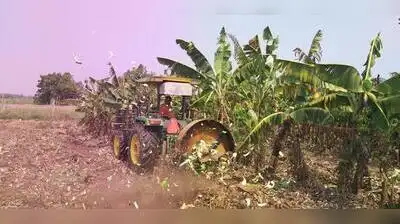
Solapur farmer destroys his banana plantations on four acres of land by blade cutter Solapur farmer destroys his banana plantations on four acres of land by blade cutter Solapur farmer destroys his banana plantations on four acres of land by blade cutter Solapur farmer destroys his banana plantations on four acres of land by blade cutter Pune: Unable to recover even the transportation cost of his produce, 42-year-old Mohan Dekale, a banana grower from Papri village in Mohol tehsil of Solapur district, recently took the painful decision of destroying his four-acre, two-year-old banana plantation. Traders were offering him just Rs 2 per kg for the fruit, leaving him with little choice but to run a blade cutter through the standing crop, including bunches that had ripened naturally on the trees. “How can traders expect us to sell bananas at Rs 2 per kg? At this rate of Rs 2 per kg, I would not even have recovered the transportation cost. He said cultivating banana on one acre required a capital investment of at least Rs 2 lakh, besides continuous care and irrigation. “I had spent lakhs of rupees growing this plantation, but now I have to spend another Rs 50,000 just to destroy it.
Because the crop requires regular and substantial irrigation, especially during fruit development, agricultural experts said the drought conditions had created a particularly difficult situation for banana growers. Because it involves substantial upfront investment and continuous irrigation, agricultural experts point out that banana cultivation is particularly vulnerable to the combination of market volatility and drought.
So, in extreme pain and frustration, I hired a blade cutter to destroy the entire plantation,” Dekale said, his voice choking with emotion. Imagine the mental condition of a farmer who has to destroy a crop after spending so much money and working for two years,” he said. Another Solapur farmer, Pandurang Bhosale, said several growers in the region were considering uprooting their plantations in the coming weeks. We are now planning to destroy our plantations rather than incur further losses,” he said. “Unlike seasonal crops, banana plantations cannot withstand prolonged interruptions in water supply without suffering substantial losses in fruit development, quality and overall yield,” said the expert Umesh Chavan. Similarly, a prolonged water shortage can render an otherwise healthy plantation commercially unviable,” a senior official from the state agriculture department told TOI.
Dekale asked. Dekale is not alone. Banana growers across Jalgaon, parts of Vidarbha, Marathwada and western Maharashtra are confronting an unprecedented crisis. The disruption of exports to West Asian markets, particularly Iran and Iraq , following the regional conflict has affected the movement of Indian bananas. “Half of my plantation had ripened naturally on the trees. But it was impossible to harvest, load and transport the produce to the market. For Dekale, the destruction of the plantation meant losing not just an entire season’s income but also the investment and painstaking efforts that had gone into nurturing the crop. It was the most painful day for me. I have not been able to sleep for the last two days. Export-oriented produce that would otherwise have been shipped overseas is now being diverted into domestic markets, adding to the supply glut and triggering a sharp decline in wholesale prices. However, the market crisis is only one part of the problem. An extended rainfall deficit, drought-like conditions, drying wells and borewells and rising temperatures have made it increasingly difficult for farmers to sustain their plantations. The shortage of irrigation water has also coincided with power supply disruptions affecting agricultural pumps, further worsening the situation. “There is a shortage of water and frequent load-shedding affecting our motor pumps. How are we supposed to irrigate the plantations? It is becoming increasingly difficult to sustain the crop. At the same time, there is hardly any remunerative rate in the market. Export disruption triggers market glut Market experts and exporters attribute the sharp price correction primarily to the disruption of India’s banana export trade with West Asia. Maharashtra is a major supplier of export-quality bananas, with Iran, Iraq and other Gulf countries forming important destinations for its produce. “Farmers cannot immediately alter harvesting schedules when prices collapse. Once the fruit matures, it has to be harvested and marketed within a limited period.
According to a Feb 2026 banana market intelligence dashboard prepared by Crisil for the Agricultural and Processed Food Products Export Development Authority (APEDA), around 75-80% of India’s banana exports are destined for Middle Eastern markets. India exports only around 3-5% of its total banana production, largely of the G9 variety. The APEDA-Crisil assessment noted that domestic banana prices had fallen from around Rs 18-20 per kg in February 2026 to Rs 8-9 per kg by the second week of March, as shipment disruptions triggered an inventory build-up in major exporting centres, including Maharashtra and Andhra Pradesh. The situation subsequently deteriorated further in several producing pockets, with farmers reporting offers of just Rs 2-5 per kg. “In Solapur’s Karmala belt, banana exporters have reported that container freight costs have climbed substantially, while the time taken to transport consignments has increased from around 10 days to nearly 40 days in some cases. Newly planted banana crops were fetching around Rs 6-7 per kg, while ratoon crops were receiving only Rs 3-4 per kg in the affected markets, according to him. According to the ICAR-Indian Agricultural Statistics Research Institute’s Agricultural Research Data Book 2025, Maharashtra produced approximately 72.29 lakh tonnes of bananas in 2024-25, against the national production of 380.34 lakh tonnes.
The interruption of shipments has resulted in export-quality bananas being diverted into domestic markets, adding to the existing supply and depressing prices, said the market experts and traders. Longer transit times and rising freight costs have made shipments commercially unviable for several exporters, said a section of traders. Such delays are particularly damaging for bananas, which have a limited shelf life and require an uninterrupted cold-chain network,” said a senior official from the state agriculture marketing board. Banana trader Gorakh Haidale said the disruption in exports had directly affected the prices received by growers.
their concentration in West Asian markets makes the trade particularly vulnerable to geopolitical disruptions Although exports constitute a relatively small share of India’s overall production. The logistics bottleneck has aggravated the situation. Exporters have faced difficulties securing shipping services and transporting perishable consignments to West Asian destinations. Maharashtra accounts for nearly a fifth of national production The scale of the crisis is significant considering Maharashtra’s contribution to India’s banana production.
The impact of drought is particularly evident in Washim district, where a young farmer, Umesh Markad from Dhilli village, had to run a tractor through his 2.5-acre banana plantation after prolonged dry conditions and rising temperatures destroyed his crop. Markad had planted nearly 3,000 banana plants and spent an entire year nurturing the orchard. After spending around Rs 3.5 lakh to Rs 4 lakh on the plantation, “I was left with virtually no produce to sell. This means Maharashtra accounts for nearly 19% of the country’s total banana production, making it India’s largest banana-producing state.
The disruption therefore threatens a substantial agricultural economy involving not just cultivators but also exporters, transporters, pack-house operators, cold-storage facilities, agricultural labourers and traders. You Can Also Check: Gold Rate in Pune | Silver Rate in Pune | Bank Holidays in Pune | Public Holidays in Pune | Petrol Price in Pune | Diesel Price in Pune | CNG Price in Pune | LPG Price in Pune Stay updated with the latest Pune news.
With the crop beyond recovery, I had to eventually destroy the entire orchard by running a tractor through it,” he said. The simultaneous impact of export disruptions, a domestic supply glut, rainfall deficit, groundwater depletion and rising input costs has exposed the vulnerability of Maharashtra’s banana economy, said the official. Harvesting was scheduled to begin next month. However, the prolonged rainfall deficit caused his well and borewell to dry up in Oct itself. With temperatures rising and irrigation water unavailable, the plantation gradually began drying up, leaving little possibility of recovering the investment. Jalgaon, Solapur, Nanded, Pune and other districts have significant banana-growing pockets. Download the TOI App.