
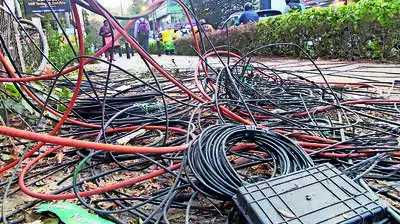
Pic used for representation purpose
The Comprehensive Trenching and Reinstatement Policy 2026, to be placed before the civic standing committee at its meeting on Thursday, seeks to replace the existing 2023 guidelines. The defect-liability period for cement-concrete roads will be increased to 10 years, while it will be five years for non-concrete roads, compared with three years for all road surfaces under the existing policy. The proposed policy also seeks to simplify the classification of road surfaces for calculating RI charges by reducing the existing 16 categories to just two — cement-concrete and non-cement-concrete surfaces. For horizontal directional drilling, which allows utilities to be laid underground with minimal surface excavation, a ₹15 lakh per km security deposit has been proposed. A security deposit of 50% of the applicable RI charge has also been proposed for regular trenching, subject to conditions.
The civic administration said the revision was necessary as the existing policy had become repetitive and cumbersome to implement, while trench reinstatement charges were higher than those levied by other municipal corporations. BMC has also proposed that the reinstatement charge be calculated according to the actual size of the trench rather than using a standard width. A BMC official said, “The revised policy is aimed at reducing repeated digging of Mumbai’s roads as the city expands its underground telecom, electricity and other utility networks. ”
Mumbai: BMC has proposed a revised policy to regulate road digging by telecom and other underground utility agencies, with stricter provisions for unauthorised excavation, mandatory GIS mapping of underground utilities and longer defect-liability periods for reinstated roads. Under the proposed policy, low-voltage electrical and telecom utilities with cables up to 100mm in diameter will have to use existing utility ducts. If ducts are unavailable, the utility agency will have to construct one or the Roads Department will do so. The policy also seeks to make utility agencies more accountable for the condition of roads after reinstatement. For concrete roads, the use of diamond cutters will be mandatory for trenching.