
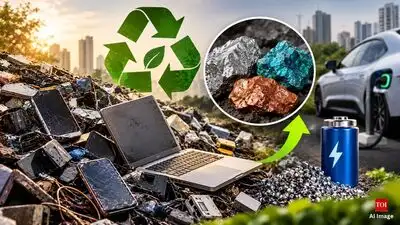
Discarded mobile phones and laptops contain recoverable metals, while old automobile catalytic converters are a source of platinum-group metals. (AI image)
An assessment cited in an industry presentation, drawing on a Centre for Social and Economic Progress (CSEP) working paper, estimates that 573 kilotonnes of minerals worth around Rs 1.01 lakh crore could be recovered from retired lithium-ion batteries in India between FY2026-27 and FY2040-41. India’s battery recycling market is projected to reach Rs 31,150 crore (about $3.5 billion) by 2030, according to an ICEA-Accenture report cited in the industry presentation. An IEEFA assessment published in October 2024, cited by a news organisation, highlights India’s 100% import dependence on lithium, cobalt and nickel. The hidden wealth in India’s e-waste 573 kilotonnes: Potential mineral recovery from retired lithium-ion batteries between FY2026-27 and FY2040-41. Rs 1.01 lakh crore: Estimated value of recoverable minerals. Rs 31,150 crore: Projected size of India’s battery recycling market by 2030.
Because of the risk of fire, damaged lithium-ion batteries require particular care. Yet, a substantial share of this resource risks being lost through informal scrap channels, where unsafe handling of discarded batteries can also trigger fires. MUMBAI: As festive-season discounts trigger a rush for new cars, electric two-wheelers, smartphones, laptops and household appliances, an important question remains largely overlooked: where do the products being replaced end up? Discarded electronics and batteries are not merely an environmental liability. They represent a potentially valuable domestic source of critical minerals, including lithium, cobalt and nickel — materials essential to electric vehicles, battery manufacturing and the clean-energy transition. The scale of the opportunity is significant. The opportunity extends beyond batteries. Discarded mobile phones and laptops contain recoverable metals, while old automobile catalytic converters are a source of platinum-group metals. Recovering these materials from end-of-life products is increasingly being described as ‘urban mining’ — extracting valuable resources from the waste generated by cities and consumers. The economic case is equally compelling. More importantly, recycling could help reduce India’s dependence on imported critical minerals. For consumers, the message is straightforward: old phones, laFptops and rechargeable batteries should not be casually discarded with household garbage. Channelling end-of-life electronics and batteries through authorised collection and recycling networks is essential to ensure safe handling and recovery of valuable materials. Recyclekaro, a CPCBand MPCB-authorised e-waste and lithium-ion battery recycler, is among the companies operating in this emerging urban-mining sector. Its CEO, Prassann Daphal, has highlighted the potential of recovering critical minerals from discarded electronics and batteries to strengthen India’s domestic resource base. As the festive shopping cycle generates another wave of product replacements, the larger challenge is to ensure that India’s consumption boom does not translate into a growing waste burden — and that valuable minerals lying inside discarded products do not go up in smoke or disappear into unregulated supply chains.
A Rs 1,500-crore recycling incentive scheme has reportedly approved 58 eligible companies. Another Rs 3,000-crore scheme for lithium and nickel processing provides a 15% capital subsidy for domestic processing and refining, according to the industry presentation. The government has introduced policy measures to build domestic capacity.
The National Critical Mineral Mission seeks to strengthen indigenous critical-mineral supply chains and reduce import dependence. The Battery Waste Management Rules provide for extended producer responsibility (EPR), requiring producers to meet prescribed obligations for the collection and environmentally sound management of battery waste, alongside traceability requirements.
Closed-loop recycling — recovering materials from used batteries and feeding them back into manufacturing — could potentially meet 10-12% of India’s EV battery lithium demand over the next decade. The industry estimates that formal recycling accounts for only around 25% of the market, with informal operators handling a substantial share. The ICEA-Accenture report has stated that around 80% of collected lithium-ion battery scrap is handled by unregulated informal channels, while 20% enters formal collection channels. Only 1% of end-of-life batteries is converted into battery-grade materials domestically. 10-12%: Potential share of India’s EV battery lithium demand that recycling could meet over the next decade. 80%: Share of collected lithium-ion battery scrap handled by unregulated informal channels, according to the ICEA-Accenture report. 20%: Share entering formal collection channels. 1%: Share of end-of-life batteries converted into battery-grade materials domestically.
You Can Also Check: Gold Rate in Mumbai | Silver Rate in Mumbai | Bank Holidays in Mumbai | Public Holidays in Mumbai | Mumbai AQI | Weather in Mumbai | Petrol Price in Mumbai | Diesel Price in Mumbai | CNG Price in Mumbai | LPG Price in Mumbai Stay updated with the latest Mumbai news. However, the transition from potential to actual mineral recovery faces significant hurdles. Formal recyclers also face competition for a steady, traceable supply of discarded batteries and battery black mass, the material from which valuable metals are extracted. Recovering battery-grade materials requires sophisticated extraction and purification technologies, making investment in processing capabilities another critical requirement. What can be recovered from discarded products? Smartphones: Lithium, cobalt and nickel. Laptops: Lithium, cobalt and nickel. EV batteries: Lithium, cobalt and nickel. Automobile catalytic converters: Platinum-group metals. Download the TOI App.