
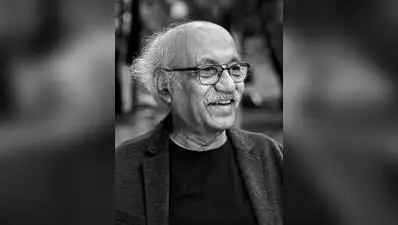
Sudhakar Nadkarni
For Professor Sudhakar Nadkarni (90), who died in Mumbai on Oct 20, these questions shaped a career spanning six decades and helped redefine how India understood design itself.
It is an honour to be his collaborator and his friend,” said architect Charles Correa. Mumbai: The measure of a designer’s influence is not always found in the objects he creates. Sometimes it lies in the questions he teaches others to ask. Why must things work the way they do? Who benefits from their design? And what might change if we began not with the product, but with the person using it? He is survived by his wife, two sons and a daughter. When Nadkarni entered the profession, industrial design was still finding its place in a newly independent country. India needed products, infrastructure and institutions, but it also needed a vocabulary for imagining them. Nadkarni belonged to a generation that believed design could do more than improve appearances. It could address inequities, conserve resources and make everyday life more humane. “Sudhakar is indeed very very special without a doubt; one of the most versatile designers India has produced in the many decades since independence.
In 1997, he founded the Department of Design at IIT Guwahati, introducing design education into an institutional landscape largely dominated by engineering. His book ‘ by design’ , published in 2026, gathered the lessons of a lifetime spent examining how things work and how they might work better.
Whether it was something as simple as painting a wall or laying a stone, or doing something of national importance, he approached everything with the same seriousness and commitment,” his daughter Suhita Nadkarni told TOI. Trained at Mumbai’s Sir J J School of Art and Germany’s Ulm School of Design, he returned with a conviction that creativity required intellectual discipline, and that the best solutions emerged from understanding the problem before attempting to solve it. His career became inseparable from the growth of Indian design education. At the National Institute of Design and later IIT Bombay’s Industrial Design Centre, he helped establish design as a serious field of inquiry, bringing artistic imagination into conversation with engineering and technology. His experiments with bamboo furniture and medical equipment demonstrated a principle he held throughout his life: innovation need not begin with sophisticated technology. And what gave him particular satisfaction was the work of his students. Among their contributions were the Indian rupee symbol, the electronic voting machine, modern petrol pumps and everyday household products. His professional work ranged from household appliances to public exhibitions, but teaching remained perhaps his most consequential contribution. He encouraged students to question conventions, embrace experimentation and recognise failure as an essential part of discovery. “The idea that no work is lesser than any other is something I think his students value a lot. Even in his later years, Nadkarni remained engaged with documenting India’s design history.
You Can Also Check: Gold Rate in Mumbai | Silver Rate in Mumbai | Bank Holidays in Mumbai | Public Holidays in Mumbai | Mumbai AQI | Weather in Mumbai | Petrol Price in Mumbai | Diesel Price in Mumbai | CNG Price in Mumbai | LPG Price in Mumbai Stay updated with the latest Mumbai news. Institutions endure, products become obsolete, and technologies change beyond recognition. What survives a great teacher is something less visible but more powerful: a habit of mind passed from one generation to the next. Nadkarni leaves behind not merely a body of work, but generations who learned from him that the ordinary world was never beyond improvement. Download the TOI App.