
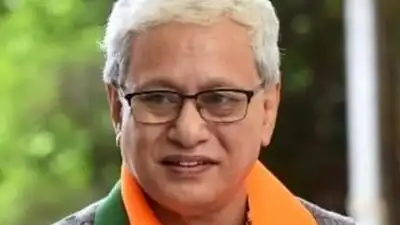
Governor Jishnu Dev Varma emphasizes the need for a complete value chain for bamboo processing.
MUMBAI: Maharashtra’s ambitious plan to turn bamboo into a ₹50,000-crore-plus industrial opportunity and generate around five lakh jobs must move beyond plantation and raw-bamboo sales to processing, product development and global markets, Governor Jishnu Dev Varma said on Sunday. Because the state’s Bamboo Industry Policy 2025 envisages 15 bamboo clusters, anchored by industrial units and supported by common facility centres and MSMEs, his emphasis on value addition is significant.
Speaking at the Bamboo Economy and Sustainability Summit at The Westin Mumbai Powai Lake, Varma said Maharashtra could build a strong bamboo value chain by combining farmers and forest communities with processing units, technology, finance, design and markets. The official policy says these clusters are intended to connect cultivators with downstream manufacturers and end markets and provide greater market and price assurance to bamboo farmers. Farmers will benefit from value addition of raw bamboo,” Varma said.
“Raw bamboo may not get you good income. He suggested that districts such as Gadchiroli could develop an integrated bamboo economy, creating opportunities for farmers, tribal communities, rural enterprises and young entrepreneurs. The state policy also provides for plantation support and identifies the Atal Bamboo Samruddhi Yojana as an important component of expanding bamboo cultivation.
Employment Guarantee Scheme minister Bharat Sheth Gogawale said farmers cultivating bamboo could receive assistance of approximately ₹7 lakh per hectare over three years, from plantation through nurturing. For Maharashtra, therefore, the bamboo challenge is no longer simply how much bamboo can be planted. You Can Also Check: Gold Rate in Mumbai | Silver Rate in Mumbai | Bank Holidays in Mumbai | Public Holidays in Mumbai | Mumbai AQI | Weather in Mumbai | Petrol Price in Mumbai | Diesel Price in Mumbai | CNG Price in Mumbai | LPG Price in Mumbai Stay updated with the latest Mumbai news.
He said bamboo could be grown on fallow land, field boundaries and other locations where conventional cultivation is difficult, and that a plantation could yield harvests over several years without repeated replanting. For ordinary consumers, this could eventually mean a wider range of bamboo-based alternatives in furniture, interiors, packaging and everyday products. But the environmental benefit will depend on how such products are produced, transported, treated and ultimately disposed of or recycled. It is whether the state can create a complete ecosystem in which the farmer grows it, the local unit processes it, the entrepreneur adds value, the market buys it and the farmer receives a predictable return. Download the TOI App.
The state policy proposes 15 clusters in bamboo-rich regions, including Gadchiroli, Nagpur, Amravati, Yavatmal, Buldhana, Chhatrapati Sambhajinagar, Latur, Nandurbar, Nashik, Pune, Kolhapur and Ratnagiri-Sindhudurg, with two additional clusters to be allocated based on demand. NOAA’s latest global daily estimate was 427.98 ppm on September 24, 2026, while its latest complete global monthly figure was 427.62 ppm for June. Patel cited a rise from 350 ppm to around 430 ppm and warned of the consequences of further increases. The policy is now officially part of Maharashtra’s industrial-policy framework; the Industries Department lists the Maharashtra Bamboo Industry Policy 2025 among the state’s notified sectoral policies.
The Governor, who is from Tripura, said Maharashtra could learn from his home state’s experience of moving beyond raw-bamboo sales to treatment, processing and value-added products. He said bamboo had potential in construction, furniture, paper, textiles, packaging, bioenergy and new-age materials. Gogawale, who hails from Raigad, described bamboo as having moved from being regarded as the “poor man’s timber” to emerging as “green gold”. Pasha Patel, chairman of the Maharashtra State Agriculture Price Commission and executive chairman of the Chief Minister’s Task Force on Environment and Sustainable Development, said bamboo could play a major role in expanding green cover and providing farmers with a more climate-resilient crop option. Varma said bamboo, as a rapidly renewable resource, could contribute to sustainable production and consumption and support the transition towards a more circular economy. He said universities in bamboo-rich areas such as Gadchiroli could become laboratories for the bamboo economy, while design institutions could help convert traditional craftsmanship into market-oriented products.
With appropriate treatment, engineering and certification, it could also find wider applications in sustainable construction and green infrastructure. The proposed clusters are to include anchor units, MSMEs and common facility centres covering activities such as processing, textiles, paper, furniture, charcoal and handicrafts. But the larger question for farmers is what happens after the plantation matures. Who will buy the bamboo, at what price, how far will it have to be transported and who will bear the cost of treatment and processing? The policy’s proposed anchor units and common facility centres are intended to address precisely this missing link by integrating raw-material supply with manufacturing and markets. He recalled visiting the Pasha Patel SkillTech University at Lodga in Latur district, where he saw bamboo nurseries, houses, furniture, textiles and handicrafts being made and rural youth being trained. He also highlighted bamboo’s carbon-sequestration and soil-conservation potential. The summit’s climate message comes against a backdrop of rising atmospheric CO₂. However, the figures should not be interpreted as established scientific thresholds at which human habitation suddenly becomes unsafe. The established climate concern is the continuing accumulation of greenhouse gases and its effects on global warming and climate systems. He also expressed hope that bamboo could provide alternatives to some plastic applications. Varma called for Maharashtra’s agricultural, technical and other universities to work with the industry on scientific cultivation, improved planting material, productivity, pest management and post-harvest practices. He also highlighted opportunities for women entrepreneurs, self-help groups and rural youth, citing bamboo products made by tribal women from Palghar. The Governor urged the summit to produce actionable recommendations on cultivation, processing, finance, infrastructure, skilling, market development and exports.