
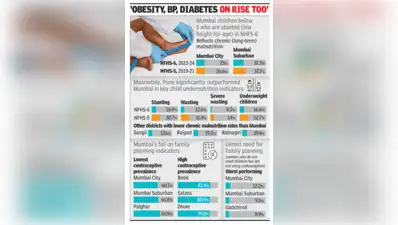
Mumbai: Contraceptive use is dropping across the city while its fertility rate shrinks so rapidly that surveyors have struggled to find enough infants to track vaccination rates. At the same time, Mumbai’s malnutrition rates remain stagnant—and have even worsened in the suburbs—even as neighbouring Pune has managed to cut its child undernutrition in half.
These startling paradoxes are revealed in district-wise fact sheets from the latest round of National Family Health Survey (NFHS-6), recently released by Union Ministry of Health and Family Welfare. The survey was conducted between June 2023 and Jan 2024. However, Mumbai’s overall contraceptive use has fallen from 74.3% to 60.1%. More women (12.2% in NFHS-6, up from 4.9% in NFHS-5) now have an unmet need for family planning—meaning they do not wish to become pregnant but lack access to contraception.
You Can Also Check: Gold Rate in Mumbai | Silver Rate in Mumbai | Bank Holidays in Mumbai | Public Holidays in Mumbai | Mumbai AQI | Weather in Mumbai | Petrol Price in Mumbai | Diesel Price in Mumbai | CNG Price in Mumbai | LPG Price in Mumbai Stay updated with the latest Mumbai news.
Dr Soumitra Ghosh, chairperson at Centre for Health Policy at Tata Institute of Social Sciences, said, “Based on the limited information we have from the NFHS factsheets, if the estimates are true, then we are witnessing a failure of our health and education systems. “It is serious that one of India’s richest cities has such a high number of malnourished or undernourished children,” he said. A professor from International Institute for Population Sciences (IIPS), which conducts NFHS, noted that fertility rates have fallen nationwide, and the same is true for Mumbai. Dr Ghosh added that in the absence of a comprehensive report, it remains difficult to address contradictions such as a simultaneous decline in both contraceptive usage and fertility rates. Health economist Dr Ravi Duggal noted that malnutrition levels in Mumbai have crept up over the years. Former BMC executive health officer Dr Daksha Shah advised caution: “We need to take this data with a pinch of salt. The city has a large migrant population, and the survey data is based on a small sample size. However, Dr Duggal added, “The quality of the NFHS may not be perfect, but it is the best we have at a time when data has become scarce in this country. The NFHS is reliable enough to show the broader trend for each indicator. Download the TOI App.
The data also reveals that the percentage of women aged 20 to 24 who were married before age 18 rose from 4.5% to 8.5% in the city, and from 10.0% to 10.3% in the suburbs. Moreover, the proportion of women with 10 or more years of schooling fell from 71.1% to 65.4% in Mumbai City, and from 65.7% to 59.8% in the suburbs. About 25.0% of surveyed children under five suffer from low height-for-age (stunting) and 18.0% from low weight-for-height (wasting). Meanwhile, 28.6% recorded low weight-for-age (underweight, down from 29.6%), while severe wasting stands at 8.8% (down from 9.1%). Mumbai is also facing a severe non-communicable disease crisis marked by nearly half of all adult women surveyed (45.1% in city, 47.7% in suburbs) being overweight or obese, over a quarter of adults suffering from high blood sugar, and more than a third of men struggling with hypertension.
Additionally, the proportion of women who want to delay their next pregnancy by at least two years but cannot do so rose from 1.9% to 6% in Mumbai City, and from 3.4% to 7.8% in Mumbai suburbs.